Portable Field CNCs: Are Used CNC Machines Worth It?
Evaluating if used portable CNC machines are worth it for field work, focusing on OSHA compliance, safety retrofits, and on-site machining risks.
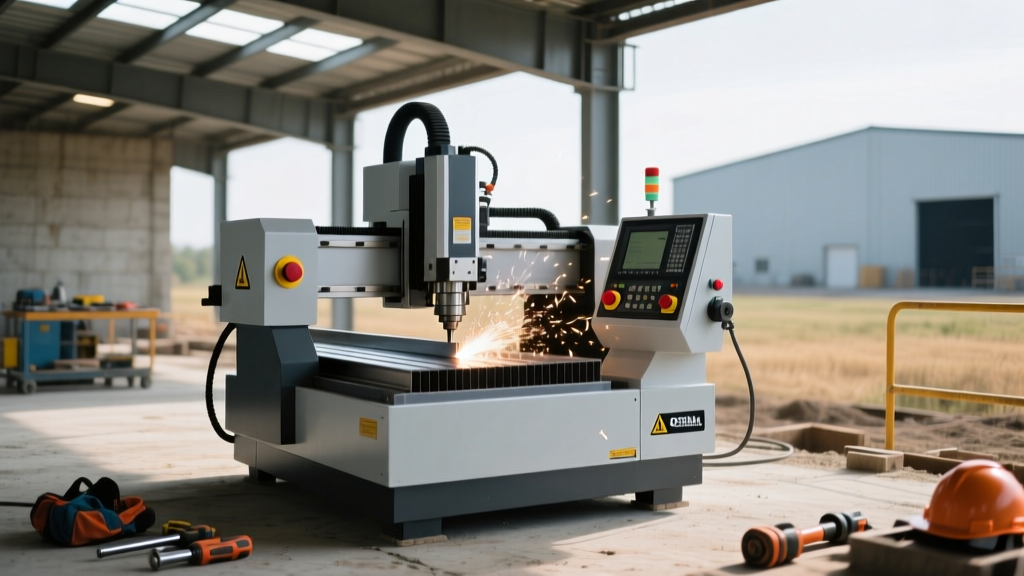
On-site machining in refineries, nuclear power plants, and shipyards relies heavily on portable CNC mills, flange facers, and line boring machines. When outfitting a field service team for an upcoming outage or emergency repair, procurement departments frequently ask: are used CNC machines worth it? The short answer is that a used portable CNC can yield a 40% capital savings, but only if you possess the in-house engineering capability to audit and retrofit its safety systems to current field compliance standards.
WARNING: The Hidden Liability of Used Field EquipmentPurchasing a used 2018 Climax CM6000 portable CNC mill might save $40,000 upfront. However, deploying a machine with bypassed safety interlocks or worn Z-axis brakes to a regulated job site can trigger OSHA 1926 fines exceeding $16,131 per violation, alongside immediate work stoppages that cost contractors upwards of $100,000 per day in delayed outage penalties.
The Compliance Reality of On-Site Machining
Unlike a controlled manufacturing shop floor, field environments are inherently uncontrolled. You cannot rely on fixed yellow safety lines, overhead cranes with dedicated rigging, or standardized power drops. Portable CNC machines must comply with both OSHA 1910.212 (General Requirements for All Machines) and the specific ANSI B11.8 standards for milling operations, adapted for temporary installations.
When evaluating used portable equipment, the primary safety gap lies in control system degradation. Modern field sites require safety circuits built to ISO 13849-1 Category 3 or 4 standards. Many used portable CNCs manufactured prior to 2020 feature Category 1 or 2 single-channel E-stop circuits that fail to meet the stringent redundancy requirements of modern refinery and offshore safety managers.
Cost vs. Compliance: New vs. Used Portable CNC Matrix
The table below breaks down the operational and compliance differences between deploying a factory-new portable CNC versus a typical used model found on the secondary market.
| Feature / Metric | New Climax CM6000 (2025/2026 Spec) | Used CM6000 (2017-2020 Vintage) | Field Compliance Risk Level |
|---|---|---|---|
| Base Capital Cost | $95,000 - $115,000 | $45,000 - $65,000 | Low (Financial) |
| E-Stop Architecture | Dual-channel, Category 4 (ISO 13849-1) | Often Single-channel, Category 1 or 2 | Critical (Requires $4,500+ Retrofit) |
| Z-Axis Holding Brake | Redundant mechanical fail-safe | Subject to pad wear and spring fatigue | High (Risk of tool drop on workpiece) |
| CE / UKCA Certification | Current, valid for global deployment | Often voided by unauthorized field repairs | High (Blocks entry to EU/Offshore sites) |
| Cable Jacket Integrity | Oil/UV resistant, continuous flex rated | Micro-fractures from coiling and transport | Moderate (Spark risk in hot zones) |
5-Point Field Safety Audit for Used Portable Mills
If you determine that the capital savings justify the procurement effort, you must subject the used portable CNC to a rigorous safety audit before it is loaded onto a service truck. Execute these five technical checks:
- E-Stop Relay Redundancy Test: Open the control pendant. Verify the presence of a dual-channel safety relay (e.g., Pilz PNOZ series). Trigger the E-stop and use a multimeter to confirm that both independent contactor paths drop power to the servo drives simultaneously. If the machine uses a single standard relay, it must be retrofitted before site deployment.
- Z-Axis Mechanical Brake Validation: Mount a dial indicator to the spindle nose. Apply full Z-axis load (simulating a heavy facing toolholder). Cut power to the machine. Measure the Z-axis drop over a 24-hour period. Any drift exceeding 0.002 inches indicates worn brake pads or degraded spring tension, which poses a severe crush hazard if the machine is mounted vertically on a flange.
- Chip Guarding and Coolant Containment: Field machining generates swarf and coolant runoff that can violate environmental and safety protocols. Inspect the polycarbonate chip guards for UV yellowing and micro-cracking. Under OSHA machine guarding standards, brittle guards that shatter upon impact with high-speed swarf are considered non-compliant and must be replaced with 1/4-inch thick PETG or polycarbonate.
- Continuous-Flex Cable Inspection: Portable CNCs are constantly assembled, disassembled, and transported. Inspect the umbilical cables connecting the pendant to the base unit. Look for micro-fractures in the outer jacket. In classified hazardous locations (Class I, Div 1), a compromised cable jacket that exposes shielding is an automatic violation of hot work and intrinsically safe perimeter rules.
- Base Clamping and Vibration Dampening: Check the integrity of the magnetic bases, bolt-down flanges, and chain-mounting hardware. Worn chain tensioners or stripped threaded inserts on the machine base can lead to catastrophic workpiece shifting during heavy roughing cuts.
Edge Case: Confined Space and Hot Work Intersections
Portable CNCs are frequently deployed inside pressure vessels, heat exchangers, and storage tanks. These are classified as permit-required confined spaces under OSHA 1910.146. When operating a used CNC in these environments, the machine's electrical footprint becomes a life-safety issue. Older servo drives and spindle motors may lack the IP65 ingress protection required to prevent internal arcing in humid, enclosed spaces. Furthermore, if the portable CNC is used for automated thermal cutting or weld prep, it must comply with OSHA 1926.300 fire protection standards, requiring verified grounding and spark containment that older, used models often lack without custom fabrication.
Pro-Tip for Site Managers:Always request the machine's original electrical schematics and pneumatic diagrams before purchasing a used portable CNC. If the previous owner modified the safety circuit to bypass a faulty limit switch—a common 'quick fix' in field environments—and you cannot trace the wiring without the OEM schematic, the machine is uninsurable and unfit for regulated site work.
Financial Breakdown: The True Cost of 'Cheap' Used Equipment
To accurately answer whether used portable CNCs are financially viable, you must calculate the Total Cost of Compliance (TCC). Consider a scenario where you purchase a used portable boring machine for $35,000 (compared to $75,000 new).
- Safety Relay Retrofit (Pilz/Sick): $3,500 (Parts and integration labor)
- Z-Axis Brake Rebuild & Recertification: $2,800
- Replacement of UV-Degraded Chip Guards: $1,200
- New Continuous-Flex Umbilical Cables: $2,500
- Third-Party CE/OSHA Compliance Audit: $4,000
Your actual capital expenditure is now $49,000. While still below the new price, you have absorbed the downtime, integration risk, and warranty voidance associated with the retrofit. If the machine requires a ball screw replacement due to backlash (an $8,000+ repair on large portable mills), your savings evaporate entirely.
Verdict: When Used Makes Sense (And When It Doesn't)
Used portable CNC machines are worth it only if your organization employs dedicated field service engineers who can perform in-house safety retrofits, validate ISO 13849-1 control architectures, and maintain strict chain-of-custody documentation for confined space deployments. For heavy-use contractors operating on tight nuclear or offshore outage schedules where equipment failure results in massive liquidated damages, the premium for a new, fully warranted, and immediately compliant portable CNC is a necessary risk mitigation expense. Do not compromise on safety interlocks to save on initial capital; the regulatory and human costs of a field machining accident far exceed the price of a new machine.