Is a 3D Printer a CNC Machine? Mill-Turn Buying Guide
Is a 3D printer a CNC machine? Compare additive CNC to subtractive multi-function mill-turn centers in this 2026 industrial buying guide.
The CNC Taxonomy: Additive vs. Subtractive Manufacturing
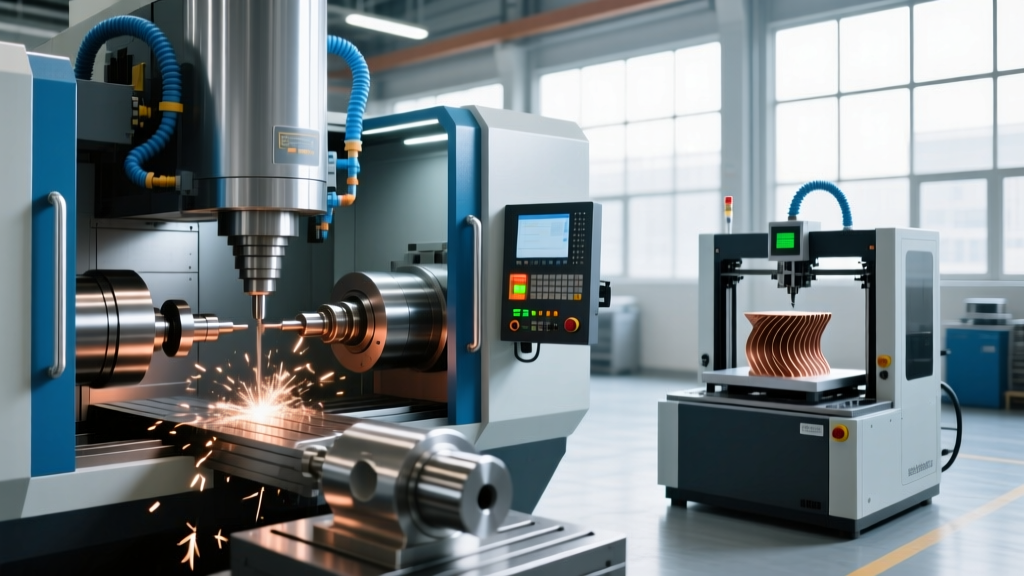
When shop owners and engineering students first explore automated manufacturing, a common question arises: is a 3d printer a cnc machine? The strict engineering answer is yes. Fused Deposition Modeling (FDM) and Stereolithography (SLA) printers are driven by G-code and M-code, utilizing multi-axis stepper or servo motors to follow precise numerical toolpaths. They are, by definition, Additive CNC machines.
However, in industrial procurement, the term 'CNC' is almost exclusively reserved for Subtractive CNC machines—mills, lathes, and routers that remove material from a solid billet. While industrial 3D printers (like the Stratasys F900 or Markforged Metal X) excel at rapid prototyping and complex internal geometries, they cannot match the dimensional accuracy, surface finish, or structural integrity required for high-stress aerospace or automotive components.
For production environments demanding tight tolerances and high throughput, the ultimate evolution of subtractive CNC technology is the Multi-Function Mill-Turn Center. This 2026 buying guide bridges the gap between additive concepts and advanced subtractive realities, detailing what you need to know before investing $400,000+ in a turn-mill center.
Capabilities Matrix: 3D Printing vs. 5-Axis Mill-Turn Centers
To understand why heavy industry invests in multi-tasking subtractive machines over additive alternatives, we must compare the physical output and economic realities of both systems.
| Specification | Industrial Metal 3D Printer (Additive CNC) | 5-Axis Mill-Turn Center (Subtractive CNC) |
|---|---|---|
| Dimensional Tolerance | ± 0.100mm to 0.250mm (requires secondary CNC machining) | ± 0.005mm (5 microns) or tighter |
| Surface Finish (Ra) | 3.2 to 6.3 µm (stair-stepping effect) | 0.4 to 0.8 µm (mirror finish achievable) |
| Material Integrity | Anisotropic; layer adhesion weaknesses | Isotropic; continuous grain structure from wrought billet |
| Cycle Time (Complex Part) | 12 to 48+ hours | 15 to 45 minutes (with automated bar feeding) |
| Setup / Fixturing | Support structures required, manual removal | Hydraulic chucks, B-axis milling, sub-spindle transfer |
Core Anatomy of a Multi-Function Mill-Turn Machine
If you are upgrading from a standard 2-axis lathe or a 3-axis mill, the kinematics of a mill-turn center require a fundamental shift in programming and operational strategy. The architecture relies on four critical subsystems:
- B-Axis Milling Spindle: Unlike a standard lathe with static live tooling, a mill-turn center features a full B-axis contouring head. This allows the milling spindle to tilt and lock at any angle (typically ±110 degrees), enabling 5-axis simultaneous machining of complex aerospace blisks or angled hydraulic ports.
- Lower Turret: A secondary 9 to 12-station turret operates on the X and Z axes (and sometimes Y-axis). While the B-axis spindle mills the top of the part, the lower turret can simultaneously turn or drill the bottom, effectively cutting cycle times in half.
- C-Axis Sub-Spindle: The right-hand sub-spindle catches the part from the main spindle. The C-axis allows the sub-spindle to index and rotate in synchronization with the milling spindle, enabling off-center drilling and back-working operations without unchucking the part.
- Y-Axis Travel: True mill-turn centers incorporate a Y-axis on the main spindle or turret, moving the cutting tool perpendicular to the X-Z plane. This is mandatory for machining flats, keyways, and off-center holes without relying on slower, less rigid C-axis interpolation.
2026 Buyer’s Matrix: Top Multi-Tasking CNC Models
The market for multi-tasking machines is dominated by three primary OEMs, each offering distinct control architectures and thermal stability solutions. Below is a comparison of three industry-standard models configured for mid-sized precision manufacturing.
| Feature | Mazak Integrex i-200S | DMG Mori NTX 1000 (2nd Gen) | Okuma Multus U3000 |
|---|---|---|---|
| Base Price Range (2026) | $450,000 - $580,000 | $390,000 - $520,000 | $430,000 - $560,000 |
| Max Turning Diameter | 26.0″ (660 mm) | 15.9″ (404 mm) | 25.6″ (650 mm) |
| Milling Spindle Speed | 12,000 RPM (30 HP) | 20,000 RPM (35 HP) | 12,000 RPM (25 HP) |
| Control System | MAZATROL SmoothAi | CELOS (Siemens-based) | OSP-P300G (Windows-based) |
| Thermal Compensation | AI Thermal Shield | Cooling through ball screws | Thermo-Friendly Concept |
Sources: Procurement data aggregated from Mazak Multi-Tasking, DMG Mori Turn & Mill, and Okuma Multus official 2026 specification sheets.
Hidden Costs: CAM Software and Automation Integration
The capital expenditure of the machine is only the entry fee. Multi-function CNC machines require advanced software and peripheral automation to achieve ROI.
1. Advanced CAM Post-Processors
Programming a 5-axis mill-turn center cannot be done efficiently on the shop floor via conversational controls. You must utilize high-end CAM software like hyperMILL, Mastercam, or Siemens NX. Because the kinematics of a B-axis head and C-axis sub-spindle are highly specific, you must purchase a custom post-processor. Expect to pay $12,000 to $25,000 for a verified, collision-tested mill-turn post-processor from a third-party developer like Postability or the CAM vendor directly.
2. Bar Feeders and Chip Conveyors
To run untended overnight shifts (lights-out manufacturing), a mill-turn center requires a high-capacity bar feeder. For the Mazak Integrex or Okuma Multus, integrating an Iemca Master 80 or LNS Turbo S2 bar feeder adds $45,000 to $75,000 to the project. Furthermore, mill-turn operations generate long, stringy chips (from turning) mixed with fine chips (from milling). A standard hinge-belt conveyor will jam; you must specify a high-pressure coolant system (300+ PSI) paired with a scraper-style chip conveyor to prevent bird-nesting inside the machine enclosure.
Decision Framework: Do You Need a Mill-Turn Center?
Use this operational checklist to determine if a multi-function subtractive CNC is the correct capital investment for your facility:
- Part Complexity: Does the part require operations on more than two planes, or feature deep, angled bores? (If yes → Mill-Turn).
- Fixturing Bottlenecks: Are you spending more than 15% of total cycle time manually moving parts from a lathe to a 3-axis mill? (If yes → Mill-Turn eliminates secondary setup).
- Metallurgical Requirements: Do the parts endure high cyclic fatigue (e.g., landing gear components, titanium medical implants) where additive layer adhesion is unacceptable? (If yes → Subtractive Mill-Turn).
- Production Volume: Are you producing batches of 50 to 5,000 parts? (If volume is under 10, a 5-axis mill or industrial 3D printer may be more economical. If over 10,000, consider dedicated transfer lines).
Frequently Asked Questions
So, is a 3D printer a CNC machine or not?
Yes, technically. A 3D printer is an Additive CNC machine. It uses computer numerical control to dictate the movement of its extruder or laser along X, Y, and Z axes. However, in the context of heavy manufacturing, metal cutting, and tight-tolerance engineering, 'CNC' refers to subtractive machines like mills, lathes, and mill-turn centers.
Can a mill-turn center machine hardened steel?
Yes, but with caveats. Mill-turn centers can perform 'hard turning' on materials up to 62 HRC using CBN (Cubic Boron Nitride) inserts. However, heavy interrupted milling on hardened steel is better suited to rigid 5-axis vertical machining centers due to the dampening characteristics of the machine casting.
What is the footprint requirement for these machines?
Multi-tasking machines are dense. A machine like the DMG Mori NTX 1000 requires roughly 120 square feet of floor space, but when factoring in the bar feeder, chip conveyor, high-pressure coolant unit, and operator clearance, you must allocate a minimum of 250 square feet of shop floor space per cell.