Portable CNC Machine Tolerance: Field Work Safety & Compliance
Learn how environmental factors affect portable CNC machine tolerance during field work, plus safety standards and compliance tips for on-site milling.
The Reality of In-Situ Machining: Shop vs. Field
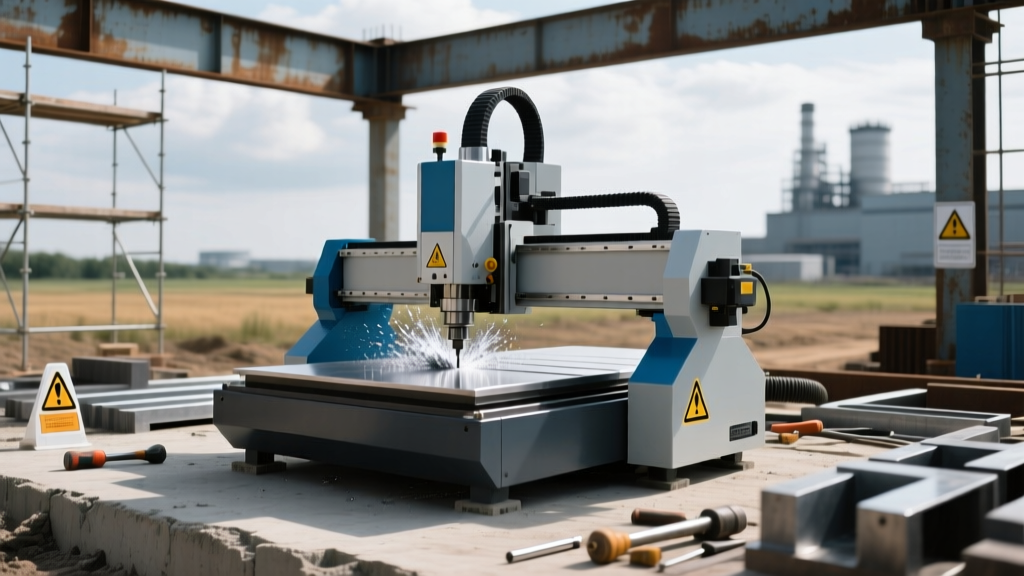
When heavy industry assets like pipeline flanges, wind turbine main shafts, or marine propulsion housings require precision repair, transporting them to a climate-controlled facility is often impossible. The solution is in-situ machining: bolting portable CNC mills and flange facers directly onto the asset. However, achieving strict cnc machine tolerance outside the shop floor introduces severe environmental variables. While a stationary Haas VF-2 might effortlessly hold ±0.0005 inches in a 68°F shop, a portable CNC rig operating on an outdoor oil rig must battle thermal gradients, wind-induced vibration, and uneven mounting surfaces just to maintain a ±0.002-inch flatness specification.
Beyond precision, field machining triggers complex safety and compliance liabilities. Site supervisors must reconcile the precision demands of engineering standards with the rigid safety mandates of OSHA and ISO. This guide details the exact protocols, environmental compensations, and compliance frameworks required to execute portable CNC field work safely and accurately in 2026.
⚠️ CRITICAL SAFETY WARNING: Portable CNC setups inherently lack the full-enclosure guarding of standard machine tools. Never operate a field-mounted CNC mill or facing tool without establishing an interlocked perimeter safety zone compliant with OSHA 1910.212 and ISO 12100 risk assessments.Environmental Factors Destroying CNC Machine Tolerance
The primary enemy of portable cnc machine tolerance is thermal expansion. The coefficient of thermal expansion for carbon steel is approximately 6.5 µin/in/°F. When a portable flange facer is mounted to a massive steel valve body exposed to direct sunlight or shifting ambient temperatures, the workpiece itself grows and shrinks beneath the cutting tool.
Thermal Drift Calculation Matrix
The table below illustrates the dimensional drift on a standard 40-inch diameter carbon steel pipeline flange when subjected to ambient temperature shifts from the baseline calibration point (typically 68°F / 20°C).
| Temperature Delta (ΔT) | Radial Expansion (inches) | Impact on Flatness Tolerance |
|---|---|---|
| ± 10°F | 0.0026" | Marginal risk; acceptable for roughing passes |
| ± 25°F | 0.0065" | Exceeds standard ±0.002" field tolerance; requires compensation |
| ± 40°F | 0.0104" | Catastrophic drift; guarantees flange leakage if uncompensated |
Actionable Fix: To maintain tolerance during critical finishing passes, field machinists must use infrared surface thermometers (e.g., Fluke 568) to monitor the workpiece. If ΔT exceeds 15°F, pause machining. Alternatively, program the CNC controller to apply real-time Z-axis tool offsets based on thermal expansion algorithms integrated into modern portable controllers like the FANUC 0i-MF Plus.
Safety Standards & Compliance for Portable Rigs
Operating a portable CNC machine in the field removes the protective polycarbonate shields found in traditional factories. This creates severe kinetic and entanglement hazards. Compliance requires a multi-layered safety approach governed by two primary frameworks.
1. OSHA 1910.212: General Machine Guarding
Under OSHA 1910.212, employers must provide machine guarding to protect operators from point-of-operation hazards. Because bolting a steel enclosure to a portable flange facer is impractical, compliance in 2026 relies on electro-sensitive protective equipment (ESPE).
- Perimeter Interlocks: Deploy safety laser scanners, such as the SICK microScan3, to create a virtual 360-degree guarding perimeter around the portable CNC.
- Safe Torque Off (STO): The portable CNC's spindle drive must be wired to the safety scanner via an STO circuit (SIL 3 / PLe compliant). If a worker breaches the 3-foot laser boundary, the spindle ceases torque instantly, preventing entanglement.
- Cost Expectation: A fully compliant portable safety scanner setup, including mounting tripods, relay logic, and STO integration, costs between $4,500 and $8,200 per field rig.
2. ISO 12100: Risk Assessment for Temporary Setups
ISO 12100:2010 mandates a formal risk assessment for all machinery. For portable CNCs, this assessment must account for site-specific hazards: overhead crane movements, confined space atmospheric risks, and uneven scaffolding. Documenting this risk assessment via a Job Safety Analysis (JSA) before the spindle starts is a non-negotiable compliance requirement for Tier-1 industrial sites.
ASME PCC-1 and the Surface Finish Tolerance
In field work, cnc machine tolerance is not limited to dimensional flatness; it heavily dictates surface finish. When machining pressure boundary bolted flange joints, adherence to the ASME PCC-1 guidelines (referenced alongside NIST metrology standards) is critical. PCC-1 mandates a serrated spiral or concentric groove finish with a roughness average (Ra) between 125 and 250 microinches to ensure proper gasket seating.
💡 Expert Tip: If your portable CNC's Z-axis exhibits stick-slip friction due to field dust contamination, the tool will chatter, producing an Ra finish exceeding 300 µin. This will cause the spiral gasket to leak under high pressure. Always use way covers and continuous air-purge systems on portable linear guides when operating in cement or mining environments.Equipment Matrix: Leading Portable CNC Systems
Selecting the right portable rig dictates your baseline capability to hold tolerance. Below is a comparison of two industry-standard portable CNC platforms used in heavy field work.
| Feature | Mirage Tools CFF-600 (Flange Facer) | York Portable Machine Tools PMT-3000 (Mill) |
|---|---|---|
| Primary Application | Pipeline flanges, heat exchanger faces | Turbine bases, marine engine blocks, ship hulls |
| Axis Travel | Radial: 24" / Z-Axis: 6" | X/Y/Z: 40" x 20" x 12" (Modular) |
| Rigidity & Mass | Moderate (Aluminum/Steel hybrid) | Extreme (Heavy-duty cast iron bases) |
| Expected Field Tolerance | ±0.003" Flatness over 48" | ±0.001" Positional / ±0.0005" Flatness |
| Estimated Base Cost (2026) | $38,000 - $45,000 | $75,000 - $92,000 |
Step-by-Step Calibration Protocol for Field Tolerances
To guarantee your portable CNC meets engineering tolerances before cutting metal, execute this 5-step field calibration protocol:
- Sub-Frame Leveling: Bolt the portable base to the asset. Use a precision machinist level (e.g., Starrett 199Z, reading 0.0005"/ft) to level the base. Shim using stainless steel feeler gauges, never composite shims which compress under cutting loads.
- Spindle Tramming Sweep: Mount a Mitutoyo 513-404-10E dial indicator in the spindle. Sweep a 12-inch radius on a certified ground test plate clamped to the workpiece. Adjust the spindle tilt until the sweep variance is less than 0.0002".
- Thermal Equilibration: Run the spindle at 75% of the intended cutting RPM (e.g., 2500 RPM for a Sandvik CoroMill 390) for 15 minutes. This expands the spindle bearings and housing to their operating temperature, preventing Z-axis drift during the first cut.
- Backlash Verification: Program a 1-inch square test cut. Measure the dimensions with a digital micrometer. If the X and Y axes show asymmetrical over-travel, input the mechanical backlash compensation values into the portable CNC pendant.
- Coolant Flow Validation: Ensure flood coolant or minimum quantity lubrication (MQL) is hitting the exact shear zone. Inadequate cooling in field work causes localized workpiece hardening, leading to tool deflection and immediate tolerance loss.
Compliance Checklist for Site Supervisors
Before authorizing the start of any portable CNC field operation, site supervisors must verify the following compliance markers:
- [ ] LOTO Integration: The portable CNC's main power disconnect is integrated into the facility's Lockout/Tagout procedure to prevent accidental energization from upstream breakers.
- [ ] Swaging & Chip Deflection: Magnetic chip shields are deployed to prevent hot, stringy steel swarf from falling into sensitive asset internals (e.g., valve seats or bearing housings).
- [ ] Vibration Isolation: If heavy machinery (like rock crushers or stamping presses) is operating within 50 feet, accelerometer readings confirm background vibration is below 0.1 in/sec, ensuring it won't induce chatter marks on the machined surface.
- [ ] Metrology Certification: All field measuring instruments (micrometers, dial indicators, surface roughness testers) possess valid, unexpired calibration certificates traceable to national standards.
Mastering portable cnc machine tolerance requires acknowledging that the environment is an active participant in the machining process. By combining rigorous thermal compensation, strict adherence to OSHA guarding mandates, and meticulous setup protocols, field machining teams can deliver shop-floor precision to the most remote and hostile industrial environments.