Portable CNC Machine Retrofitting: Field Safety & Compliance
Navigate OSHA and ISO compliance for portable CNC machine retrofitting. Learn safety protocols, control upgrades, and guarding for field-deployed equipment.
Field machining—repairing turbine casings, facing flanges on offshore rigs, or line-boring excavator booms—relies heavily on portable CNC machines. As heavy industry shops modernize, cnc machine retrofitting of legacy manual portable mills, lathes, and flange facers (such as older Climax, Mirage, or W.S. Testa models) is accelerating. Bolt-on CNC kits offer immense precision gains, but integrating modern servos and automated controllers onto machines designed for manual operation in uncontrolled environments introduces severe compliance liabilities. Safety is not an afterthought; it is the primary engineering constraint.
⚠️ Field Retrofit Warning: Bypassing hardware travel limits or relying solely on software-based E-stops to 'save time' during a portable CNC retrofit violates OSHA 29 CFR 1910.212 and voids the integrator's liability shield. Always hardwire dual-channel, category-rated E-stops independent of the CNC software logic.Core Safety Standards for Field-Deployed CNC Retrofits
When executing a cnc machine retrofitting project for field-deployed assets, integrators must bridge the gap between factory-floor machinery directives and rugged field realities. The two governing frameworks are ISO 13849-1 (Safety of machinery — Safety-related parts of control systems) and OSHA's general industry machine guarding standards.
ISO 13849-1: Performance Levels in Harsh Environments
Under ISO 13849-1, safety functions are graded by Performance Level (PL) and Category. A retrofitted portable CNC operating on an active mining site or offshore platform faces high environmental stress (vibration, moisture, conductive dust). Therefore, the safety control system—specifically the E-stop chain and axis-limit monitoring—must meet a minimum of Category 3 / Performance Level d (PLd). This requires redundant architecture where a single fault does not lead to a loss of the safety function, and the fault is detected before the next demand upon the safety system.
OSHA 1910.212: Machine Guarding Without Enclosures
Standard CNC mills utilize full sheet-metal enclosures to contain chips, coolant, and broken tooling. Portable field machines rarely have this luxury. According to OSHA 1910.212(a)(1), machines must be guarded to protect operators from rotating parts, flying chips, and sparks. For retrofitted portable units, compliance requires engineered localized guarding rather than full enclosures.
The Guarding Challenge: Active and Passive Safeguards
Because a portable flange facer or line-boring machine is bolted directly onto the workpiece, the 'work zone' is inherently open. Retrofitting these machines requires a hybrid approach to safeguarding.
- Passive Shielding: Use 1/2-inch thick Makrolon (polycarbonate) shields with heavy-duty magnetic bases. These must be positioned to intercept the direct line of fire from the cutting tool. Thinner acrylic shatters under the impact of heavy metal swarf; polycarbonate absorbs the kinetic energy.
- Active Perimeter Safeguarding: For larger retrofitted setups (e.g., a portable gantry mill on a ship hull), integrate safety laser scanners like the SICK microScan3. These devices project an invisible, multi-zone infrared field around the machine footprint. If a worker breaches the 1.5-meter warning zone, the CNC feed rate overrides to 10%. If the 0.5-meter stop zone is breached, the safety PLC instantly cuts power to the axis servos and spindle drive.
Compliance Matrix: Legacy vs. Retrofitted Portable CNCs
| Safety Feature | Legacy Manual Setup | Non-Compliant CNC Retrofit | Fully Compliant CNC Retrofit |
|---|---|---|---|
| Emergency Stop | Manual spindle disengagement | Software E-stop via HMI screen | Hardwired dual-channel safety relay (Cat. 3) |
| Axis Over-Travel | Operator visual monitoring | Software limit switches in CNC | Physical NC limit switches + Software limits |
| Chip/Coolant Guarding | Operator wears face shield | None (relying on PPE) | Magnetic 1/2" polycarbonate localized shields |
| Spindle Lockout | Unplug generator | Turn off pendant | Integrated LOTO points on main disconnect |
Control System Upgrades: Integrating Safety PLCs
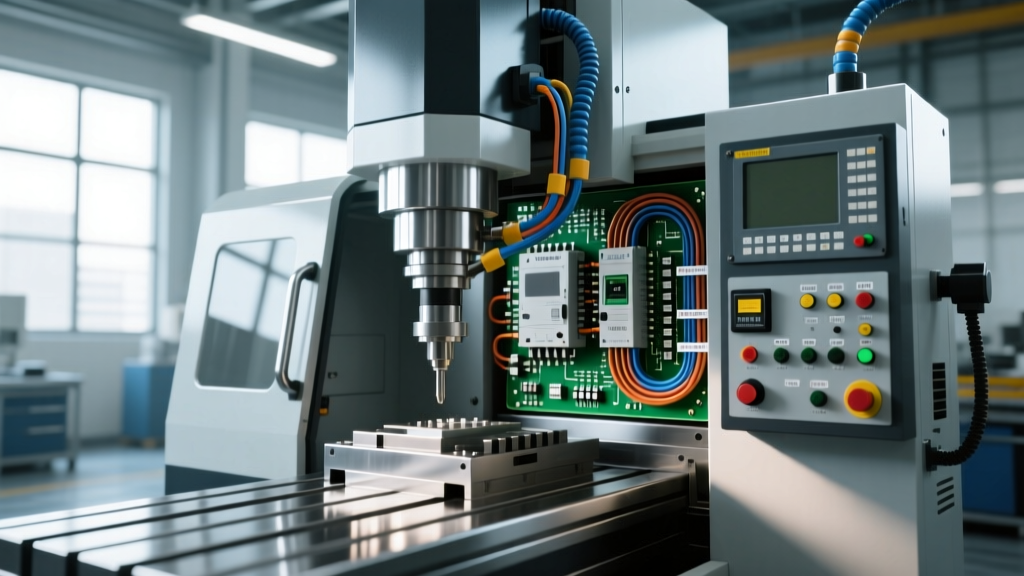
A common mistake in cnc machine retrofitting is relying on the CNC controller (e.g., Centroid M400S or FANUC 0i-F Plus) to process safety-critical E-stop signals. While modern CNCs have safety I/O, best practice dictates using a dedicated, certified safety PLC—such as the Pilz PNOZmulti 2—to monitor field safety devices.
The safety PLC sits between the field E-stops, light curtains, and the CNC's safe torque off (STO) inputs on the servo drives. If a magnetic shield is removed during operation, a non-contact RFID interlock (e.g., Euchern TZ series) signals the safety PLC, which immediately triggers the STO function on the spindle VFD, halting rotation in under 200 milliseconds without relying on the CNC's operating system.
Step-by-Step LOTO Integration for Retrofitted Portables
Portable machines often draw power from temporary field generators or daisy-chained site power. Compliance with OSHA 1910.147 (Lockout/Tagout) requires specific hardware integration during the retrofit phase:
- Main Disconnect Integration: Install a NEMA 4X rated rotary disconnect switch on the machine's primary control panel. This must accept standard padlocks.
- Stored Energy Dissipation: Retrofitted servo drives contain high-voltage capacitors. The retrofit panel must include an automatic bleed-down resistor circuit with a visual 'Voltage Present' LED indicator that extinguishes only when DC bus voltage drops below 50V.
- Gravity Drop Prevention: If retrofitting a portable vertical mill or facing head, install a pneumatic or mechanical axis brake that automatically engages when the main disconnect is turned to the OFF/LOTO position, preventing the spindle head from dropping on the workpiece.
Cost & ROI of Compliant Portable CNC Machine Retrofitting
Budgeting for a compliant retrofit requires looking beyond the cost of the CNC pendant and motors. Below is a realistic cost breakdown for retrofitting a mid-sized portable boring machine (e.g., Climax BB5000 equivalent) to full ISO/OSHA compliance:
Estimated Retrofit Costs (2026 Pricing):- Base Mechanical & Servo Integration: $12,500 - $16,000 (Ball screws, servo mounts, wiring)
- CNC Controller & Pendant: $8,000 - $11,000 (e.g., Centroid or Mach4 industrial package)
- Safety PLC & Interlocks: $4,500 - $6,500 (Pilz/SICK hardware, RFID shield switches)
- Custom Polycarbonate Guarding: $2,000 - $3,500
- Total Compliant Retrofit: $27,000 - $37,000
While a non-compliant 'garage-built' retrofit might cost $18,000, the ROI of a compliant system is realized through site access. Tier-1 mining and oil & gas contractors routinely audit portable equipment. Machines lacking certified safety PLCs and proper LOTO hardware are barred from entering sites, rendering the capital investment entirely useless.
'In field machining, the environment is the enemy of safety systems. Vibration loosens standard limit switches, and conductive dust shorts out proximity sensors. A successful portable CNC retrofit uses heavy-duty, IP67-rated safety components that are mechanically isolated from the machine's cutting vibrations.' — Lead Automation Engineer, Heavy Industry Field Services
Pre-Deployment Field Safety Checklist
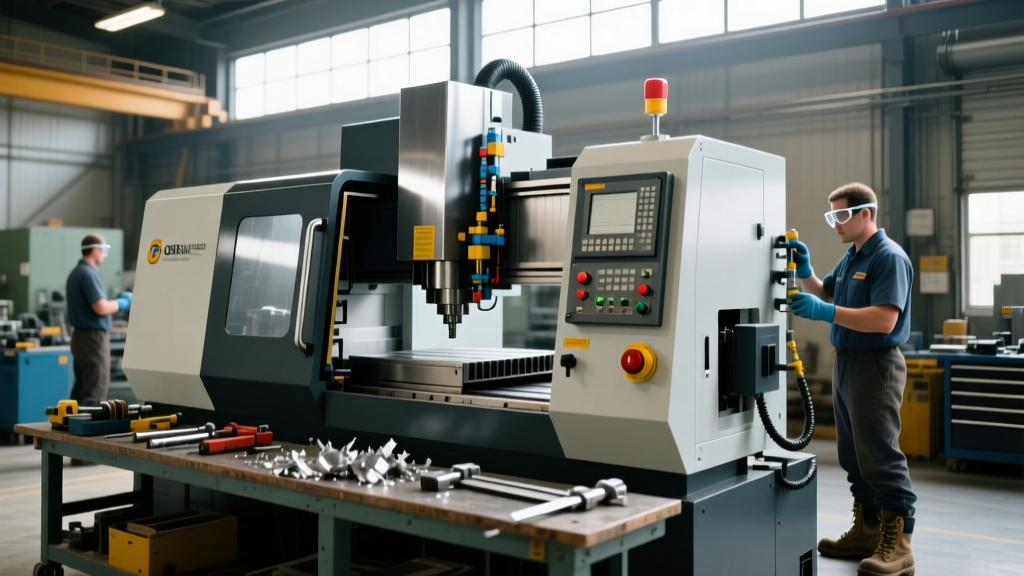
Before energizing a retrofitted portable CNC on a job site, the lead technician must verify the following compliance checkpoints:
- [ ] E-Stop Chain Verification: Trigger all physical E-stops; verify the safety PLC faults out and the STO engages on all axis drives.
- [ ] Shield Interlock Test: Remove the localized polycarbonate shields; verify the spindle cannot be commanded to start via the CNC pendant.
- [ ] Generator Grounding: Verify the temporary power source has a verified earth ground; portable CNCs are highly susceptible to ground faults which can bypass safety relays.
- [ ] LOTO Hardware Check: Ensure the main rotary disconnect accepts the site-specific lockout padlocks and physically prevents the handle from moving to the ON position.
For further reading on integrating safety systems into automated machinery, the Rockwell Automation Safety Reference Manual provides extensive wiring diagrams for Category 3 and Category 4 safety circuits applicable to heavy-duty retrofits.
Ultimately, cnc machine retrofitting for portable field equipment is an exercise in risk mitigation. By prioritizing safety PLCs, localized physical guarding, and rigorous LOTO integration, shops can deploy automated field machinery that meets the strictest industrial compliance standards while maximizing uptime and cutting precision.