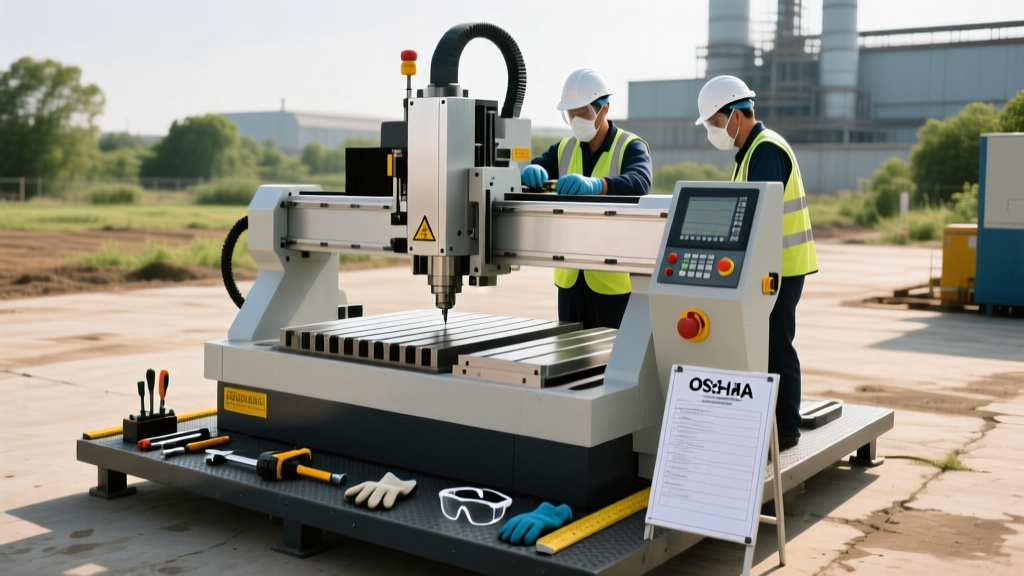
Portable CNC Machine Plans: Field Work Safety & Compliance
Reviewing portable CNC machine plans for field work? Ensure OSHA and ISO compliance with our guide on safety standards for mobile milling and routing.
The Hidden Dangers in Open-Source Portable CNC Machine Plans
Taking a 3-axis router or mini-mill to a construction site, shipyard, or remote pipeline facility introduces severe electrical and mechanical hazards that factory environments simply do not have. When fabricators and field engineers evaluate or draft portable CNC machine plans, the primary focus is usually on weight reduction, modularity, and axis travel. However, stripping down a machine for mobility often strips away critical safety redundancies.
In 2026, job site safety auditors and OSHA compliance officers are heavily scrutinizing temporary automated fabrication setups. A portable CNC that is perfectly safe in a climate-controlled garage can become a lethal liability when plugged into a temporary construction generator and exposed to silica dust, moisture, and uneven terrain. This guide dissects the critical safety standards and compliance modifications required when adapting or building portable CNC equipment for field deployment.
⚠ Critical Field Power Warning
Never connect a portable CNC control box directly to an unverified job site generator without a line conditioner. Field generators frequently produce Total Harmonic Distortion (THD) exceeding 15%, which will destroy standard Variable Frequency Drive (VFD) rectifiers and cause unpredictable stepper motor stalling, leading to tool breakage and projectile hazards.
Electrical Continuity and Grounding in Modular Frames
The most common material specified in DIY and custom portable CNC machine plans is aluminum extrusion (such as 80/20 1515 or 2020 profiles) due to its high strength-to-weight ratio. However, this introduces a massive, often overlooked compliance failure regarding electrical grounding.
Most structural aluminum extrusions are anodized to prevent corrosion. Anodization is an electrical insulator. If a spindle motor or limit switch shorts to the frame, the fault current cannot travel through the bolted joints back to the main grounding lug. The breaker will not trip, leaving the entire machine frame energized at line voltage—a fatal risk in damp field conditions.
OSHA-Compliant Grounding Modifications
According to OSHA 1926.404 (Design safety standards for electrical systems), all non-current-carrying metal parts of portable equipment must be effectively grounded. To make an aluminum extrusion frame compliant:
- Star Washers and Raw Metal: Use stainless steel star lock washers at every structural joint to bite through the anodized layer, ensuring metal-to-metal electrical continuity.
- Dedicated Ground Bus: Run a continuous 10 AWG bare copper grounding wire across all major structural nodes, terminating at a centralized, clearly marked grounding lug connected to the site's ground rod or generator ground.
- GFCI Integration: The main power inlet on the portable control box must integrate a 30mA Residual Current Device (RCD) or Ground Fault Circuit Interrupter (GFCI) to protect operators from micro-shocks in wet outdoor environments.
Mechanical Rigidity and Vibration Damping
Portable CNC frames lack the mass of traditional cast-iron machine beds. In field work, the machine is often bolted to temporary plywood workbenches or uneven concrete floors. This lack of mass and rigid mounting leads to harmonic chatter during heavy roughing passes.
Chatter is not just a surface finish issue; it causes premature carbide endmill fracture. When a 1/2-inch carbide endmill snaps at 18,000 RPM, the shrapnel poses a severe laceration and ocular hazard to nearby site workers. To meet OSHA hand and power tool safety standards regarding flying particle containment, portable plans must incorporate specific dampening and shielding strategies.
| Plan Component | Standard DIY Spec | Field-Compliant Upgrade | Safety Benefit |
|---|---|---|---|
| Base Plate | 1/2" MDF or Aluminum | 1/4" Steel or Epoxy Granite | Lowers center of gravity; absorbs high-frequency vibration. |
| Spindle Shielding | Open-air or acrylic dust shoe | 1/8" Polycarbonate (Lexan) full enclosure | Contains tool shrapnel and deflects heavy chips. |
| Linear Motion | V-slot wheels on aluminum | Sealed profile linear rails (e.g., HIWIN HGR15) | Prevents field dust ingestion and catastrophic carriage seizing. |
Ingress Protection (IP) and Environmental Sealing
Field environments are hostile to electronics. Concrete silica dust, welding spatter, and sudden rainstorms will destroy exposed stepper drivers and CNC controller boards. When reviewing portable CNC schematics, you must audit the electrical enclosure specifications against NEMA and IP standards.
For outdoor or heavy-industry field work, the control box must be rated NEMA 4X (watertight and corrosion-resistant) or at minimum IP65. Standard 3D-printed PLA or PETG enclosures found in many open-source plans are entirely non-compliant for field use, as they degrade under UV exposure and offer zero protection against pressurized water or fine particulate ingress. Specify fiberglass-reinforced polyester or powder-coated steel enclosures with silicone gasket seals for all cable glands.
E-Stop Architecture: Software vs. Hardware Compliance
The most frequent safety violation in custom CNC builds is routing the Emergency Stop (E-Stop) button through the software controller (e.g., Mach4, LinuxCNC, or GRBL). If the software crashes or the USB connection drops—a common occurrence when running long toolpaths on ruggedized field laptops—the E-Stop button becomes useless.
ISO 13850:2015 (Safety of machinery - Emergency stop function) strictly requires that E-stop systems operate independently of the machine's primary control logic. Modern 2026 portable builds must utilize Safe Torque Off (STO) technology.
Expert Insight on STO Integration:
"When drafting portable plans, specify VFDs and servo drives equipped with dual-channel SIL3/PLe rated STO inputs. Wire a hardwired safety relay, such as the Pilz PNOZ X3 or Siemens 3SK1, directly from the E-Stop mushroom button to the STO terminals on the drives. This physically cuts the power to the motor gates at the hardware level, ensuring the spindle coasts to a halt even if the main CNC brain is completely dead."
— Industrial Automation Safety Auditor
5-Point Safety Audit for Portable CNC Plans
Before cutting material or ordering parts for a mobile fabrication unit, run your schematics through this compliance checklist:
- Power Conditioning: Does the electrical schematic include a 3-5% impedance line reactor or DC choke between the field generator inlet and the spindle VFD to mitigate THD?
- Chassis Continuity: Are star washers and a dedicated 10 AWG ground bus specified for all anodized aluminum frame joints?
- Hardwired E-Stop: Does the E-stop bypass the software controller and utilize a dedicated safety relay to trigger Safe Torque Off (STO) on all axis drives?
- Environmental Sealing: Are all electronics housed in NEMA 4X / IP65 enclosures with sealed cable glands, avoiding UV-degradable 3D printed plastics?
- Containment Shielding: Is the cutting area enclosed in minimum 1/8" polycarbonate to contain carbide tool fractures and deflect heavy chips?
Final Considerations for Site Managers
Building a portable CNC from scratch using internet plans can save money upfront, but the cost of retrofitting for OSHA and ISO compliance often eclipses those savings. If your field work involves high-liability environments like aerospace field repairs or structural steel modification, consider investing in purpose-built, factory-certified portable CNCs (such as the ShopBot PRSalpha or specialized magnetic-base milling units) that arrive with pre-validated CE and NRTL safety certifications. For custom rigs, strict adherence to the hardware-level safety protocols outlined above is non-negotiable for operator survival and corporate liability protection.