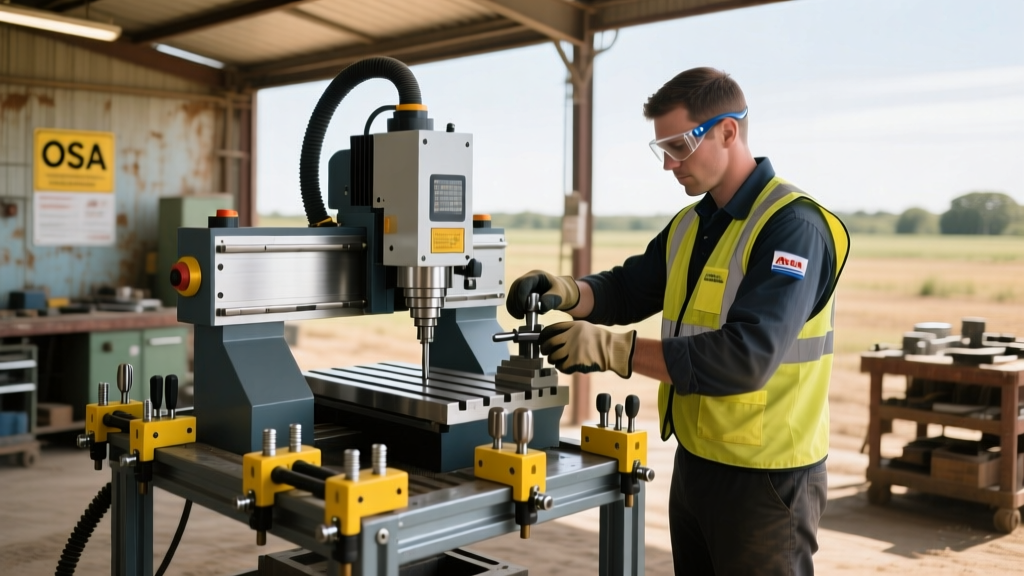
Safe Tooling for CNC Machines in Portable Field Operations
Ensure OSHA compliance and operator safety when using portable CNC machines on-site. Expert guide to field tooling, rigging, and LOTO protocols.
The Hidden Hazards of On-Site CNC Machining
Deploying portable CNC machines—such as flange facers, portable boring mills, and on-site gantry routers—transforms uncontrolled field environments into temporary machine shops. Whether repairing a 10,000-pound valve body in a refinery or resurfacing a turbine casing in a power plant, the physical forces remain identical to in-plant machining. However, the safety infrastructure does not. Without the benefit of fixed polycarbonate enclosures, standardized chip conveyors, and dedicated grounding grids, field operators face amplified risks of entanglement, swarf projection, and electrical fault.
Selecting the correct tooling for CNC machines deployed outside the shop floor is not merely a matter of metallurgical efficiency; it is a critical compliance requirement. A toolholder failure at 3,000 RPM on an open-air portable mill can turn a carbide insert into a lethal projectile. This guide details the exact safety standards, tooling specifications, and compliance protocols required for portable CNC field work in 2026.
CRITICAL WARNING: Field machining environments account for a disproportionate number of struck-by and entanglement injuries compared to fixed-facility operations. Never bypass portable guarding shields to 'speed up' a manual tool change on an active job site.Regulatory Framework for Portable CNC Operations
Many site managers mistakenly believe that temporary field machining is exempt from standard factory safety regulations. Under OSHA 29 CFR 1910.212 (General Requirements for All Machines), machine guarding mandates apply universally, regardless of whether the equipment is bolted to a concrete factory floor or magnetically clamped to a pipeline flange. Furthermore, the NIOSH Machine Guarding guidelines explicitly highlight the dangers of portable power tools and temporary milling setups where point-of-operation guards are frequently improvised or omitted.
For portable CNC operations, compliance hinges on three pillars:
- Point-of-Operation Guarding: Utilizing adjustable, transparent PETG or polycarbonate shields that mount directly to the portable machine base or spindle housing.
- Lockout/Tagout (LOTO): Adhering to OSHA 1910.147, which in field work requires isolating not just the portable CNC controller, but the massive workpiece itself (e.g., ensuring a suspended turbine rotor cannot rotate via wind or gravity).
- Environmental Electrical Safety: Meeting IP (Ingress Protection) ratings for coolant pumps and control pendants exposed to rain, mud, or conductive metal dust.
Specifying Compliant Tooling for CNC Machines in Field Environments
When sourcing tooling for CNC machines in field environments, standard shop-floor assumptions fail. Portable CNC rigs, such as the Mirage Machines CM1000 or Climax Portable BB5000 series, often utilize modified BT30 or BT40 spindles with lower drawbar retention forces than vertical machining centers. This mechanical limitation creates a severe pull-out hazard during heavy interrupted cuts common in field repair work.
Retention Knob and Pull-Stud Safety
The most catastrophic tooling failure in portable CNC milling is the ejection of the toolholder from the spindle taper. In the field, where machines are often mounted at odd angles (overhead or vertical), gravity exacerbates this risk. You must strictly match the pull-stud angle to the portable spindle's drawbar mechanism. A 45-degree pull stud used in a spindle designed for a 90-degree pull stud will result in incomplete seating and immediate ejection under load.
Actionable Specification: Mandate the use of dual-contact BT40 toolholders with precision-ground retention knobs rated for a minimum of 2,500 lbf (11,120 N) of pull force. Always use a calibrated torque wrench to install the retention knob into the toolholder; never rely on an impact wrench, which can micro-fracture the stud and cause delayed failure during a cut.
Carbide Grades and Interrupted Cut Stability
Field workpieces are rarely perfectly round or clean. Machining a corroded, out-of-round flange face subjects the cutting tool to violent interrupted cuts. Using standard CVD-coated carbide inserts designed for continuous finishing cuts will result in immediate edge chipping, sending hot carbide shards toward the operator. For portable CNC facing and boring, specify PVD-coated, tough-substrate grades (such as ISO M-class or K-class with high cobalt binders) paired with chip-breaker geometries designed to curl swarf tightly, preventing long, stringy 'birds nests' that can entangle portable guarding shields.
| Toolholder / Tooling Type | Field Application | Primary Safety Hazard | Required Mitigation |
|---|---|---|---|
| BT40 Dual-Contact | Heavy portable face milling | Spindle ejection due to vibration | Calibrated torque installation; 2,500 lbf retention |
| ER32 Collet Chucks | Portable drilling / tapping | Tool slippage under axial load | Use sealed, high-clamping force nuts; clean tapers |
| Weldon Shank (Flat) | Rough boring on-site | Set-screw shearing on hard materials | Dual set-screw holders; avoid for overhead cuts |
| Hydraulic Chucks | Precision field journal turning | Loss of clamping pressure in high heat | Restrict to light finishing; monitor ambient temp |
Rigging, Fixturing, and Swarf Containment Compliance
Unlike a shop-floor VMC where the workpiece is clamped to a massive cast-iron table, portable CNC machines are often bolted directly to the workpiece. The safety of the tooling is irrelevant if the machine base itself becomes a projectile.
When mounting a portable CNC mill to a vertical surface, rely exclusively on high-tensile through-bolting or engineered vacuum/magnetic bases with certified load ratings. Never use standard C-clamps to secure a portable machine base that generates more than 500 Nm of cutting torque. Furthermore, swarf containment in the field is an environmental and safety compliance issue. Hot, sharp metal chips falling from an elevated flange repair can injure workers on lower scaffolding levels. Deploy flexible, magnetic chip-containment tarps rated for high temperatures (Kevlar or fiberglass blends) beneath the cutting zone.
Electrical Grounding and IP Ratings in Wet Environments
Field machining frequently involves water-based coolants, rain exposure, and conductive metal structures. The control pendants and coolant pumps must meet a minimum of IP67 (pendants) and IP65 (spindle motors and pumps) to prevent short circuits that could cause the machine to auto-cycle unexpectedly. All portable CNC power supplies must be integrated with a 15mA Ground Fault Circuit Interrupter (GFCI) and physically bonded to the workpiece grounding grid to prevent stray voltage accumulation in the tooling and spindle bearings.
'The most common safety failure we see in field machining isn't the cutting tool breaking; it's the operator reaching past a temporary guarding shield to clear a jammed chip while the spindle is still in orient mode. Portable machines demand strict LOTO discipline because the 'door interlock' safety feature of a standard VMC simply doesn't exist in the field.'
— Lead Field Service Engineer, Major Portable Machine Tool OEM
Pre-Machining Safety Audit Checklist for Field Ops
Before initiating the spindle on any portable CNC setup, the site supervisor must complete and sign off on the following compliance audit:
- Workpiece Isolation: Verify the massive workpiece (e.g., valve, rotor, pipe) is locked out from all kinetic, hydraulic, and pneumatic energy sources per OSHA 1910.147.
- Base Rigidity Test: Apply a lateral force indicator to the portable machine base to confirm zero deflection at maximum expected cutting loads.
- Tooling Retention Verification: Physically inspect all pull-studs for micro-cracks and verify retention knob torque logs.
- Guarding Deployment: Ensure adjustable polycarbonate shields are positioned within 2 inches of the cutting zone without obstructing the operator's line of sight.
- Swarf & Coolant Containment: Confirm magnetic tarps and GFCI-protected coolant catchment systems are active and grounded.
The Financial Reality of Non-Compliance
Investing in premium, field-rated tooling and portable guarding systems carries an upfront cost. A set of dual-contact BT40 toolholders and custom PETG shields for a portable flange facer may add $2,500 to $4,000 to a project's consumable budget. However, as of 2026, OSHA's maximum penalty for a single willful safety violation exceeds $161,000. Beyond regulatory fines, a tooling ejection injury on a remote job site triggers immediate work-stoppage, emergency medical evacuation costs, and catastrophic liability exposure. Specifying compliant, heavy-duty tooling for CNC machines in field environments is not an optional upgrade; it is the fundamental baseline for operational viability in modern on-site repair work.