Long Form CNC Machine Safety Protocols for Portable Field Operations
Explore long form CNC machine safety protocols for portable field work. Covers OSHA, ATEX compliance, hydraulic drives, and on-site milling audits.
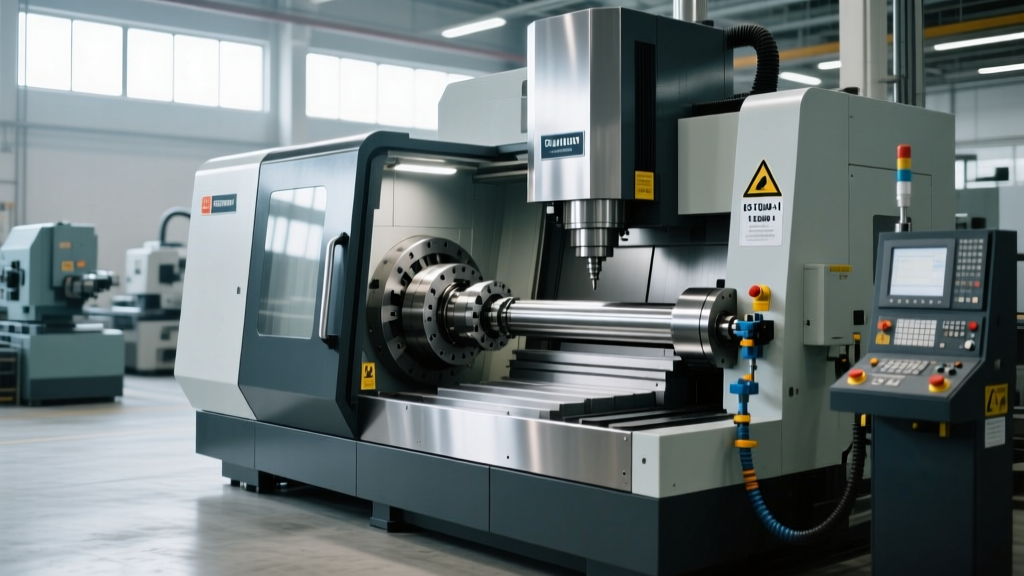
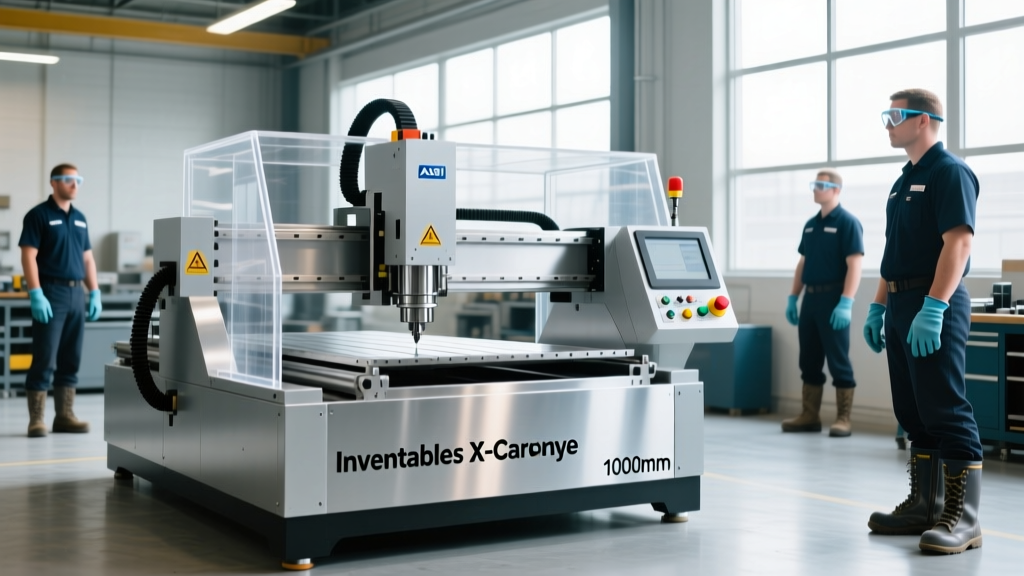
Taking a precision CNC machine tool out of a climate-controlled factory and deploying it to a remote pipeline, offshore rig, or mining site introduces severe compliance and operational hazards. Portable CNC machines—such as the Mirage MFT6000 portable milling machine or the Climax PM-4000 portable flange facer—deliver 5-axis capabilities directly to the workpiece. However, the temporary nature of field setups often leads to critical gaps in machine guarding, grounding, and emergency stop (E-Stop) circuit integrity. This guide details the exact safety standards, mounting tolerances, and compliance frameworks required for portable CNC field operations in 2026.
The Regulatory Intersection: OSHA and ANSI B11.8 in the Field
Field technicians frequently assume that temporary setups are exempt from permanent facility machine guarding rules. This is a fatal compliance error. Under OSHA 29 CFR 1910.212, the general requirements for all machine tools apply regardless of whether the machine is bolted to a concrete foundation or magnetically clamped to a steel beam. Furthermore, ANSI B11.8 (Safety Requirements for Drilling, Milling, and Boring Machines) mandates specific guarding for rotating spindles and swarf ejection zones.
When deploying a portable CNC mill on a structural steel beam, the primary hazard is not just operator entanglement, but catastrophic machine detachment. A 15-horsepower roughing pass on a 316 stainless steel flange generates cutting forces exceeding 2,500 lbs. If the temporary mounting system fails, the 600-lb machine head becomes a high-velocity projectile.
CRITICAL HAZARD WARNING: Never rely solely on magnetic bases for heavy-duty portable CNC milling in dynamic environments. Magnetic holding force degrades rapidly if the base surface has mill scale, rust, or uneven weld seams. Always supplement magnetic mounts with mechanical chain clamps or bolted jacking screws rated for a minimum 10,000 lb shear load.Mounting Integrity and Surface Preparation Tolerances
Compliance with ANSI B11.8 requires documented verification of mounting integrity before the spindle is energized. Field safety managers must enforce strict surface preparation protocols for the machine's base plates.
- Surface Flatness: The mounting area on the workpiece must be machined or ground to a flatness tolerance of 0.002 inches per foot. Portable CNC bases lacking full contact will induce harmonic chatter, leading to tool breakage and base-plate fatigue.
- Bolted Connections: When using bolted jacking screws (common on York CNC Portable Mills), technicians must use Grade 8 or ISO 898-1 Class 10.9 fasteners. Torque specs must be verified with a calibrated digital torque wrench and logged on the daily Job Safety Analysis (JSA).
- Thermal Expansion Compensation: In desert or offshore environments, ambient temperature swings of 40°F can cause the steel workpiece to expand or contract beneath the CNC base. Mounting systems must incorporate slotted adjustment holes or kinematic couplings to prevent binding and stress fractures during 12-hour continuous facing operations.
ATEX Compliance: Power Sources in Hazardous Locations
Field work in the oil, gas, and petrochemical sectors frequently places portable CNC machines in ATEX Zone 1 or Zone 2 (or IECEx equivalent) explosive atmospheres. Standard electric servo motors and VFDs (Variable Frequency Drives) used on factory CNCs are ignition sources and are strictly prohibited in these zones without expensive, heavy Ex-d (flameproof) enclosures.
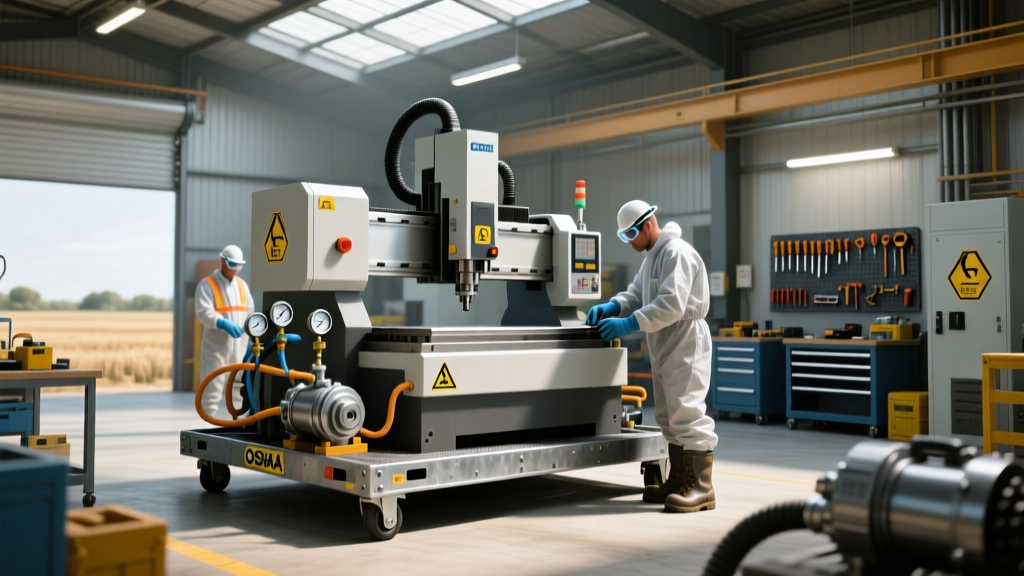
To maintain compliance, field operators utilize hydraulic or pneumatic-driven portable CNCs. Hydraulic rotary actuators replace electric servo motors for the X, Y, and Z axes, while hydraulic orbital motors drive the spindle.
| Power Source | ATEX Compliance | Field Limitations | Typical Use Case |
|---|---|---|---|
| Electric (Standard VFD/Servo) | Non-Compliant in Zone 1/2 | Requires 480V stable grid power; heavy control cabinets. | Shipyard drydocks, non-hazardous mining sites. |
| Hydraulic (Actuators/Orbital Motors) | Fully Compliant (Intrinsically Safe) | Requires hydraulic power pack; risk of fluid spills (EPA SPCC rules apply). | Offshore platforms, refinery pipe flanges, Zone 1 areas. |
| Pneumatic (Air Motors) | Fully Compliant | Low torque; spindle speed fluctuates under varying cutting loads. | Light-duty valve seat cutting, soft material facing. |
Executing a Long Form CNC Machine Safety Audit
Executing a long form CNC machine safety audit in the field requires moving beyond standard factory checklists. A comprehensive field audit must evaluate the interaction between the portable tool, the temporary power supply, and the uncontrolled environment. Safety managers should implement the following 4-point audit matrix prior to spindle start-up:
- LOTO (Lockout/Tagout) Isolation Verification: Portable CNCs are often powered by rented 50kW diesel generators. The audit must verify that the E-Stop circuit on the operator pendant physically severs the control voltage (24VDC) AND triggers a main contactor drop-out on the generator skid. Relying solely on software-based spindle halts violates ISO 13849-1 Category 3 safety relay requirements.
- Umbilical and Cable Management: Pendant cables must be rated for continuous flexing (e.g., PUR jackets) and elevated at least 6 feet off the ground using temporary stanchions. Cables dragged through mud or struck by site forklifts expose 480V lines, creating fatal electrocution hazards in wet field conditions.
- Swarf Containment and Wind Mitigation: Unlike enclosed factory mills, portable CNCs eject sharp, hot metal chips (swarf) directly into the environment. In high-wind offshore conditions, swarf becomes an airborne laceration hazard. Audits must confirm the installation of heavy-duty magnetic chip mats and weighted, fire-retardant welding tarps enclosing a minimum 10-foot radius around the cut zone.
- Hydraulic Spill Prevention (SPCC): If using a hydraulic power pack, the EPA's Spill Prevention, Control, and Countermeasure (SPCC) rule mandates secondary containment. The power pack must sit in a rated drip tray capable of holding 110% of the reservoir's total volume, and all quick-disconnect fittings must utilize flat-face, no-spill couplers.
Control Pendants and Environmental Ingress Protection
The operator interface for a portable CNC is typically a detached, handheld pendant connected via a multi-pin umbilical. In field environments, these pendants are subjected to blowing sand, sea spray, and heavy rain.
Compliance requires a minimum IP65 rating for the pendant enclosure, though IP67 is heavily recommended for offshore and marine applications. More critically, the E-Stop button on the pendant must be a positive-break, mechanically latching switch. If the pendant is dropped from a scaffolding height of 20 feet, the physical shock must not cause the internal safety relay to reset or short-circuit. Field procurement specs should mandate pendants encased in over-molded polyurethane bumpers with shrouded E-Stop buttons to prevent accidental impacts from disengaging the safety circuit.
"The most common failure mode in portable CNC field work isn't the machine's accuracy—it's the assumption that temporary setups justify temporary safety measures. A portable flange facer operating at 300 RPM on an offshore rig demands the exact same Category 3 safety architecture as a 5-axis Mazak in a Detroit plant."
— Field Engineering Safety Directive, Heavy Industry Maintenance Sector.
Final Compliance Directives for Site Supervisors
To maintain continuous compliance, site supervisors must archive the daily JSA, torque verification logs, and LOTO test results for every portable CNC deployment. Regulatory bodies, including OSHA and the HSE, evaluate these specific documentation trails following any near-miss or incident involving temporary machining equipment. For further guidance on equipment certification in explosive atmospheres, refer to the HSE guidelines on ATEX equipment to ensure your hydraulic power packs and pneumatic actuators carry valid, unexpired third-party testing marks.