Safety Compliance for Portable CNC Embroidery Machine Field Ops
Master OSHA and NEC safety compliance for portable CNC embroidery machine field operations, covering mobile power, needle hazards, and dust mitigation.
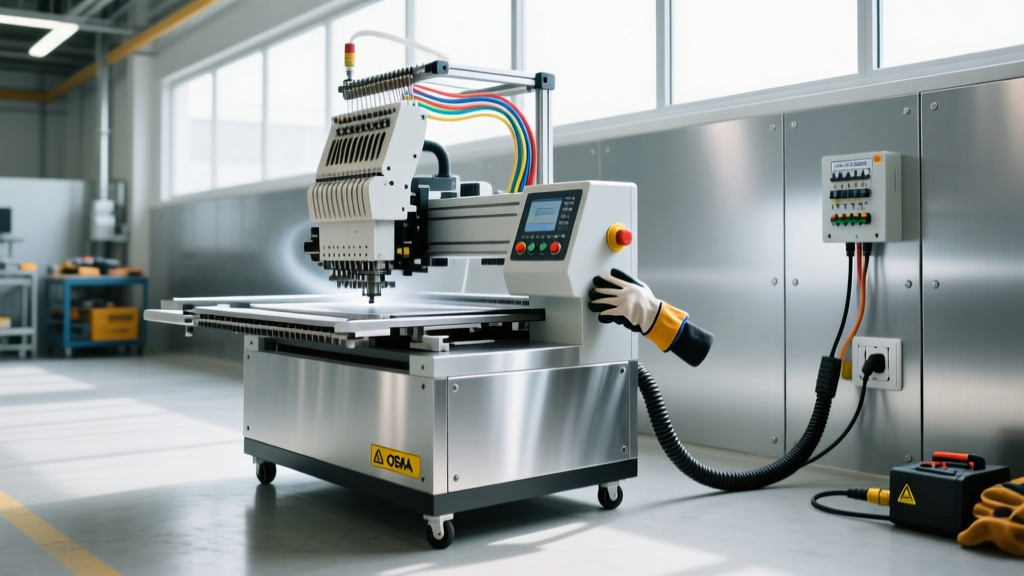
Mobile CNC embroidery machines, such as the Melco EMT16 Plus and Ricoma MT-1501, have migrated from climate-controlled commercial shops into mobile trailers, military forward operating bases, and outdoor event tents. Operating a 1,200-stitch-per-minute automated needle array in a temporary field environment introduces severe electrical, mechanical, and environmental compliance liabilities that standard shop-floor safety manuals completely ignore. When a portable CNC embroidery machine is deployed off-grid, site managers must bridge the gap between OSHA general industry standards and the realities of uncontrolled, temporary workspaces.
Electrical Compliance in Temporary Field Setups
The most critical failure point in field-deployed CNC embroidery equipment is power delivery. Standard shop environments provide stable, grid-tied 110V/220V power. Field operations rely on portable generators, which frequently violate NFPA 70 (National Electrical Code) Article 590 guidelines for temporary wiring if not properly managed. CNC embroidery logic boards and servo motors are highly sensitive to voltage spikes and harmonic distortion.
Using a standard open-frame contractor generator (which typically produces Total Harmonic Distortion, or THD, of 5% to 8%) will cause erratic pantograph movements and needle bar misfires. This creates an immediate laceration hazard for the operator and risks catastrophic damage to the machine's main servo driver, a component that costs between $1,200 and $1,800 to replace. For field compliance, only inverter generators producing a pure sine wave with a THD of less than 3% (such as the Honda EU2200i or Yamaha EF2200iS) are acceptable for powering portable embroidery heads.
⚠️ WARNING: Grounding and GFCI RequirementsUnder OSHA temporary wiring standards, all portable generators used for CNC textile equipment must be bonded to a grounding rod if they exceed 5kW, or utilize the manufacturer's bonded neutral setup for smaller units. Furthermore, because field environments often involve damp ground or morning condensation, a portable, weatherproof GFCI (Ground Fault Circuit Interrupter) inline protector rated for 20A must be installed between the generator and the machine's main power switch to prevent fatal shock hazards in wet grass or mud.
Mechanical & Needle Hazard Mitigation in Transit
A portable CNC embroidery machine weighs between 75 and 120 lbs (head only) and features a high-speed reciprocating needle bar and a free-floating X-Y pantograph table. Transporting these units over rough terrain without engaging mechanical transit locks results in severe internal misalignment and poses a crushing hazard during loading.
According to OSHA Standard 1910.212 regarding general requirements for all machines, moving parts must be guarded. In the confined space of a mobile merchandising trailer, the operator is often within 18 inches of the needle array. If the pantograph is not locked during transit, the sudden jolt of a trailer hitting a pothole can snap the X-axis drive belt or bend the precision linear rails, leading to unpredictable machine behavior upon the next startup.
| Phase | Action Item | Compliance / Safety Rationale |
|---|---|---|
| Pre-Transit | Engage X/Y axis transit locking screws | Prevents linear rail deformation and belt snapping over rough terrain. |
| Pre-Transit | Remove all needles and rotary hook covers | Eliminates vibration-induced needle fractures that become airborne projectiles. |
| Pre-Operation | Verify generator THD and inline GFCI test | Ensures clean power to servo motors; prevents shock in damp conditions. |
| Pre-Operation | Clear 36-inch operational perimeter | Meets OSHA clearance requirements for high-speed automated textile machinery. |
Environmental Controls: Lint, Static, and Thermal Limits
Textile CNC machines generate massive amounts of microscopic polyester and cotton lint. In a traditional shop, HVAC systems and industrial vacuums manage this. In a dry, windy field environment, lint accumulation inside the machine's rotary hook area and main logic board housing creates a severe fire hazard. The OSHA Combustible Dust National Emphasis Program highlights that fine particulate matter, when suspended or heavily concentrated near an ignition source, can ignite rapidly. Static electricity generated by synthetic threads moving at high speeds in low-humidity field conditions acts as the ignition source.
Fire Suppression for Mobile Textile CNCs
Water-based fire extinguishers are strictly prohibited near active CNC embroidery electronics. Mobile units must be equipped with a 5 lb. Clean Agent (Halotron or Halon alternative) fire extinguisher. This suppresses electrical and lint fires without destroying the machine's $4,000 mainboard. Additionally, operators must use anti-static thread lubricants (such as silicone-based cone oils) to reduce static buildup when operating in environments where relative humidity drops below 30%.
"The biggest mistake mobile event operators make is treating a CNC embroidery head like a standard sewing machine. A sewing machine stops when you take your foot off the pedal. A CNC embroidery machine operates on automated G-code logic; if a sensor fails due to field dust, the needle bar will continue to drive at 1,000 SPM into the operator's hand if the emergency stop circuit isn't properly grounded to the trailer chassis."
— Marcus Vance, Industrial Safety Compliance Officer, Mobile Manufacturing Systems
Ergonomic & Laser Safety in Uncontrolled Lighting
Modern portable CNC embroidery machines utilize Class 2 red or green laser diodes for cap and pocket alignment. In a dimly lit shop, these lasers are perfectly visible and safe. In bright outdoor sunlight or under high-lumen event tent lighting, operators often lean dangerously close to the needle array to see the laser crosshairs, bypassing the physical needle guard to get a better line of sight.
To maintain compliance and operator safety in high-ambient-light conditions, site managers must deploy localized, adjustable shade canopies over the machine head to reduce ambient lux to below 500, ensuring the alignment lasers remain visible without requiring the operator to breach the 6-inch safe distance zone from the reciprocating needles. Furthermore, operators must wear ANSI Z87.1 rated safety glasses with a slight tint to protect against accidental needle shrapnel, which can occur if the machine strikes a heavy metallic zipper pull or thick leather seam.
Decision Matrix: Field Power Supply Selection
Selecting the correct power supply is the foundation of field safety and machine longevity. Use the following matrix to determine the appropriate power generation setup based on your specific mobile deployment scenario.
Scenario A: Single-Head Mobile Trailer
Equipment: 1x Melco EMT16 Plus (approx. 4.5 Amps)
Recommended Power: 2200W Inverter Generator (Pure Sine Wave)
Safety Benefit: Low noise (53 dB), THD < 3%, lightweight for safe single-person loading. Eliminates logic board fry risks.
Scenario B: Multi-Head Event Tent
Equipment: 2x Ricoma 15-Needle Heads + Laptop + Lighting
Recommended Power: 7000W+ Dual-Voltage Inverter Generator with GFCI distribution block.
Safety Benefit: Prevents voltage sag when both machines start their main shaft motors simultaneously, which could cause thermal overload in temporary wiring.
Rapid Compliance Audit Summary
Before initiating any field-based CNC embroidery production, the site supervisor must verify the following non-negotiable parameters:
- Power Quality: Inverter generator confirmed (THD < 3%); inline 20A GFCI tested.
- Grounding: Trailer chassis or generator bonded to earth ground per NEC Article 590.
- Machine Guarding: Polycarbonate needle guards intact; transit locks fully disengaged before power-on.
- Fire Safety: 5 lb. Clean Agent extinguisher mounted within 10 feet of the operator station.
- Environmental: Ambient temperature verified between 41°F and 104°F (5°C - 40°C) to prevent servo overheating; anti-static thread oil applied.
Adhering to these specialized field protocols ensures that portable CNC embroidery operations remain both highly productive and strictly compliant with industrial safety standards, regardless of the deployment environment.