2026 Buyer's Guide: Multi-Function Plastic CNC Machine Mill-Turn
Compare top multi-function plastic CNC machines for milling and turning. Expert specs on spindles, tooling, and workholding for PEEK, Delrin, and PTFE.
The Engineering Paradox of Polymer Mill-Turn Machining
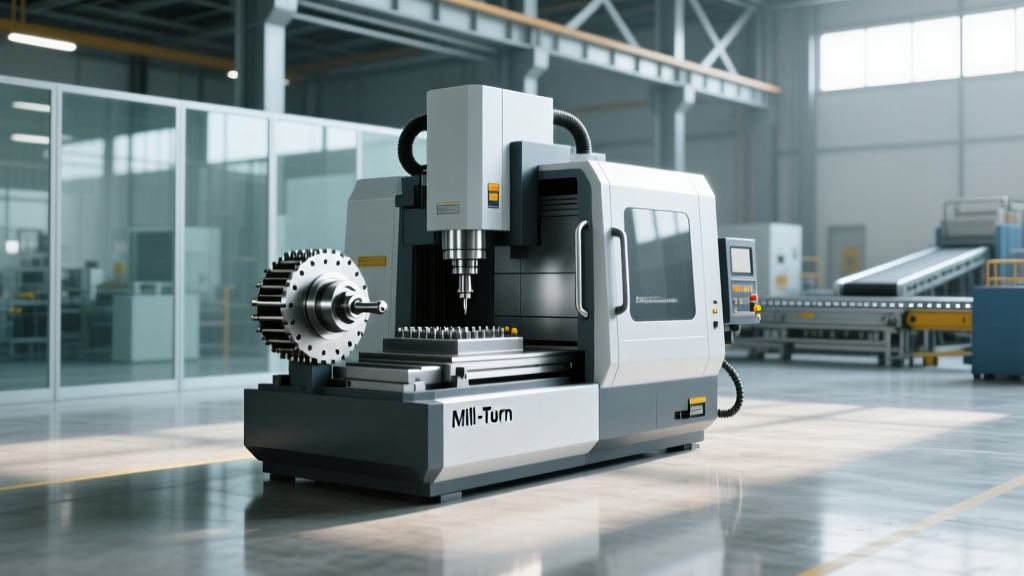
Machining engineering polymers on a multi-function CNC machine for milling and turning presents a unique mechanical paradox. Unlike steel or titanium, plastics possess low thermal conductivity, high coefficient of thermal expansion, and minimal structural rigidity. When a standard mill-turn center designed for ferrous metals attempts to machine PEEK, Delrin, or PTFE, the result is often catastrophic: melted chip welds, crushed workpieces, and severe dimensional instability due to thermal growth.
Selecting the right plastic CNC machine requires ignoring standard metal-cutting paradigms. A true polymer-optimized mill-turn center must prioritize ultra-high spindle speeds, low-pressure workholding, and specialized chip evacuation over raw torque and heavy-duty rigidity. This guide dissects the exact specifications, tooling requirements, and machine models necessary for high-volume plastic component manufacturing in 2026.
Information Gain: The primary cause of tolerance failure in plastic mill-turn operations is not tool deflection, but thermal expansion of the part itself. Polymers like Acetal (Delrin) expand up to 10 times more than aluminum under the same thermal load. High-speed spindles paired with air-blast cooling are mandatory to keep the cutting zone below the material's glass transition temperature.Critical Machine Specifications: Beyond Standard Metal Cutting
When evaluating a multi-function plastic CNC machine, the base configuration is rarely sufficient. You must specify options that cater to the high surface-feet-per-minute (SFM) requirements of polymers. According to Sandvik Coromant's polymer machining guidelines, achieving a clean shear cut rather than a tearing action requires significantly higher RPMs than metal cutting.
Spindle Speed and Live Tooling RPM
Standard turning spindles cap at 3,000 to 4,000 RPM, and standard live tooling (driven tools in the turret) often max out at 6,000 RPM. This is vastly insufficient for milling small-diameter features in plastics. For a 0.25-inch endmill cutting PEEK at 1,000 SFM, you need roughly 15,200 RPM. Therefore, any mill-turn center purchased for plastics must feature a High-Speed Spindle (HSS) option and high-RPM live tooling or a dedicated B-axis milling spindle capable of 12,000 to 20,000+ RPM.
| Polymer Material | Target SFM (Milling) | Required RPM (1/4" Tool) | Max Clamping Pressure |
|---|---|---|---|
| PEEK (Unfilled) | 800 - 1,200 | 12,000 - 18,000 | 150 - 200 PSI |
| Delrin (Acetal) | 1,000 - 1,500 | 15,000 - 22,000 | 100 - 150 PSI |
| PTFE (Teflon) | 300 - 500 | 4,500 - 7,500 | 30 - 50 PSI |
| UHMW-PE | 800 - 1,000 | 12,000 - 15,000 | 60 - 90 PSI |
Tooling Geometry and Workholding Strategies
The machine is only half the equation. A plastic CNC machine will still yield scrap if equipped with standard metal-cutting inserts and hydraulic chucks.
The "Melt and Mar" Prevention Protocol
- Tool Material: Avoid TiN or TiAlN coatings. These coatings increase friction and heat retention at the cutting edge. Specify uncoated micro-grain carbide with a mirror-polished flute surface. For high-volume PEEK or abrasive glass-filled nylon, CVD diamond-coated tooling is mandatory.
- Rake and Relief Angles: Plastics require aggressive positive rake angles (15° to 20°) to shear the material cleanly rather than plowing it. Relief angles must be increased to 10° to 15° to prevent the tool's flank from rubbing against the part's elastic recovery zone.
- Workholding: Standard hydraulic chucks operating at 300+ PSI will permanently deform PTFE and UHMW tubes. You must equip the machine's main and sub-spindles with pneumatic collet chucks featuring precision pressure regulators, allowing you to dial clamping force down to 30 PSI while maintaining grip via serrated or diamond-coated collet pads.
2026 Multi-Function Plastic CNC Machine Contenders
Based on current market availability, spindle options, and thermal stability, these three mill-turn platforms represent the top tier for polymer manufacturing.
1. Haas ST-15Y with High-Speed Spindle (HSS) Option
The Haas ST-15Y is a highly accessible Y-axis mill-turn center. To adapt it for plastics, you must select the 10,000 RPM HSS option and upgrade the live tooling to the 12,000 RPM package. It excels at secondary operations on pre-extruded plastic tubes and larger diameter PEEK aerospace fittings.
- Estimated Price: $165,000 - $185,000 (Fully equipped with pneumatic collet package)
- Best For: Mid-volume aerospace and automotive plastic manifolds.
- Limitation: The 10,000 RPM main spindle is still borderline for micro-milling features in Delrin; secondary operations may require careful toolpath optimization to avoid melting.
2. Tsugami BS20V-III Swiss-Type Mill-Turn
Swiss-type lathes are the undisputed champions of plastic medical components. The Tsugami BS20V-III offers a 20,000 RPM main spindle and 15,000 RPM live tooling. The guide bushing provides ultimate support for long, slender plastic shafts (like surgical guide wires or catheter components), eliminating deflection entirely.
- Estimated Price: $380,000 - $420,000
- Best For: High-volume, micro-tolerance medical implants and PEEK spinal components.
- Limitation: Requires bar stock preparation and strict chip management; stringy plastic chips can easily jam the guide bushing if not evacuated via high-pressure air.
3. DMG MORI NLX 2500 / 1250
For large-format, complex polymer parts requiring B-axis contouring, the NLX series offers unparalleled thermal stability. DMG MORI's integrated cooling systems prevent the machine bed from transferring ambient heat to the plastic workpiece, a critical factor when holding ±0.0005" tolerances on large PEEK insulator rings.
- Estimated Price: $290,000 - $340,000
- Best For: Complex, multi-axis semiconductor plastic components and large-format fluidic valves.
- Limitation: Overkill for simple, high-speed production of small bushings; the footprint and cycle-time overhead are better suited to complex, low-to-medium volume engineering plastics.
Coolant Strategy: Air Blast vs. Flood vs. MQL
As noted by Haas Automation's machining guidelines, thermal management in plastics is counter-intuitive. While flood coolant works for metals, it can cause thermal shock in certain polymers, leading to micro-cracking, or induce moisture absorption.
- Compressed Air Blast (Chilled): The gold standard for PTFE and UHMW. Using an air chiller to deliver 40°F air directly to the cutting zone keeps the polymer rigid and blows chips away without introducing liquids.
- Minimal Quantity Lubrication (MQL): Ideal for Delrin and Polycarbonate. A fine mist of vegetable-based or synthetic ester oil reduces friction on the tool's flank face without soaking the part.
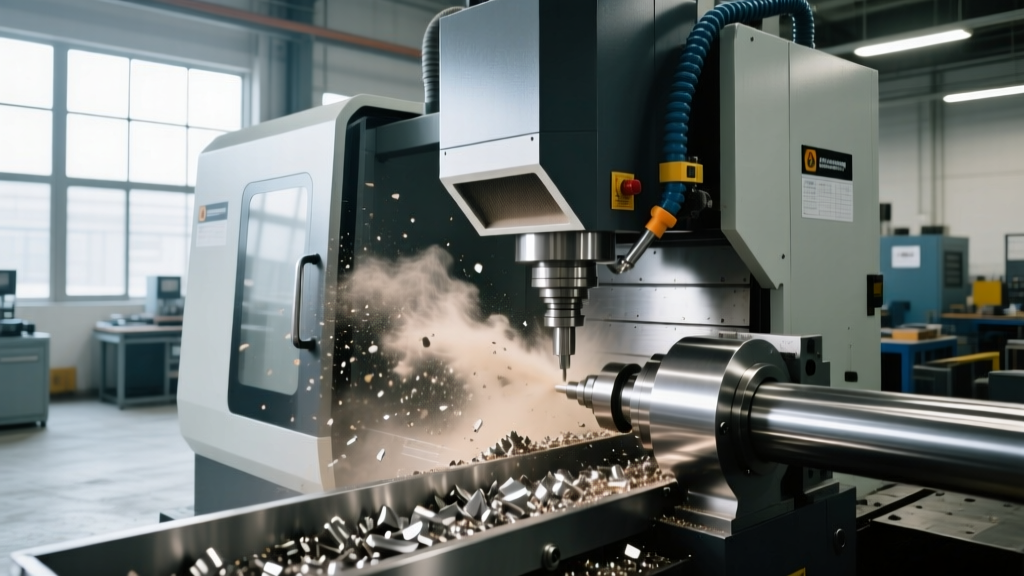
- Flood Coolant: Strictly reserved for heavily glass-filled or carbon-filled engineering plastics (e.g., 30% GF PEEK) where the abrasive filler generates extreme heat and tool wear, and the base resin is not hygroscopic.
ROI and Purchasing Decision Framework
Before issuing a purchase order for a multi-function plastic CNC machine, run your specific part geometry through this decision matrix:
The Mill-Turn Justification Test: If your plastic part requires milling flats, cross-drilling, or eccentric turning, and the lot size exceeds 500 pieces annually, a multi-function mill-turn center will reduce cycle times by 40-60% compared to moving the part from a lathe to a 3-axis VMC. However, if the part is strictly cylindrical with simple facing and boring, a standard 2-axis CNC lathe with a high-speed spindle is a more capital-efficient choice.
Investing in a plastic-optimized mill-turn center is an exercise in thermal and mechanical restraint. By prioritizing ultra-high RPM live tooling, low-pressure pneumatic workholding, and non-aqueous cooling systems, manufacturers can unlock the full profitability of engineering polymers, achieving aerospace and medical tolerances while eliminating the scrap rates that plague poorly configured shops.