Mill-Turn CNC Selection Guide for CNC Machined Auto Parts
Discover how to select multi-function mill-turn CNC machines for producing complex CNC machined auto parts. Compare specs, costs, and top models.
The Shift to Done-in-One Automotive Manufacturing
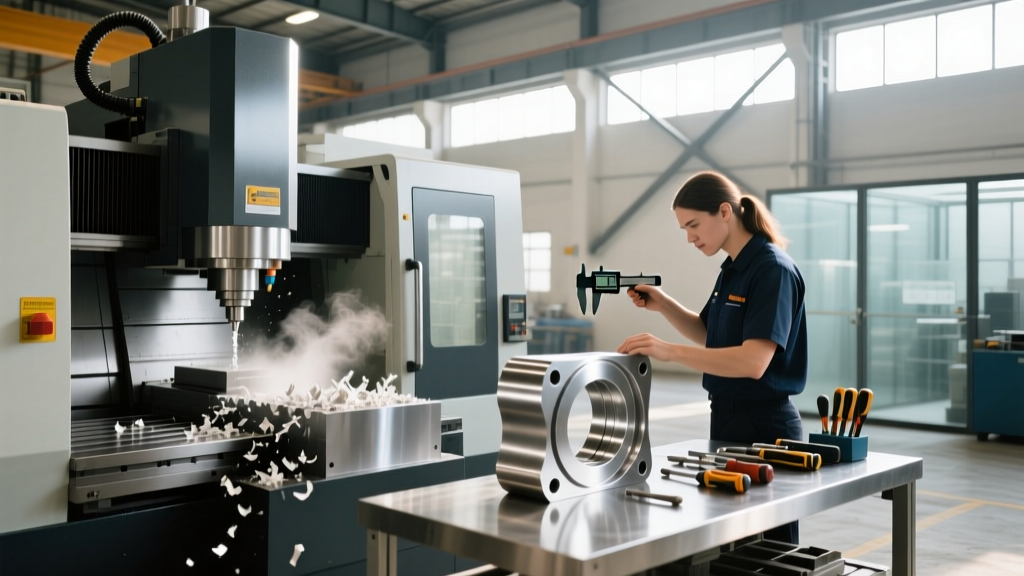
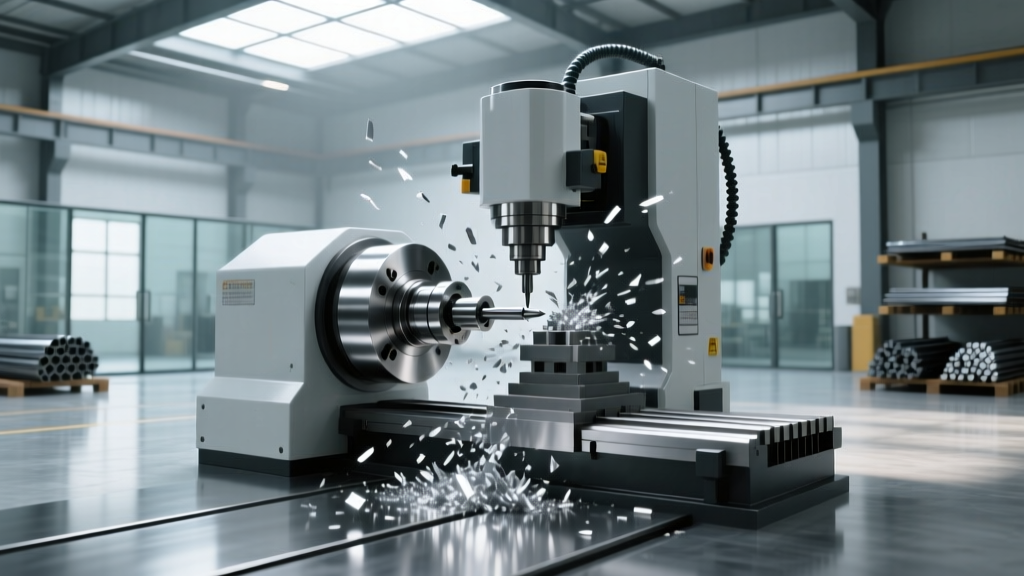
Producing high-precision cnc machined auto parts traditionally required a fragmented workflow: turning a blank on a lathe, moving it to a vertical machining center for milling, and then to a drill press or secondary fixture for cross-holes. This multi-setup approach introduces cumulative tolerances, extensive work-in-progress (WIP) inventory, and massive setup times. Multi-function mill-turn centers (CNC turning centers with live tooling, Y-axis, and B-axis capabilities) collapse these operations into a single chucking.
The 'Done-in-One' Economics
Transitioning a complex component like an aluminum steering knuckle from a 3-machine setup to a single mill-turn center reduces cumulative setup time from 45 minutes to under 10 minutes. More importantly, it eliminates inter-machine queuing and secondary fixturing errors, holding true position tolerances within 0.0005 inches across milled and turned features.
Mill-Turn Machine Comparison Matrix
When evaluating equipment for cnc machined auto parts, shop managers must balance work envelope, axis travel, and capital cost. Below is a 2026 baseline comparison of three dominant platforms frequently deployed in automotive tier-1 and tier-2 supply chains.
| Model Platform | Max Turning Dia. | Y-Axis Travel | Spindle RPM | Est. Base Price |
|---|---|---|---|---|
| Haas DS-30Y | 17.75 in | ±2.0 in | 4,000 | $185,000 |
| DMG MORI NTX 1000 | 17.3 in | ±4.7 in | 6,000 | $390,000 |
| Mazak INTEGREX i-200 | 26.0 in | ±10.2 in | 5,000 | $480,000 |
While the Haas DS-30Y offers an accessible entry point for smaller automotive brackets and sensor housings, the Mazak INTEGREX and DMG MORI NTX series provide the Y-axis travel and B-axis contouring required for deep, off-center features found in turbocharger housings and EV motor end-bells. For comprehensive specifications on these platforms, refer directly to the Mazak Multi-Tasking Machines catalog and the DMG MORI Turning Mill Centers lineup.
Axis Travel and Work Envelope Realities
Y-Axis: The Dealbreaker for Off-Center Features
Many buyers mistakenly prioritize maximum turning diameter over Y-axis travel. For cnc machined auto parts like transmission valve bodies or suspension uprights, milled features often sit far from the part's centerline. A restricted Y-axis (e.g., ±2.0 inches) forces the programmer to use C-axis spindle positioning and polar interpolation, which drastically increases cycle times and accelerates way wear. If your part portfolio includes components with off-center bosses or side-mounted fluid ports, mandate a minimum Y-axis travel of ±8.0 inches.
B-Axis Contouring vs. Indexing
For 5-axis simultaneous milling—such as machining the complex vanes of an automotive turbocharger impeller or the aerodynamic profiles of active aero suspension components—a fully contoured B-axis is mandatory. Indexing B-axes (which lock into position before cutting) are sufficient for simple cross-drilling and flat milling but will fail on compound-curvature automotive surfaces.
Workholding Edge Cases: Centrifugal Force and Thermal Growth
Warning: Chuck Jaw Lift-Off at High RPMWhen turning thin-walled aluminum auto housings (e.g., 6061-T6 EV battery enclosures), operators often push spindle speeds past 3,500 RPM to achieve fine surface finishes. At these speeds, centrifugal force causes standard hard chuck jaws to 'lift' outward, losing up to 60% of their gripping force. This results in part slippage and catastrophic tool crashes. Always specify counter-centrifugal chucks (such as the Kitagawa B-210 series or Rohm models) which use internal leverage mechanisms to maintain clamping force at high RPMs. Budget an additional $15,000 to $25,000 per machine for this critical upgrade.
Managing Thermal Growth in EV Motor Shafts
Electric vehicle motor rotors and shafts frequently exceed 600mm in length. During prolonged heavy milling and turning cycles, friction and ambient heat cause the workpiece to expand longitudinally. If supported by a rigid tailstock without pressure compensation, the shaft will bow, ruining concentricity. Modern mill-turn centers equipped with servo-driven tailstocks and automatic steady rests dynamically adjust clamping pressure to accommodate thermal expansion, a non-negotiable feature for EV drivetrain manufacturing.
Control Systems and Automation Integration
The CNC control dictates how efficiently your shop can program complex automotive geometries. The industry standard remains split between three primary ecosystems:
- Mazatrol SmoothAi: Highly favored for its conversational programming. Shop floor operators can program intricate cnc machined auto parts directly at the control without relying on offline CAM software, drastically reducing lead times for prototype automotive components.
- Siemens Sinumerik One: Offers superior kinematic transformation functions (TRAORI) for 5-axis simultaneous milling. It is the preferred choice for shops machining complex fluid dynamics components like supercharger rotors.
- Fanuc 31i-B5: The workhorse of high-volume production. While less intuitive for conversational programming, its look-ahead processing and servo-tuning algorithms provide unmatched surface finish consistency on long production runs of camshafts and gears.
Automation Readiness: To achieve true lights-out manufacturing for high-volume auto parts, the mill-turn center must be pre-wired for gantry loaders or articulated robots. Integrating a system like a Halter CNC Automation gantry adds roughly $70,000 to the project cost but enables uninterrupted weekend production, effectively lowering the per-part cost by 30% over a 24-month period.
ROI Framework: When to Justify the Capital Expense
Multi-function CNC machines represent a massive capital outlay. According to SME Machining Technologies industry benchmarks, the break-even point for a $500,000 mill-turn center versus a $150,000 lathe and $200,000 VMC combo depends entirely on batch sizes and part complexity.
- High-Volume, Low-Mix (10,000+ parts/year): Dedicated transfer lines or specialized Swiss-type lathes remain more cost-effective. Mill-turn centers cannot compete with the cycle times of dedicated mass-production tooling for simple fasteners or basic shafts.
- Mid-Volume, High-Mix (50 to 2,000 parts/batch): This is the sweet spot. For performance automotive components, heavy-duty commercial truck parts, and low-volume EV prototypes, the ability to drop a raw forging into one machine and pull out a finished, deburred part justifies the premium.
- Low-Volume, Extreme Complexity (1 to 50 parts/batch): Aerospace and motorsport auto parts (e.g., Formula 1 suspension components) demand mill-turn capabilities to maintain tight GD&T callouts across multiple datum shifts.
Ultimately, selecting the right multi-function CNC machine for cnc machined auto parts requires looking past the base price tag. Factor in the cost of counter-centrifugal workholding, high-pressure coolant pumps (minimum 1,000 PSI for chip evacuation in deep automotive bores), and automation interfaces. By aligning the machine's axis travel and control ecosystem with your specific automotive part portfolio, you secure a manufacturing asset that dominates both cycle time and geometric accuracy.