How to Make CNC Machine Selections: Multi-Function Mill-Turn Guide
Learn how to make CNC machine selections for multi-function mill-turn centers. Compare Mazak, DMG MORI, and Okuma models, pricing, and ROI metrics.
The Economics of Multi-Function Mill-Turn Machining
When precision manufacturing shops decide to make CNC machine upgrades from traditional 2-axis lathes and standalone vertical machining centers, the multi-function mill-turn center is often the target investment. These machines consolidate turning, 5-axis milling, deep-hole drilling, and synchronous tapping into a single chucking. The primary value proposition is not just cycle time reduction, but the elimination of cumulative tolerance stack-up that occurs when moving a part between multiple machines.
For aerospace, medical, and high-mix job shops operating in 2026, the barrier to entry remains high. Base machine prices range from $280,000 to over $600,000, excluding the mandatory peripheral investments in high-pressure coolant systems, specialized tooling, and advanced CAM software. This guide provides a technical and financial framework for selecting the right multi-function platform for your production environment.
Strategic Decision Framework: Is Mill-Turn Right for Your Shop?
Do not default to a mill-turn center simply for the sake of advanced capability. Use this threshold matrix to justify the capital expenditure:
- Setup Time Dominance: If your batch sizes require more than 4 hours of cumulative setup time across a lathe and a mill, a mill-turn center will yield a positive ROI within 18 months.
- Geometric Tolerance Requirements: If concentricity and true position tolerances between turned diameters and milled features are tighter than 0.0005 inches (12 microns), single-chucking is mandatory.
- Part Envelope: Ideal for parts with a length-to-diameter ratio between 1:1 and 4:1. Extremely long shafts still require dedicated turn-mill centers with steady rests and tailstocks.
- Volume Threshold: High-volume (10,000+ parts/year) simple components are better served by dedicated Swiss-type lathes or multi-spindle screw machines. Mill-turn centers excel in low-to-medium volume, high-complexity production.
Tier 1 Contenders: 2026 Market Snapshot & Specifications
The multi-tasking market is dominated by three primary OEMs, each offering distinct architectural advantages. Below is a deep dive into the current generation of mid-sized mill-turn centers that represent the highest volume of sales in the North American market.
1. Mazak Integrex i-250S ST
Mazak remains the market leader in multi-tasking terminology and adoption. The Integrex i-250S ST (equipped with a second spindle and lower turret) is the workhorse for shops machining complex hydraulic manifolds and aerospace landing gear components.
- Max Turning Diameter: 26.0 inches (660 mm)
- B-Axis Torque: 433 ft-lb continuous, utilizing a roller gear cam drive that eliminates backlash and provides superior contouring rigidity compared to traditional worm gear drives.
- Spindle Speed: 5,000 RPM main spindle (40 kW output).
- Estimated Base Price: $410,000 - $460,000 (depending on bar feeder and chip conveyor integration).
Expert Insight: Mazak's MAZATROL SmoothAi control significantly reduces programming time at the machine. However, shops relying heavily on offline CAM programming may find the post-processor customization for the lower turret slightly more demanding than competing platforms.
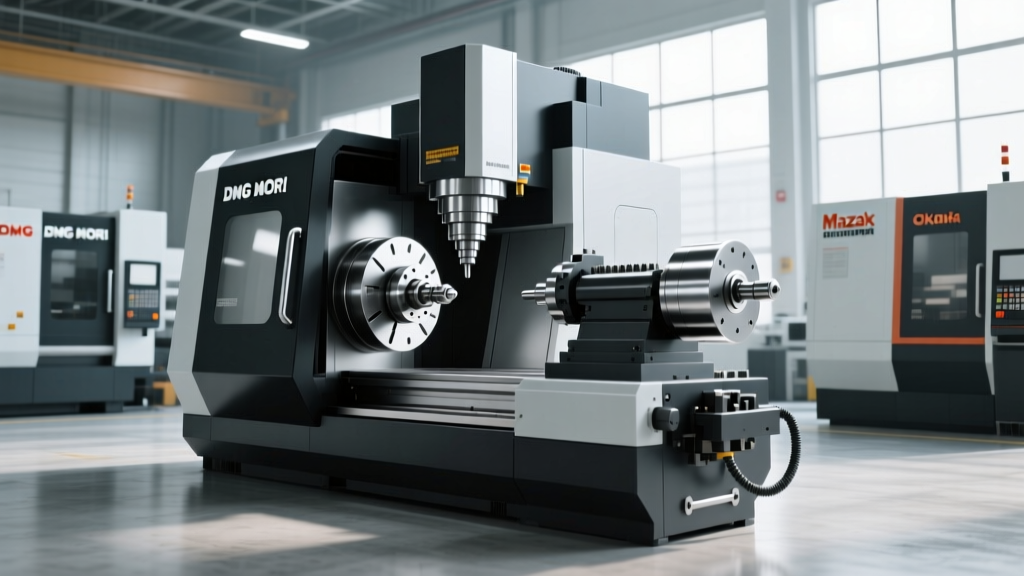
2. DMG MORI NTX 1000 2nd Generation
Targeting the medical and precision optics sectors, the NTX 1000 2nd Gen offers a highly compact footprint without sacrificing the Y-axis travel necessary for complex off-center milling. DMG MORI's focus on thermal stability makes this a top choice for lights-out manufacturing.
- Max Turning Diameter: 16.9 inches (430 mm)
- B-Axis Torque: 295 ft-lb, featuring direct-drive technology for ultra-smooth 5-axis simultaneous machining.
- Spindle Speed: 12,000 RPM (turn-mill spindle), ideal for micro-milling and small-diameter tapping in titanium and stainless alloys.
- Estimated Base Price: $315,000 - $360,000.
Expert Insight: The integration of the CELOS control system provides excellent CAD/CAM data management. According to DMG MORI's Turn & Mill portfolio data, the machine's integrated cooling systems mitigate thermal growth in the B-axis head, a common failure mode in competing brands during extended 5-axis milling cycles.
3. Okuma MULTUS U3000
Okuma approaches mill-turn from a heavy-duty turning perspective. The MULTUS U3000 is built for shops that need to take aggressive turning cuts while maintaining the ability to perform heavy milling operations on oil and gas valve bodies.
- Max Turning Diameter: 25.5 inches (650 mm)
- B-Axis Torque: 516 ft-lb, providing the highest continuous torque in this class for heavy-duty milling in Inconel and hardened steels.
- Spindle Speed: 4,200 RPM main spindle, prioritizing low-end torque over high RPM.
- Estimated Base Price: $485,000 - $550,000.
Expert Insight: Okuma's Thermo-Friendly Concept and OSP-P500A control actively compensate for thermal expansion in real-time. This machine is over-engineered for aluminum but unmatched for heavy ferrous and exotic alloy machining.
Technical Comparison Matrix
| Feature | Mazak Integrex i-250S ST | DMG MORI NTX 1000 2nd Gen | Okuma MULTUS U3000 |
|---|---|---|---|
| Y-Axis Travel | +/- 8.26 in | +/- 7.87 in | +/- 9.84 in |
| Tool Magazine | 72 Tools (Chain) | 48 Tools (Disc) | 40 Tools (Chain) |
| Footprint (L x W) | 236 x 98 in | 165 x 86 in | 248 x 104 in |
| Best Application | High-Mix Aerospace | Medical / Precision | Heavy Oil & Gas |
Hidden Costs: The True Price of Multi-Function Machining
When shops make CNC machine purchasing decisions based solely on the base hardware quote, they inevitably face budget overruns. A multi-function mill-turn center requires a specialized ecosystem to operate efficiently. Budget for the following mandatory additions:
1. Quick-Change Tooling Systems
Standard V-flange or BT toolholders are obsolete in mill-turn environments due to the lack of pull-stud retention in turning spindles and the need for automated tool changing. You must standardize on a quick-change system like Sandvik Coromant Capto (C5, C6, or C8 depending on machine size). Expect to spend $15,000 to $30,000 on initial Capto adapters, turning holders, and driven tooling just to populate the first 40 pockets of the magazine.
2. Advanced CAM Software & Post-Processors
Standard 3-axis milling and 2-axis turning CAM modules cannot handle B-axis contouring, lower turret synchronization, or spindle hand-offs. You will need a premium Mill-Turn module from providers like Mastercam, GibbsCAM, or hyperMILL. These modules typically cost between $12,000 and $18,000 per seat. Furthermore, custom post-processor generation and verification (using software like VERICUT or NCSIMUL to prevent catastrophic B-axis collisions) will add another $8,000 to $15,000 to your software stack.
3. High-Pressure Coolant (HPC) Integration
Machining exotic alloys like Ti-6Al-4V or Inconel 718 on a mill-turn center requires coolant pressures of 1,000 to 2,000 PSI to break chips and prevent built-up edge (BUE) on the cutting tool. Most OEMs charge $25,000 to $40,000 for the integrated HPC pump package. Do not attempt to retrofit an external pump later; the machine's internal rotary unions and B-axis coolant passages must be factory-sealed for high pressure.
Critical Warning: Collision Risks in Y-Axis Machining
The most common cause of catastrophic failure in new mill-turn operations is a Y-axis collision during lower turret operations. When the lower turret is engaged in Y-axis milling, the clearance between the main spindle chuck and the turret body is often less than 2 inches. Operators must implement strict software limits and utilize machine simulation before running any program that combines main spindle rotation with lower turret Y-axis translation.
Market Trends and ROI Justification
According to recent manufacturing technology shipments tracked by the Association for Manufacturing Technology (AMT), multi-axis and multi-tasking machines continue to capture a larger share of total capital equipment spending, even as overall machine tool consumption fluctuates. This indicates that shops are prioritizing capability and flexibility over raw volume capacity.
To justify the investment to stakeholders, focus your ROI calculation on the reduction of Work-In-Progress (WIP) and floor space. A single mill-turn center occupying 150 square feet replaces a CNC lathe, a 5-axis VMC, and the associated part-washing and inspection stations between operations. The reduction in WIP handling alone typically reclaims 20% to 30% of total lead time, a critical metric when quoting complex components in competitive bidding environments.
Final Selection Recommendations
If your shop primarily machines small, complex medical implants or aerospace fittings from bar stock under 2.5 inches in diameter, the DMG MORI NTX 1000 offers the best balance of high-RPM capability and thermal stability. For shops processing larger forgings, hydraulic blocks, and requiring aggressive material removal rates, the Okuma MULTUS U3000 provides the necessary mass and torque. The Mazak Integrex i-250S remains the safest, most versatile choice for general job shops that need a proven platform with widespread operator familiarity and robust local service networks. Review the Mazak Multi-Tasking portfolio and request a sample part time-study from your local distributor before issuing a purchase order.