Industrial vs Consumer CNC Sewing Machine Technical Specs
Compare industrial and consumer CNC sewing machine specifications, kinematics, motor types, and ROI metrics for automated textile manufacturing.
The Mechanics of Automated Stitching: Kinematic Differences
True CNC (Computer Numerical Control) sewing relies on programmable X-Y axis logic to execute complex stitch patterns with sub-millimeter precision. However, the term CNC sewing machine is frequently misapplied to consumer computerized embroidery modules. From an engineering perspective, industrial programmable pattern sewing machines and consumer computerized machines operate on fundamentally different kinematic architectures.
Core Kinematic Architecture
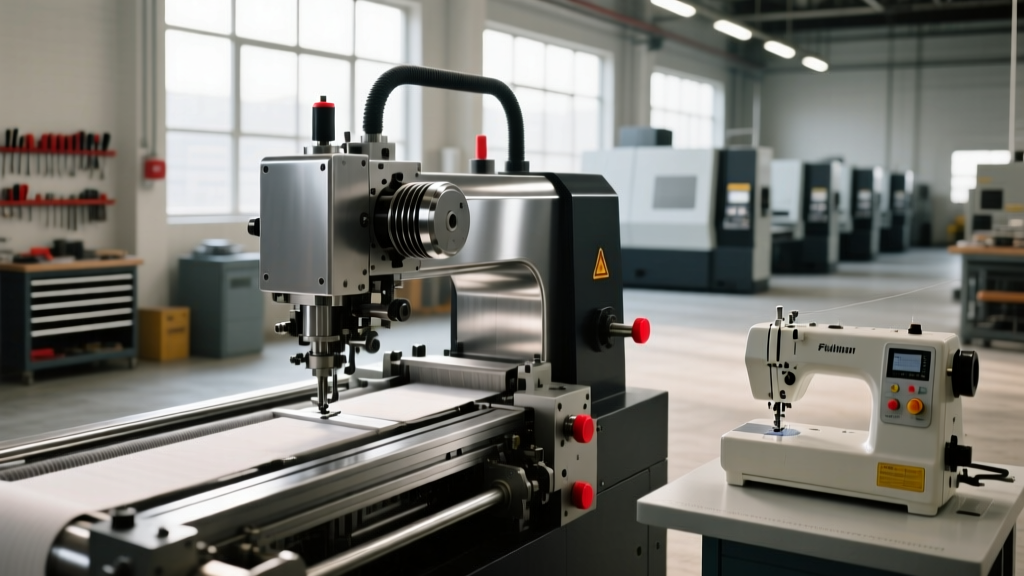
Industrial CNC (Clamp Feed): The needle bar remains static in the X-Y plane. The fabric is secured in a heavy-duty metal clamp mounted to a high-torque X-Y gantry. The gantry moves the material beneath the needle at speeds up to 3,000 stitches per minute (SPM). This eliminates fabric slippage and allows for sewing through dense, multi-layered materials like Kevlar webbing or automotive leather.
Consumer/Prosumer (Drop Feed): The machine relies on feed dogs (metal teeth beneath the presser foot) to pull the fabric. In embroidery modes, a lightweight plastic hoop is moved by low-torque stepper motors. The needle bar itself may also deflect slightly during high-speed directional changes, limiting precision on dense materials.
Industrial CNC Sewing Machines: Heavy-Duty Specifications
Industrial CNC sewing machines, such as the Juki AMS-210EN series or the Mitsubishi PLK-2616, are engineered for continuous 24/7 operation in automotive, aerospace, and heavy canvas manufacturing. These machines utilize advanced servo mechanics and active digital tensioning to maintain stitch integrity across varying material thicknesses.
Motor and Drive Systems
Modern industrial units utilize 550W to 750W AC Servo motors for the main shaft, coupled with independent X-Y axis stepper or servo drives. Unlike older clutch motors, these digital servos provide instant torque at 0 RPM, allowing the machine to start and stop precisely on a single stitch point without overshooting. The X-Y gantry is typically driven by reinforced timing belts or precision ball screws, ensuring zero backlash during sharp directional reversals.
Active Digital Thread Tension
One of the most critical advancements in 2026 industrial CNC sewing is active electronic thread tensioning. Machines like the Brother BAS-326G use solenoid-driven tension discs that adjust dynamically based on the X-Y travel speed. If the gantry decelerates for a tight corner radius, the tension automatically drops to prevent thread breakage, then increases during straight-line high-speed runs. According to Juki Industrial's technical documentation, this active compensation reduces thread breakage rates by up to 35% compared to mechanical dial tensioners.
Presser Foot Lift and Material Clearance
Industrial CNC machines feature a presser foot lift ranging from 17mm to 25mm. This massive clearance is required to accommodate 3D foam inserts, multi-layered ballistic nylon, or rigid plastic inserts used in tactical gear. The intermediate presser foot stroke is electronically adjustable from 0.5mm to 4.0mm, allowing the foot to 'float' just above the material surface to maintain clamping pressure without marring delicate top-grain leathers.
Consumer and Prosumer 'CNC' Sewing: Capabilities and Limits
Consumer computerized machines (e.g., Bernina B 790 PLUS or Janome Memory Craft 15000) blur the line between traditional sewing and CNC automation. While they feature computerized stitch regulation and embroidery modules, their technical specifications reveal strict limitations for industrial applications.
- Speed Limitations: Consumer embroidery modules max out between 800 and 1,000 SPM. Pushing beyond this causes excessive vibration, leading to needle deflection and skipped stitches.
- Motor Torque: The X-Y hoop carriages are driven by small DC or micro-stepper motors. They lack the holding torque required to pull heavy materials like canvas or denim through the needle zone, resulting in pattern distortion (often called 'flagging' in the industry).
- File Formats: Consumer machines rely on proprietary, closed-loop embroidery formats (.PES, .JEF, .DST). They cannot natively interpret standard G-code or DXF vectors without third-party CAM software translation, unlike industrial PLCs which integrate directly with factory ERP systems.
Technical Specification Matrix: Industrial vs. Consumer
The following matrix contrasts the exact engineering specifications of a standard industrial programmable pattern machine against a high-end consumer computerized embroidery machine.
| Specification | Industrial CNC (e.g., Juki AMS-210EN) | Consumer Prosumer (e.g., Bernina 790) |
|---|---|---|
| Max Sewing Speed | 3,000 SPM | 1,000 SPM (Embroidery) |
| X-Y Drive Mechanism | High-torque Servo / Ball Screw | Micro-stepper / Belt Drive |
| Material Feed System | Metal Clamp (Up to 150x100mm) | Plastic Snap Hoop |
| Thread Tension Control | Active Digital Solenoid | Electronic Dial / Mechanical |
| Presser Foot Lift | 17mm - 25mm | ~6mm - 8mm |
| Needle Bar Stroke | 36.4mm (Adjustable) | Fixed (~30mm) |
| Typical Capital Cost | $8,000 - $22,000+ | $2,500 - $8,000 |
Decision Framework: When to Upgrade to Industrial CNC
Determining whether to deploy an industrial CNC sewing machine requires analyzing throughput, material physics, and stitch compliance standards. For manufacturers adhering to ASTM D6193 standards for stitches and seams, consumer machines cannot guarantee the stitch density and tension uniformity required for load-bearing textiles.
Calculate the Cost-Per-Stitch Threshold
If your production volume exceeds 50,000 complex pattern cycles per month, the speed differential becomes the primary ROI driver. An industrial machine running at 2,800 SPM (factoring in acceleration/deceleration ramps) completes a 10,000-stitch automotive seat cover reinforcement pattern in approximately 3.5 minutes. A consumer machine, limited to 850 SPM and frequent thread trims, takes over 12 minutes. Over a standard 2,000-hour work year, the industrial unit yields a 340% increase in throughput, offsetting the $15,000 capital expenditure within 6 to 9 months.
Material Deflection and Edge Cases
Do not attempt to sew closed-cell foams, rigid thermoplastics, or Kevlar webbing on consumer drop-feed systems. The lack of a rigid X-Y clamp results in material shifting, causing needle strikes on the throat plate and catastrophic hook timing failures. Industrial CNC machines utilize specialized wiper mechanisms and heavy-duty rotary hooks (e.g., Hirose or KRT series) designed to withstand the lateral forces generated by dense synthetic fibers. As noted by Brother's industrial sewing division, utilizing commercial-grade rotary hooks in automated environments reduces hook replacement cycles from monthly to annually.
Software and CAM Integration
Industrial CNC sewing requires specialized CAM software (such as Juki PM-1 or Epson PS3000) to translate DXF vector files into machine-readable stitch data, accounting for thread thickness, material compression, and corner pull compensation. If your facility already utilizes CAD for laser cutting or CNC routing, integrating an industrial sewing CAM pipeline creates a seamless digital thread from design to final assembly, a capability entirely absent in consumer-grade ecosystems.