Large CNC Machine Maintenance: Aluminum Milling Service Schedule
Optimize your large CNC machine for aluminum machining with this detailed maintenance schedule. Prevent chip buildup, coolant issues, and spindle wear.
Machining aerospace and automotive-grade aluminum (such as 6061-T6 and 7075-T6) on a large CNC machine introduces unique mechanical and chemical stressors that standard factory maintenance schedules fail to address. While aluminum is generally considered a 'free-machining' material, its tendency to produce long, stringy chips and its high thermal conductivity demand specialized preventive care. When operating large-format vertical machining centers (VMCs) or gantry mills with 40-inch to 80-inch X-axis travels, the volume of chips and coolant required amplifies these maintenance challenges exponentially.
This guide provides a comprehensive, actionable maintenance and service schedule specifically engineered for large CNC machines dedicated to high-volume aluminum milling operations.
The Aluminum Wear Profile: Why Standard Schedules Fail
Standard OEM maintenance manuals are typically written for mixed-material job shops. When a large CNC machine is dedicated to aluminum, three specific failure modes accelerate:
- Way Cover Infiltration: Stringy aluminum chips easily bypass standard wipers, nesting under telescopic way covers and scoring the linear guideways.
- Coolant Degradation: Aluminum fines react with water-based coolants, altering the pH and promoting bacterial growth, which leads to rancidity and corrosion of the machine's cast iron base.
- Spindle Taper Lapping: Microscopic aluminum particles suspended in dried coolant residue act as a lapping compound inside the BT40, BT50, or HSK63 spindle taper, causing toolholder pullout and vibration.
Shift-Level Protocols: Chip and Fluid Management
On a large CNC machine, the sheer volume of material removed during aluminum roughing (often exceeding 1,000 cubic inches per hour) requires aggressive shift-based interventions.
End-of-Shift Checklist
- High-Pressure Flush: Use a minimum 100 PSI washdown gun to clear chip堆积 (accumulation) from the saddle and way cover bellows. Never use compressed air, as it drives abrasive aluminum fines into the way cover seals.
- Skimmer Verification: Ensure the belt or disk tramp oil skimmer is actively deploying. Aluminum machining requires high concentrations of synthetic or semi-synthetic coolant, which is highly susceptible to tramp oil contamination from way lube.
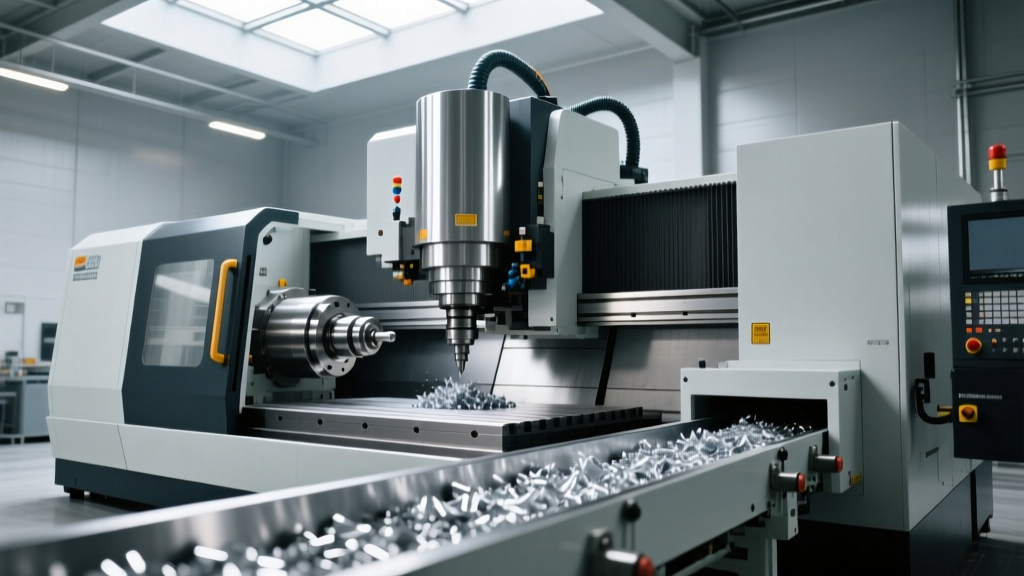
- Conveyor Auger Check: Inspect the chip conveyor. Hinge-belt conveyors frequently jam with stringy aluminum. If your large CNC machine uses a hinge belt, manually clear the bird-nesting at the discharge chute every 4 hours.
Weekly Coolant System Deep-Dives
Aluminum requires specific coolant chemistry to prevent chemical pitting on the machine table and to ensure optimal surface finishes on the workpiece. The Sandvik Coromant aluminum machining guidelines emphasize that inadequate lubricity leads to severe BUE and accelerated tool wear.
| Coolant Parameter | Target Range for Aluminum | Corrective Action if Out of Spec |
|---|---|---|
| Concentration (Refractometer) | 8.0% - 12.0% | Add specific synthetic concentrate; do not use straight water to top off. |
| pH Level | 8.8 - 9.2 | If below 8.5, add pH increaser immediately to prevent aluminum oxidation. |
| Tramp Oil Content | < 2.0% | Run skimmer continuously; deploy a portable coalescer if above 3%. |
| Water Hardness | 50 - 150 ppm | Use DI (Deionized) water for mixing if local water exceeds 200 ppm. |
Pro Tip: For heavy roughing of 7075-T6, push concentration to 11-12% to maximize boundary lubrication and prevent chip welding in deep pocketing operations.
Monthly Way Cover and Wiper Preservation
The telescopic way covers on a large CNC machine represent a massive replacement cost—often between $8,000 and $15,000 per axis. Aluminum chips are notoriously sharp and work-harden quickly, turning into miniature blades that slice through standard polyurethane wipers.
Wiper Upgrade Strategy
If your machine is dedicated to aluminum, replace the OEM rubber wipers with brass-impregnated polyurethane or specialized aluminum-grade scraper wipers. These materials resist cutting by work-hardened aluminum chips.
When inspecting way covers, look for 'micro-tracking'—tiny parallel scratches on the stainless steel cover plates. This indicates that chips are being dragged under the wipers. Adjust the wiper tension or replace the wiper element immediately to prevent linear guide rail scoring.
Quarterly Spindle Taper and Toolholder Servicing
Spindle maintenance on large CNC machines used for aluminum must go beyond standard wiping. The combination of mist coolant and aluminum fines creates a stubborn, abrasive paste.
- Chemical Cleaning: Use a specialized spindle taper cleaning tool wrapped in a lint-free swab saturated with 99% isopropyl alcohol. Never use standard shop rags, which leave lint that traps aluminum particles.
- Toolholder Inspection: Inspect the pull-studs and toolholder flanges. Discard any toolholder showing fretting corrosion or micro-pitting on the taper surface.
- Drawbar Force Verification: Use a calibrated drawbar force gauge. For a standard CAT50 taper, the retention force should be between 2,500 and 3,500 lbs. A drop below 2,000 lbs in an aluminum-milling machine often indicates belleville washer fatigue accelerated by high-frequency tool changes.
Annual Geometric and Volumetric Calibration
Large CNC machines are highly susceptible to thermal growth and geometric shift, especially when running high-speed aluminum toolpaths that generate significant localized heat. Annual verification is non-negotiable for aerospace tolerances.
According to Renishaw's machine calibration protocols, utilizing a telescoping ballbar system allows operators to map circular interpolation errors in under 15 minutes.
Key Annual Tests
- Ballbar Testing (QC20-W or equivalent): Test circularity in the XY, XZ, and YZ planes. Look specifically for stick-slip errors, which indicate way lube distribution failures or linear guide contamination from aluminum fines.
- Spindle Thermal Growth Test: Run the spindle at 10,000 RPM for 45 minutes with a displacement sensor on the Z-axis. Acceptable Z-axis thermal growth for a high-performance large VMC is typically under 0.0008 inches (20 microns).
- Volumetric Laser Interferometry: For 5-axis large CNC machines machining aerospace aluminum structural components, annual volumetric compensation using a laser tracker is required to maintain true position tolerances across the massive work envelope.
Cost of Neglect: Downtime vs. Preventive Investment
Failing to adapt your maintenance schedule to the realities of aluminum machining on large-format equipment results in compounding financial losses. Below is a breakdown of preventive costs versus reactive repair costs based on current 2026 industrial service rates.
| Component / System | Preventive Maintenance Cost (Annual) | Reactive Repair / Replacement Cost | Typical Downtime |
|---|---|---|---|
| Telescopic Way Cover (X-Axis) | $450 (Wiper replacements & tensioning) | $12,500 (Full cover rebuild) | 3-5 Days |
| Spindle Assembly (15k RPM) | $300 (Taper cleaning & drawbar checks) | $38,000 (OEM Spindle replacement) | 4-6 Weeks |
| Coolant System | $1,200 (Fluid, skimmer media, filters) | $6,500 (System flush, pump replacement, casting corrosion repair) | 2-3 Days |
| Chip Conveyor | $200 (Belt tensioning, hinge pin lube) | $4,800 (Motor and belt replacement due to jamming) | 1-2 Days |
By strictly adhering to an aluminum-specific maintenance matrix, shops operating large CNC machines can easily avoid over $60,000 in unplanned capital repairs and hundreds of hours of lost spindle time annually. The key is recognizing that aluminum is not a 'clean' material; it is an abrasive, reactive medium that requires vigilant, targeted mechanical and chemical management.