Safety Compliance for Italian CNC Machine Automatic Tool Changers
Explore CE and ISO safety compliance for Italian CNC machine ATC systems, covering interlock requirements, guarding standards, and failure modes.
Regulatory Framework Governing Italian CNC ATC Systems
Italian CNC machine builders—renowned for engineering complex 5-axis bridge mills, gantry routers, and high-speed machining centres—integrate Automatic Tool Changer (ATC) systems that operate under extreme kinetic loads. When an HSK-A100 tool assembly weighing 25 kg is exchanged at 12,000 RPM, the potential for catastrophic projectile ejection is severe. Consequently, the safety compliance of an Italian CNC machine ATC is not merely a design preference; it is a rigid constraint dictated by European harmonized standards.
The foundational baseline for these systems is the Machinery Directive (currently transitioning to the new EU Machinery Regulation). For milling and machining centres, compliance hinges on ISO 16089 (Machine tools - Safety - Milling) and EN 12417 (Machining centres). These standards dictate the exact parameters for guarding, interlock logic, and tool retention verification that Italian manufacturers must embed into their PLC architectures.
⚠️ Regulatory Transition Warning: The EU Machinery Regulation (2023/1230) officially applies from January 2026. Under the new framework, ATC systems on high-speed Italian CNC machines that utilize AI-driven predictive tool clamping or adaptive collision avoidance are now classified under Annex I "high-risk" categories, requiring mandatory third-party Notified Body assessment rather than self-certification for CE marking.Tool Retention Mechanics and ISO 13849-1 Compliance
The physical retention of the toolholder is the primary safety-critical function of the ATC. Italian 5-axis machines heavily favor HSK (Hohl-Schaft-Kegel) interfaces due to their superior radial accuracy and dual-contact face/taper clamping. The clamping force is generated by a mechanical stack of Belleville spring washers housed inside the spindle drawbar, typically delivering 18 kN to 25 kN of retention force for an HSK-A63 interface.
Unclamping requires overcoming this spring force via a pneumatic or hydraulic cylinder. This creates a critical safety edge case: what happens during a total facility power loss? Compliant Italian spindle designs utilize a "spring-applied, pneumatically-released" architecture. If plant air pressure drops below 4.5 bar, the tool remains mechanically locked. However, the control logic monitoring this state must comply with ISO 13849-1 Performance Level d (PLd) or Category 3.
The "Half-Clamp" Sensor Requirement
A common failure mode in aging ATC matrices is the accumulation of swarf or coolant residue on the retention knob, preventing the drawbar from pulling the tool fully into the spindle taper. To mitigate this, compliant systems employ dual inductive proximity sensors to verify the retention knob gap. If the gap exceeds 0.2mm, the safety PLC must halt the spindle drive within 40 milliseconds, preventing the tool from ejecting under centrifugal force.
| ATC Safety Component | ISO / EN Standard Requirement | Common Failure Mode & Edge Case |
|---|---|---|
| Drawbar Belleville Springs | ISO 16089: Must maintain >80% nominal clamping force after 2 million cycles. | Spring fatigue and micro-fractures causing sudden loss of kN force during high-speed roughing. |
| Pneumatic Unclamp Valve | ISO 13849-1: Category 3 redundant valve architecture required. | Valve stiction from degraded air line oil, resulting in a half-clamped tool state. |
| Tool Presence Proximity Sensors | EN 12417: Dual-channel verification of tool seating with <50ms response. | Sensor fouling by high-pressure coolant mist causing false-positive "tool seated" signals. |
| Spindle Orientation Lock | ISO 16089: Mechanical or electronic spindle lock before ATC arm engagement. | Encoder drift causing the ATC arm to strike the drive keys, shearing the retention knob. |
Guarding and Containment: Stopping High-Velocity Projectiles
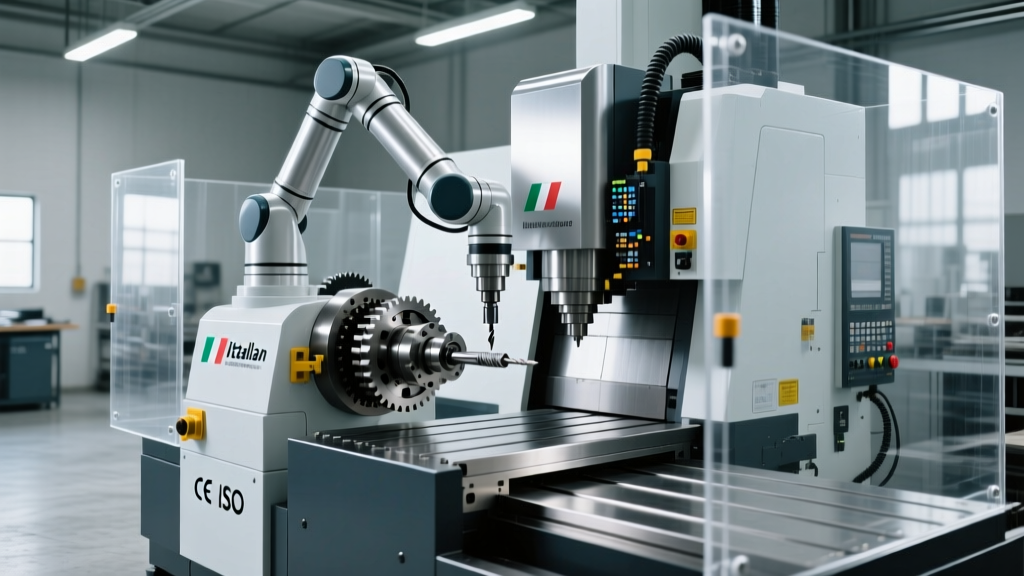
Italian gantry mills and bridge-type machining centres often feature large, open work envelopes where the ATC matrix is mounted directly to the moving bridge. The guarding enclosing these ATC units must withstand specific kinetic energy impacts defined by the spindle's maximum RPM and the mass of the heaviest permissible tool.
Standard 3mm polycarbonate is entirely insufficient for modern high-speed Italian CNC machines. The industry standard for ATC containment is 12mm to 15mm thick mar-resistant polycarbonate (such as Lexan Margard) or PETG, backed by a 2mm steel mesh cage. According to UK HSE machinery guarding guidelines and EN 12417 Annex C, the guarding must absorb the impact energy of the heaviest tool assembly breaking off at the spindle's maximum rated speed without shattering or permanently deforming past the mesh backing.
Coolant-Induced Polycarbonate Degradation
A non-obvious compliance risk specific to Italian machines utilizing 70-bar Through-Spindle Coolant (TSC) is chemical degradation. High-pressure coolant mist, particularly those containing synthetic esters and extreme pressure (EP) additives, causes micro-crazing in polycarbonate ATC guards. Safety auditors must measure guard transparency and surface crazing annually. If crazing exceeds 5% of the surface area, the impact resistance drops by up to 60%, necessitating immediate replacement. A custom-molded 12mm polycarbonate ATC hood for a standard Italian 5-axis machine typically costs between $2,800 and $4,500, excluding labor.
Pneumatic Circuit Redundancy and PLC Logic
The ATC arm swing and tool unclamping sequences are driven by pneumatic actuators. To meet CE compliance, the pneumatic circuit cannot rely on a single directional control valve. Italian OEMs integrate soft-start/dump valves with redundant exhaust pathways. If the E-stop is triggered, the soft-start valve immediately dumps the air pressure from the ATC arm swing cylinder, preventing the arm from completing its arc and colliding with the spindle or operator.
"The transition to the 2026 EU Machinery Regulation means that Italian CNC builders can no longer rely solely on self-declaration for complex, high-speed ATC systems. The integration of automated tool breakage detection and adaptive clamping force monitoring pushes these subsystems into Annex I, requiring rigorous Notified Body validation of the safety PLC logic."
— European Commission Machinery Sector Overview, Single Market Economy Portal.
Actionable Compliance Audit Checklist for Safety Officers
Maintenance managers and safety officers auditing an Italian CNC machine ATC must move beyond visual inspections and verify quantitative safety metrics. Use the following framework during your annual compliance audit:
- Drawbar Force Verification: Use a calibrated drawbar force gauge (e.g., Parlec or equivalent) to measure HSK retention force. An HSK-A63 must read between 18,000 N and 25,000 N. If force is below 16,000 N, the Belleville spring stack must be replaced immediately.
- Interlock Response Timing: Trigger the E-stop during an active tool change. Measure the time from E-stop actuation to the physical halting of the ATC arm cylinder. This must be under 50 milliseconds.
- Guarding Integrity Check: Inspect the 12mm polycarbonate ATC enclosure with a UV flashlight to detect early-stage micro-crazing from coolant exposure. Check that all door interlocks (Schmersal or Pilz rated) possess Category 4 / PLe RFID coded actuators, not simple mechanical tongue switches which can be defeated.
- Tool Magazine Pocket Sensors: Verify that the "pocket empty" and "tool present" optical sensors are free of oil film. A false "pocket empty" reading can cause the ATC to attempt to load a second tool into an occupied pocket, resulting in a catastrophic arm crash.
- Spindle Orientation Tolerance: Command a tool change and measure the spindle orientation deviation. It must be within ±0.05 degrees. Deviations beyond this indicate a failing spindle encoder or degraded orientation brake, risking drive-key shearing.
Ensuring the safety compliance of an Italian CNC machine ATC requires a synthesis of mechanical precision, pneumatic redundancy, and rigorous adherence to evolving European directives. By focusing on the specific failure modes of drawbar mechanics, guarding degradation, and PLC interlock timing, facilities can maintain both operational uptime and absolute operator safety.