Biggest CNC Machine Enclosure & Coolant System Troubleshooting Guide
Diagnose and repair enclosure seal failures and high-volume coolant leaks on the biggest CNC machine gantry mills and horizontal boring mills.
Scale Dynamics: Why the Biggest CNC Machine Models Fail Differently
When maintaining the biggest CNC machine platforms—such as 15-meter 5-axis gantry mills, massive horizontal boring mills (HBMs), or large-format aerospace routers—standard vertical machining center (VMC) maintenance playbooks are insufficient. The sheer scale of a 2,500-gallon coolant reservoir and 40-foot multi-panel enclosures introduces unique fluid dynamics, structural harmonics, and chip-management challenges.
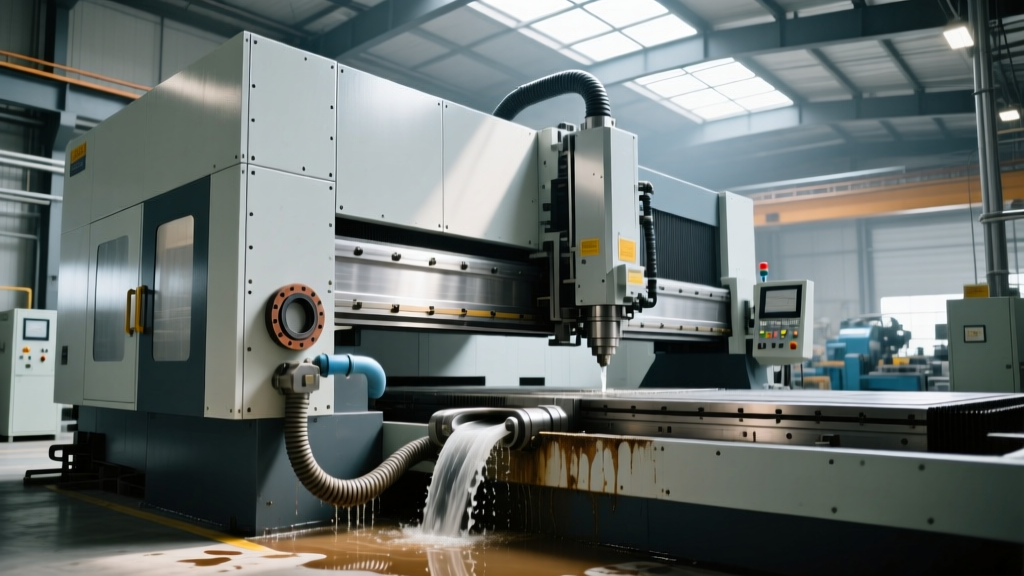
On a standard VMC, a coolant leak means a puddle on the floor. On a massive Waldrich Siegen PowerTec or Ingersoll gantry mill, a seal failure can dump 400 gallons of synthetic fluid into the foundation trench in minutes, while structural vibration on large enclosure panels can shatter standard safety glass. This guide provides advanced troubleshooting frameworks specifically engineered for the enclosure and coolant systems of heavy-duty, large-format CNC equipment.
High-Volume Coolant System Diagnostics
The biggest CNC machine models rely on high-pressure, high-volume coolant delivery to manage the extreme heat generated by heavy roughing cuts in titanium and Inconel. These systems typically utilize a 30-to-50 HP centrifugal flood pump paired with a 1,000 PSI through-spindle coolant (TSC) intensifier.
According to Sandvik Coromant's machining guidelines, high-pressure coolant application requires precise nozzle alignment and uninterrupted flow to prevent thermal shock to the cutting edge. When flow drops on a massive machine, the root cause is rarely a clogged nozzle; it is almost always a systemic pressure loss in the delivery infrastructure.
Diagnostic Flowchart: TSC Pressure Drops
Step 1: Check the Intensifier Accumulator
Large-format machines use nitrogen-charged accumulators to smooth out pressure spikes. If the TSC pressure fluctuates between 800 and 1,200 PSI on the gauge, the accumulator bladder has likely ruptured. Fix: Replace the 2.5-gallon bladder assembly ($1,800 - $2,400).
Step 2: Inspect for Centrifugal Cavitation
If the main flood pump sounds like it is pumping gravel, cavitation is occurring. On massive sumps, the Net Positive Suction Head (NPSH) drops if the suction strainer is choked by fine aerospace dust. Fix: Install a self-cleaning wedge-wire strainer with a 50-micron rating to replace standard basket strainers.
Step 3: Evaluate Fluid Degradation
The NIOSH guidelines on metalworking fluids emphasize that large, open sumps are highly susceptible to tramp oil contamination and bacterial growth, which alters the fluid's viscosity and destroys pump seals. Fix: Deploy a 100 GPM centrifugal tramp oil separator and maintain a pH between 8.8 and 9.2.
Coolant System Anomaly Matrix
| Symptom | Measurement / Threshold | Root Cause on Large Sumps | Targeted Repair |
|---|---|---|---|
| Flood pump motor overheating | Motor temp > 140°F (60°C) | Specific gravity increase due to tramp oil saturation causing amp draw spikes. | Skim sump, adjust concentration to 8-10%, install automated dosing. |
| TSC union leaking at spindle | Leak rate > 2 oz/min | Thermal expansion of the 15-foot Z-axis ram misaligning the ceramic union seal. | Replace with self-aligning spring-loaded carbide seal rings ($3,200). |
| Coolant pooling in chip trench | Sump level dropping 5 gal/hr | Chip conveyor flight chain stretching, causing scrapers to miss the trench floor. | Adjust chain take-ups; replace UHMW wear strips ($850 per 10ft section). |
Enclosure Structural Fatigue and Seal Degradation
The enclosures of the biggest CNC machines are essentially industrial buildings. A 12-meter long gantry mill enclosure features sliding doors that can weigh over 1,500 lbs each. The primary failure modes here are not simple sheet metal tears, but rather structural fatigue, guideway misalignment, and safety interlock failures.
Managing Vibration-Induced Fastener Backing
Heavy roughing cuts on large HBMs generate low-frequency, high-amplitude vibrations. Standard sheet metal screws and rivets on enclosure panels will back out within 60 days of heavy operation.
The Fix: Audit all enclosure panel joints. Replace standard rivets with structural blind rivets (e.g., Avdel Avex) and apply a medium-strength threadlocker (Loctite 243) to all M8 and M10 panel bolts. For panels that resonate audibly, apply constrained-layer damping (CLD) mats to the interior sheet metal to shift the harmonic frequency and prevent fatigue cracking.
Heavy Door Track and Interlock Failures
OSHA's general machine guarding requirements (1910.212) mandate that movable guards be securely interlocked. On massive gantry mills, the sheer weight of the doors causes the V-track wheels to deform, leading to misalignment that triggers false 'door open' fault codes via the safety PLC.
- Wheel Deformation: Replace standard polyurethane wheels with forged steel V-groove wheels rated for 2,000 lbs dynamic load.
- Interlock Misalignment: Replace mechanical limit switches with RFID-coded safety sensors (e.g., Schmersal AZM400). RFID sensors tolerate up to 8mm of door sag without dropping the safety circuit, eliminating nuisance faults caused by heavy door deflection.
- Window Crazing: Standard polycarbonate turns opaque and brittle when exposed to synthetic coolants. Upgrade to 15mm laminated polycarbonate with a chemical-resistant PETG outer layer. Expect to pay $5,500 to $8,000 per large-format window replacement.
Telescopic Way Cover & Bellow Catastrophes
The most critical enclosure component on any large-format CNC is the telescopic steel way cover protecting the X and Y-axis linear guideways. On a machine with a 12-meter travel, these covers can extend over 8 meters. When machining stringy materials like titanium, chips wrap around the wiper seals, get pulled into the overlapping steel boxes, and eventually jam the cover mechanism.
When a massive way cover jams, the servo motor will fault, but if the machine is in rapid traverse, the cover can buckle, causing $40,000+ in damage to the linear rails and ball screws.
Preventative Maintenance for Mega-Covers
- Upgrade Wiper Durometer: Standard 60 Shore A rubber wipers tear under heavy chip loads. Upgrade to 85 Shore A polyurethane wipers with integrated brass scrapers to aggressively clear stringy chips before they enter the cover overlap.
- Install Air Purge Systems: Retrofit the way covers with a low-pressure (15 PSI) continuous air purge system. By maintaining positive air pressure inside the telescopic boxes, fine graphite or cast iron dust is physically blown out of the labyrinth seals.
- Check Synchronization Cables: Large covers use internal nylon pull-cables to synchronize the extension of each steel box. Inspect these cables every 500 hours for fraying. A snapped synchronization cable will cause the cover boxes to stack unevenly and bind.
Summary: Upgrading for Scale
Troubleshooting the biggest CNC machine models requires shifting your perspective from component-level repairs to systems-level engineering. Coolant systems must be treated as industrial fluid processing plants, requiring advanced filtration and NPSH management. Enclosures must be treated as dynamic structures subject to harmonic fatigue and massive kinetic loads. By upgrading to heavy-duty structural hardware, RFID-tolerant safety interlocks, and self-cleaning fluid management systems, maintenance teams can drastically reduce the catastrophic downtime associated with large-format manufacturing equipment.