Industrial CNC vs Raspberry Pi CNC Machine: Technical Architecture
Compare industrial CNC controllers with a Raspberry Pi CNC machine setup. Explore technical specs, servo vs stepper motors, and rigidity limits.
The Controller Divide: Real-Time OS vs. General Purpose Linux
When engineering a custom manufacturing setup, the controller architecture dictates the absolute ceiling of precision and reliability. For builders configuring a CNC machine, Raspberry Pi single-board computers (specifically the Pi 4 and Pi 5 models) offer an accessible entry point into computer numerical control. However, comparing a Pi-based controller to an industrial PLC reveals fundamental differences in how motion commands are processed.
A Raspberry Pi runs a general-purpose operating system (typically Raspberry Pi OS, a Debian derivative). To execute motion control, builders must install a real-time kernel patch (PREEMPT_RT) and run software like LinuxCNC. Even with the real-time patch, the Pi's ARM architecture and USB/Ethernet bus latencies introduce microsecond-level jitter. In a hobbyist setup cutting wood or soft plastics, a 50-microsecond latency spike is imperceptible. In aerospace-grade titanium milling, that same latency causes servo following errors and surface finish defects.
Look-Ahead Processing and Kinematics
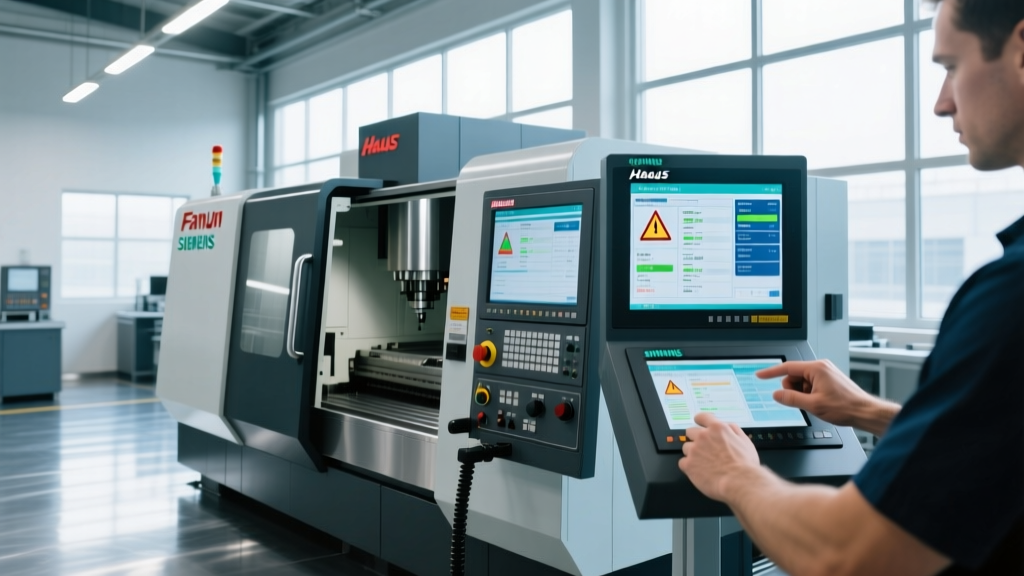
Industrial controllers, such as the FANUC 31i-B or Siemens Sinumerik 840D sl, utilize dedicated hardware ASICs for trajectory planning. These systems feature look-ahead processing capable of analyzing 1,000 to 2,000 blocks of G-code ahead of the current position. This allows the controller to calculate exact velocity vectors for complex 3D contours, decelerating smoothly before sharp corners to prevent overshoot.
Conversely, a Raspberry Pi running GRBL or basic LinuxCNC typically maxes out at 20 to 50 blocks of look-ahead. When executing complex CAM-generated toolpaths with thousands of micro-segments, the Pi's processor bottlenecks, resulting in "stair-stepping" on curved surfaces and aggressive deceleration that burns cutting tools.
Motion Control: Open-Loop Steppers vs. Closed-Loop AC Servos
The physical execution of G-code commands separates consumer-grade builds from industrial vertical machining centers (VMCs). Most Raspberry Pi CNC machines rely on NEMA 23 or NEMA 34 stepper motors driven by TB6600 or DM542T microstepping drivers. This is an open-loop system: the controller sends step and direction pulses, assuming the motor shaft has rotated accordingly.
If a Pi-driven router encounters a dense knot in hardwood or takes too aggressive a depth of cut in aluminum, the stepper motor will stall. Because there is no feedback mechanism, the controller continues sending pulses, resulting in "lost steps." The machine loses its positional coordinate reference, and the workpiece is scrapped.
Engineering Insight: If you must use steppers on a Pi-based build, upgrade to closed-loop stepper drivers (like the ODrive or BigTreeTech S42B). These add an ABZ quadrature encoder to the stepper motor, allowing the driver to detect stalls and trigger an immediate e-stop via the Pi's GPIO pins before the toolpath is ruined.Industrial CNCs utilize closed-loop AC servo motors, such as the Yaskawa Sigma-7 or FANUC alpha-i series. These motors are equipped with absolute encoders resolving up to 131,072 pulses per revolution (17-bit) or higher. The drive continuously monitors rotor position, adjusting current delivery thousands of times per second to maintain exact torque and position, even under heavy cutting loads.
Structural Rigidity: Extrusions vs. Meehanite Cast Iron
Technical specifications regarding spindle speed and feed rates are meaningless without the structural rigidity to support them. Consumer-grade CNC machines, including those built around Raspberry Pi controllers, typically utilize 6061 aluminum extrusions, linear rails, and 3D-printed or laser-cut acrylic joints.
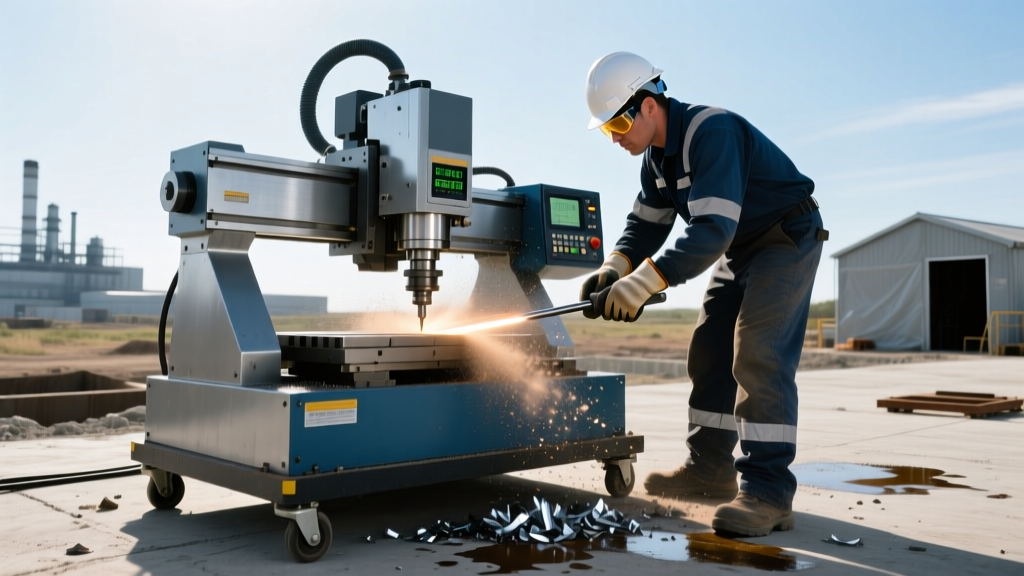
Aluminum extrusions have a high strength-to-weight ratio but poor vibration dampening characteristics. When a carbide endmill engages with metal, it generates high-frequency harmonics (chatter). In an aluminum-framed machine, these vibrations amplify, causing tool deflection and poor surface finishes. Industrial machines solve this by casting the base, column, and saddle from Meehanite cast iron. Meehanite's internal graphite flake structure provides a dampening coefficient up to 10 times greater than aluminum or steel weldments, absorbing cutting harmonics and allowing for heavy chip removal without chatter.
Electromagnetic Interference (EMI) in Pi-Based Builds
A frequent, non-obvious failure mode in DIY and consumer CNC builds is electromagnetic interference. The Raspberry Pi operates on 3.3V logic levels for its GPIO pins. Industrial PLCs operate on 24V DC logic with heavy optoisolation and noise filtering.
When a Pi-based CNC uses a Variable Frequency Drive (VFD) to control a spindle, the VFD generates massive amounts of high-frequency EMI through the spindle cables. Without proper shielding, this EMI induces phantom voltages in the Pi's stepper signal wires or limit switch lines. This results in the Pi registering phantom limit switch triggers (halting the machine randomly) or injecting rogue step pulses (causing the axis to drift). To mitigate this in a Pi build, builders must use double-shielded twisted-pair cables for all motor connections, install ferrite chokes on VFD lines, and utilize optoisolator breakout boards between the Pi's GPIO and the motor drivers.
Specification Comparison Matrix
| Specification | Raspberry Pi CNC (High-End Consumer) | Industrial VMC (e.g., Haas VF-2 / FANUC) |
|---|---|---|
| Controller OS | Linux with PREEMPT_RT patch | Proprietary RTOS (Real-Time Operating System) |
| Look-Ahead Blocks | 20 - 50 blocks | 1,000 - 2,000+ blocks |
| Drive System | Open-loop Steppers (NEMA 23/34) | Closed-Loop AC Servos (17-bit+ encoders) |
| Rapid Traverse Rate | 200 - 500 IPM (Inches Per Minute) | 1,000 - 1,500+ IPM |
| Spindle Power | 1.2 kW - 2.2 kW (Trim router or cheap VFD) | 15 kW - 22 kW (Liquid-cooled, HSK/BT40 taper) |
| Frame Material | 6061 Aluminum Extrusion / Steel Tube | Meehanite Cast Iron / Epoxy Granite |
| Positional Accuracy | ±0.005" to ±0.010" (under light load) | ±0.0002" to ±0.0005" (under heavy load) |
| Logic Voltage | 3.3V DC (Highly susceptible to EMI) | 24V DC (Optoisolated, heavily filtered) |
Decision Framework: Selecting Your Architecture
Choosing between a Raspberry Pi-based architecture and an industrial machine depends entirely on the material science and tolerances of your target application.
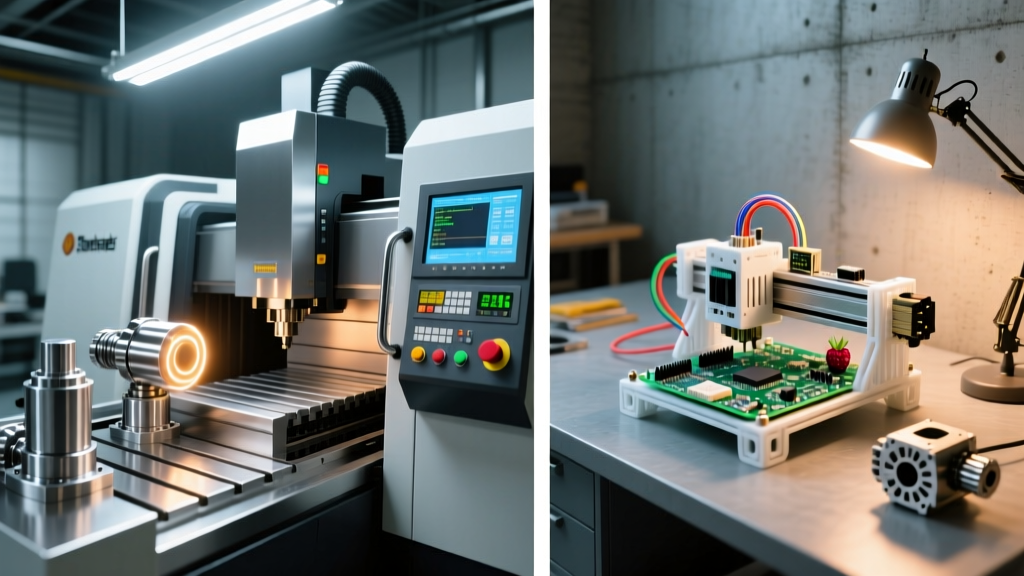
- Choose a Raspberry Pi CNC Build if: You are machining low-density materials (wood, MDF, acrylic, soft plastics, or PCB isolation routing). Your tolerances are wider than ±0.010", your budget is strictly under $3,000, and you possess the electrical engineering knowledge to properly ground and shield 3.3V logic circuits against VFD interference.
- Choose an Industrial VMC if: You are machining ferrous metals (steel, stainless, titanium) or aerospace-grade aluminum alloys (6061-T6, 7075-T6). Your application requires holding tolerances tighter than ±0.001", maintaining surface finish Ra values below 32 µin, and running unattended production cycles where a single missed step results in thousands of dollars in scrapped parts and broken tooling.
While the Raspberry Pi has democratized access to CNC motion control, the laws of physics regarding structural mass, thermal stability, and closed-loop kinematics remain the undisputed domain of industrial manufacturing equipment.