Industrial vs Desktop Grinding Machine CNC: Technical Specs Compared
Compare industrial vs desktop grinding machine CNC specs. Explore spindle runout, rigidity, thermal stability, and axis feedback for precision manufacturing.
The Physics of Precision: Why Mass and Kinematics Dictate Grinding Outcomes
When evaluating a grinding machine CNC for production or toolroom use, the divide between industrial-grade equipment and desktop or prosumer-adapted CNCs is not merely a matter of scale—it is a fundamental difference in structural physics. Grinding is an unforgiving subtractive process. Unlike milling or turning, where tool deflection can sometimes be compensated for via CAM software, abrasive grinding relies on microscopic depth-of-cut passes (often 0.0001 inches or 2.5 µm) to achieve final surface finishes. At this scale, high-frequency vibration, thermal expansion, and spindle runout immediately manifest as visible chatter marks, taper, and out-of-roundness.
This technical breakdown dissects the exact mechanical and electronic specifications that separate true industrial cylindrical and surface grinders (such as the Studer S33 or Okuma GP-47N) from desktop CNC routers or benchtop mills adapted for light grinding operations.
Structural Rigidity and Vibration Damping
The foundation of any precision grinder is its bed and column. Industrial grinding machines utilize heavily ribbed, stress-relieved Grade 35 or Grade 40 cast iron, or increasingly, advanced polymer concrete (epoxy granite) composites. The primary metric here is the specific damping capacity. Cast iron contains graphite flakes that act as internal micro-dampers, absorbing the high-frequency, low-amplitude vibrations generated when an aluminum oxide or CBN (cubic boron nitride) wheel contacts hardened steel.
Damping Coefficient Comparison
- Cast Iron (Industrial): Damping capacity of 0.01 to 0.05. A 6,000 kg industrial bed effectively neutralizes harmonic resonance above 200 Hz.
- Aluminum 6061 (Desktop/Prosumer): Damping capacity of roughly 0.0001. Aluminum frames will ring and amplify grinding harmonics, transferring chatter directly into the workpiece surface finish.
- Polymer Concrete (High-End Industrial): Damping capacity up to 0.15, offering superior vibration absorption but requiring significantly larger physical footprints to achieve the same static stiffness as cast iron.
Desktop CNCs, typically constructed from extruded aluminum or bolted steel plates, lack the mass to resist the dynamic cutting forces of grinding. Even if a desktop machine holds a tight positional tolerance statically, the dynamic forces of a grinding wheel will induce micro-deflections in the aluminum extrusions, ruining the geometric accuracy of the part.
Spindle Architecture: Hydrostatic vs. Angular Contact Bearings
The wheelhead spindle is the heart of the grinding machine CNC. The technical divergence between industrial and consumer-grade spindles is vast, directly impacting runout and surface finish capabilities.
Industrial Hydrostatic and Hydrodynamic Spindles
Precision industrial grinders utilize hydrostatic or hydrodynamic bearing systems. In a hydrostatic spindle, high-pressure oil is pumped into bearing pockets, creating an oil film thickness of 2 to 5 microns that completely separates the spindle shaft from the bearing housing. Because there is zero metal-to-metal contact, hydrostatic spindles exhibit virtually no wear over decades of use and maintain radial runout specifications of less than 0.00004 inches (1 µm). According to the Society of Manufacturing Engineers (SME), maintaining sub-micron spindle runout is mandatory for achieving Ra 0.1 µm surface finishes on hardened die steels.
Desktop P4 Angular Contact Ball Bearings
Desktop and prosumer CNCs rely on precision angular contact ball bearings (typically ABEC-7 or ISO P4 class). While these bearings are excellent for high-speed routing and light milling, they are fundamentally unsuited for heavy grinding. Under the radial loads of grinding, the balls experience elastic deformation (Hertzian contact stress). Furthermore, as the bearings heat up from friction, the preload changes dynamically, causing thermal growth that shifts the Z-axis zero point. Runout on these spindles typically ranges from 0.0001 to 0.0005 inches (2.5 to 12.5 µm), which translates directly into lobing and waviness on a cylindrical workpiece.
Technical Specification Matrix: Industrial vs. Desktop CNC Grinders
| Specification | Industrial CNC Grinder (e.g., Studer, Okuma) | Desktop / Adapted Prosumer CNC |
|---|---|---|
| Machine Mass | 4,000 kg to 15,000 kg | 50 kg to 250 kg |
| Spindle Bearing Type | Hydrostatic / Hydrodynamic Oil Film | P4 Angular Contact Ball Bearings |
| Wheelhead Runout | < 0.00004 in (1 µm) | 0.0002 in to 0.0005 in (5 - 12 µm) |
| Axis Feedback | Glass Linear Scales (0.1 µm resolution) | Open-Loop Steppers / Rotary Encoders |
| Thermal Management | Chilled oil circuits through bed and spindle | Ambient air / Passive fan cooling |
| Surface Finish (Ra) | 0.05 µm to 0.2 µm | 0.8 µm to 3.2 µm (with visible chatter) |
| Coolant Delivery | High-pressure flood (50-100 GPM), 10µm filtration | Low-flow mist or small sump pump (1-3 GPM) |
Thermal Stability and Axis Feedback Loops
Achieving a 2-micron dimensional tolerance is impossible if the machine's physical structure is expanding beneath the cutting zone. The coefficient of thermal expansion for cast iron is approximately 11 µm/m·°C. If a 1-meter grinder bed increases in temperature by just 5°C due to ambient shop fluctuations or internal friction, it will grow by 55 µm—nearly 30 times the target tolerance.
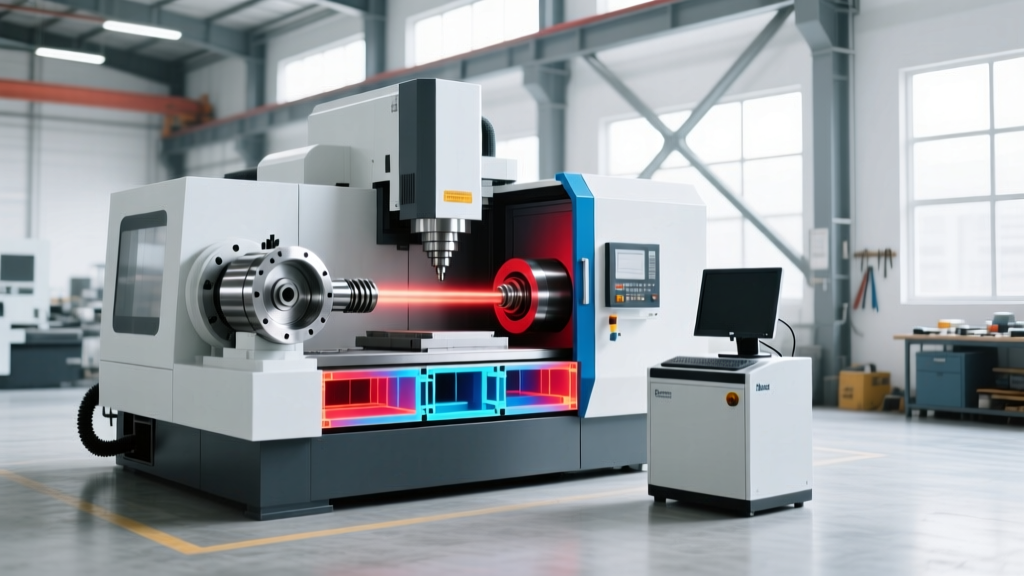
Industrial grinding machines combat this via active thermal management. Chilled oil is continuously circulated through channels cast directly into the machine bed, column, and spindle housing, locking the machine's core temperature to 20°C (68°F) ± 0.1°C. Furthermore, industrial CNCs utilize absolute glass linear scales (such as Heidenhain or Fagor) mounted directly to the axes. These scales read the actual physical position of the slide, completely bypassing the ball screw. If the ball screw heats up and expands during a long grinding cycle, the linear scale detects the true position and the servo motor corrects the error in real-time.
Desktop CNCs utilize open-loop stepper motors or rotary encoders attached to the motor shaft. The controller assumes the ball screw has moved the exact distance commanded. It cannot detect ball screw thermal expansion, backlash, or lost steps caused by the heavy cutting forces of grinding. For advanced metrology and precision alignment in manufacturing, the National Institute of Standards and Technology (NIST) emphasizes that closed-loop linear feedback is a non-negotiable requirement for sub-10-micron machining processes.
Coolant Dynamics and Swarf Management
Grinding generates intense localized heat and microscopic metallic swarf. If this swarf is not instantly evacuated, it embeds into the grinding wheel (loading the wheel) and scratches the workpiece. Industrial grinders utilize high-pressure, high-volume coolant systems delivering 50 to 100 gallons per minute (GPM) through targeted, adjustable nozzles that penetrate the air boundary layer surrounding the spinning wheel. The coolant is then routed through multi-stage filtration systems (magnetic separators followed by 10-micron paper band filters) to ensure no abrasive grit recirculates into the spindle bearings or axis way covers.
Desktop setups typically rely on flood coolants driven by small aquarium-style sump pumps or air-atomized mist systems. Mist is entirely inadequate for precision grinding, as it fails to carry away the thermal load, leading to workpiece burning, metallurgical phase changes (tempering of hardened steel), and rapid wheel degradation.
Decision Framework: Sizing the Right Grinder for Your Shop
Choosing between an industrial and a desktop/adapted CNC grinding setup requires a strict evaluation of your part geometry, tolerance stack-ups, and production volume. Use the following framework to guide your capital expenditure:
- Choose Desktop/Prosumer Adaptations If: You are performing non-critical edge breaking, light deburring of soft materials (aluminum, brass), or rough-shaping unhardened tool blanks where tolerances exceed ±0.005 inches (125 µm) and surface finish requirements are above Ra 1.6 µm. Capital outlay: $5,000 - $15,000.
- Choose Industrial CNC Grinders If: You are grinding hardened tool steels (HRC 55+), aerospace turbine components, or precision hydraulic spools requiring cylindricity within 2 µm, surface finishes below Ra 0.2 µm, and continuous unattended operation. Capital outlay: $250,000 - $800,000+.
The Hidden Cost of Chatter
Attempting to hold grinding tolerances on a machine lacking the requisite mass and hydrostatic spindle architecture will result in exponential scrap rates. The cost of a single scrapped aerospace landing gear component or a ruined set of custom extrusion dies will rapidly eclipse the financing costs of a properly specified industrial grinding machine CNC. Do not compromise on structural kinematics when sub-micron finishes are on the blueprint.