How Much CNC Machine Costs: Industrial vs Consumer Specs 2026
Compare industrial vs consumer CNC machines. Discover how much CNC machine setups cost, technical specs, drive systems, and tolerance limits for 2026.
The Core Question: How Much CNC Machine Investment is Required?
When shop owners and engineers ask how much CNC machine investment is required to transition from hobbyist prototyping to full-scale production, the answer relies entirely on the physics of machining. The market is strictly bifurcated: consumer-grade desktop routers cap out around $5,000, while true industrial vertical machining centers (VMCs) start at $75,000 and easily exceed $250,000 for multi-axis configurations. This 15x to 50x price disparity is not merely a brand premium; it reflects fundamental differences in structural kinematics, drive train mechanics, thermal stability, and control system interpolation.
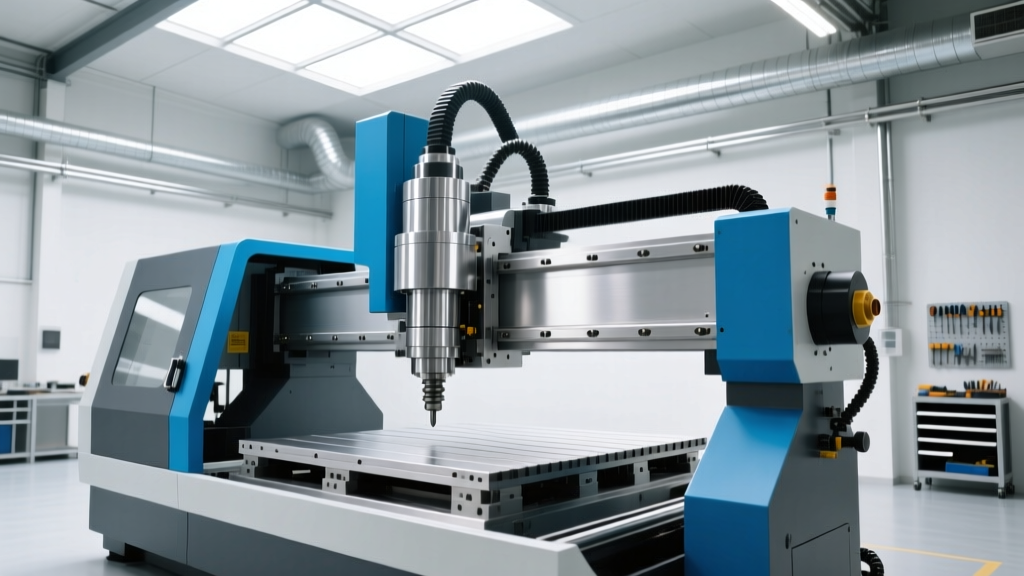
Quick Cost & Tolerance Matrix (2026 Market Data)• Consumer/Desktop (e.g., Inventables X-Carve): $1,500 – $3,500 | Positional Accuracy: ±0.005" (125µm)
• Prosumer/Benchtop (e.g., Tormach PCNC 1100): $10,000 – $18,000 | Positional Accuracy: ±0.001" (25µm)
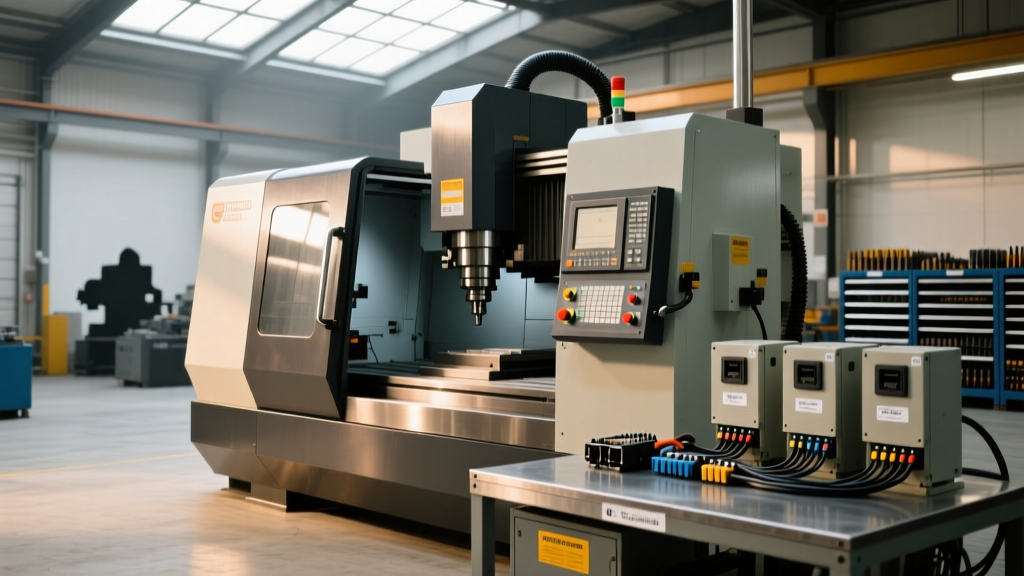
• Industrial VMC (e.g., Haas VF-2SS): $85,000 – $120,000 | Positional Accuracy: ±0.0002" (5µm)
• High-End 5-Axis (e.g., DMG Mori DMU 50): $250,000+ | Positional Accuracy: ±0.00008" (2µm)
Frame Kinematics and Harmonic Dampening
The foundation of any CNC machine is its frame, which must absorb the harmonic vibrations generated during aggressive material removal. Consumer machines predominantly utilize 80/20 T-slot aluminum extrusions bolted together with steel brackets. While aluminum is lightweight and inexpensive, its damping coefficient is poor. When a carbide end mill engages 6061 aluminum or steel at high feed rates, the cutting forces induce chatter. In an aluminum extrusion frame, these vibrations amplify, causing poor surface finishes and accelerated tool wear.
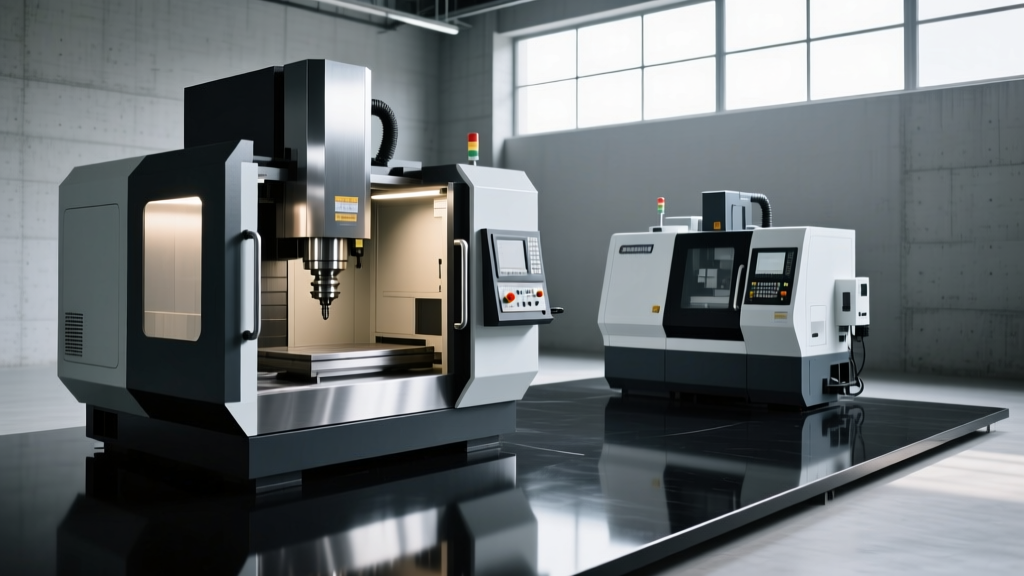
Industrial VMCs utilize heavily ribbed, stress-relieved cast iron (typically Grade 30 or 40) or polymer concrete bases. A standard Haas VF-series mill weighs between 8,000 and 10,000 lbs. This massive weight provides the inertial dampening required to absorb high-frequency harmonics. Cast iron also possesses a cellular graphite microstructure that naturally dissipates vibrational energy as heat, ensuring the cutting tool remains stable even during heavy roughing passes in titanium or Inconel.
Drive Train Mechanics: Backlash and Repeatability
The mechanism that translates motor rotation into linear axis movement dictates the machine's repeatability. This is where the technical divide between consumer and industrial specs becomes most apparent.
Consumer: Lead Screws and GT3 Belts
Most sub-$5,000 machines rely on ACME lead screws or fiberglass-reinforced GT3 timing belts. Lead screws suffer from inherent friction and thermal expansion. As the nut travels along the screw, friction generates heat, causing the screw to expand and altering the Z-axis depth or X/Y positioning mid-job. Belts, while capable of high rapid traverse speeds, are subject to elastic deformation. Under heavy cutting loads, belts stretch, resulting in lost steps and dimensional inaccuracies that can exceed 0.010" (250µm) over a long toolpath.
Industrial: Ground C3 Ball Screws and Linear Guides
Industrial machines utilize precision-ground C3-grade ball screws paired with oversized pre-tensioned linear guideways. Ball screws replace sliding friction with rolling friction via recirculating ball bearings, achieving mechanical efficiency rates of 90% or higher. Furthermore, industrial ball screws are pre-tensioned and anchored at both ends to eliminate axial play and compensate for thermal growth. This architecture guarantees bidirectional repeatability within 0.0002" (5µm), a strict requirement for aerospace and medical device manufacturing.
⚠️ Warning: Open-Loop Stepper Failure ModesConsumer CNCs use open-loop NEMA 23 or NEMA 34 stepper motors. If the cutting force exceeds the motor's holding torque, the motor stalls and 'loses steps' without alerting the controller. The machine will continue running the G-code, but the physical toolpath will be offset, instantly scrapping the part and potentially crashing the spindle into the workholding fixture. Industrial machines use closed-loop AC servo motors with high-resolution encoders that detect positional errors in real-time and trigger an immediate E-stop if deviation exceeds the tolerance threshold.
Spindle Architecture and Thermal Growth
Spindle specifications dictate the machine's material versatility and cycle times. Consumer machines typically integrate off-the-shelf trim routers (1.25 HP to 2.2 kW) or basic VFD spindles. These spindles lack the low-end torque required for large-diameter facing operations in steel and rely on high RPMs (18,000–24,000) to compensate. Crucially, they lack active cooling systems. After 20 minutes of continuous cutting, the spindle housing expands thermally. In a consumer machine, this Z-axis thermal growth can push the tool deeper into the material by 0.005" to 0.015", ruining tight-tolerance pockets.
Industrial spindles are engineered as integrated, liquid-cooled cartridge units. A 30-HP vector drive spindle maintains constant torque from 150 RPM up to its maximum rated speed (often 8,100 to 12,000 RPM). The spindle housing is jacketed with a closed-loop oil or glycol cooling system that maintains the spindle temperature within ±1°C of ambient room temperature, entirely neutralizing thermal Z-axis drift. Additionally, industrial spindles feature air purges and labyrinth seals to prevent microscopic coolant and swarf ingestion into the precision angular contact bearings.
Control Systems and Look-Ahead Interpolation
The physical hardware is only as capable as the brain directing it. Consumer machines rely on open-source or entry-level controllers like GRBL, Mach3, or proprietary 8-bit/32-bit microcontrollers. These systems typically process 20 to 40 blocks of G-code look-ahead. When machining complex 3D contours with thousands of micro-segments, a 20-block look-ahead forces the machine to decelerate at every slight directional change to avoid overshooting, resulting in dwell marks on the surface finish and cycle times that are 300% to 500% longer than necessary.
Industrial controllers, such as Fanuc, Siemens, or Heidenhain systems, utilize advanced AI contour control and high-speed processing architectures capable of 1,000 to 5,000+ block look-ahead. They calculate the exact velocity and acceleration vectors required for complex splines, maintaining constant chip load and feed rates through tight radii without sacrificing surface finish. This computational power is what allows industrial shops to machine complex impellers and mold cores in a fraction of the time it would take a desktop machine.
Decision Framework: When to Cross the Industrial Threshold
Determining whether to purchase a consumer, prosumer, or industrial CNC requires matching your technical requirements to the machine's physical limitations. Use this framework to guide your capital expenditure:
- Material Hardness & Volume: If you are exclusively cutting wood, plastics, or non-ferrous metals (aluminum/brass) for prototyping or low-volume custom parts, a $3,000 prosumer machine like the Shapeoko 5 with upgraded linear rails is sufficient. If your queue includes daily runs of 316 stainless steel, titanium, or high-temp alloys, an industrial VMC with a rigid tapping spindle and flood coolant is mandatory.
- Tolerance Requirements: If your print tolerances are ±0.005" (125µm) or looser, consumer drive trains will suffice. If you are holding ±0.0005" (12µm) for press fits, aerospace mating surfaces, or optical molds, you must invest in ground ball screws and cast iron mass.
- Coolant and Chip Evacuation: Consumer machines are designed for dry routing or manual mist. Machining steel or aluminum at production speeds requires high-pressure flood coolant to prevent chip welding and tool breakage. Industrial VMCs feature fully enclosed splash guards and high-volume chip conveyors, which are non-negotiable for unattended lights-out manufacturing.
- Spindle Uptime: A consumer spindle bearing replacement might be required every 500–1,000 hours of aggressive use. Industrial spindles are rated for 10,000+ hours of continuous operation before requiring a rebuild. Calculate your cost-per-part based on spindle lifecycle, not just the initial machine purchase price.
Ultimately, the question of how much CNC machine you need is answered by the cost of failure. When a scrapped part costs $5 in raw material, a consumer machine's lack of rigidity is an acceptable trade-off. When a scrapped part is a $4,000 titanium forging with 40 hours of prior machining, the $90,000 investment in an industrial VMC with closed-loop servos, thermal compensation, and C3 ball screws becomes the most cost-effective insurance policy in the shop.