How to Sell CNC Machine Assets: Electrical & Power Setup Guide
Learn how to sell CNC machine assets faster by documenting electrical requirements, power setups, and regenerative drive specs for modern buyers.
In the 2026 manufacturing landscape, figuring out how to sell CNC machine equipment requires far more than listing axis travel, spindle RPM, and tool changer capacity. Driven by strict ESG (Environmental, Social, and Governance) mandates and widespread adoption of ISO 50001 energy management standards, modern machine shops are hyper-focused on electrical efficiency, power quality, and facility integration costs. A seller who provides a comprehensive electrical and power setup dossier will command a premium, accelerate the sales cycle, and drastically reduce post-sale liability.
The 2026 Electrical Dossier: Your Primary Sales Asset
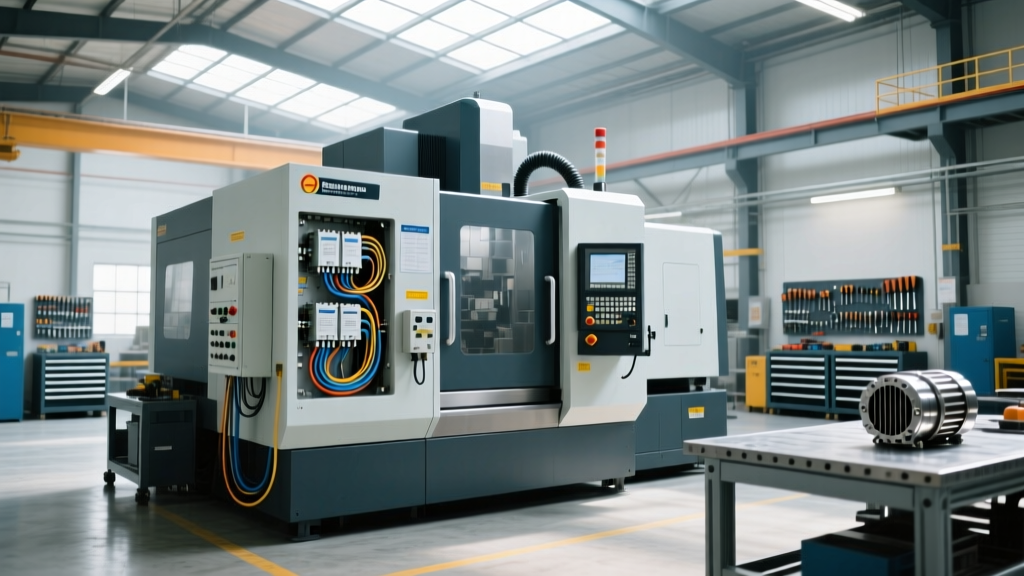
When high-tier buyers evaluate used or surplus CNC machines, their facility engineers immediately look at the electrical footprint. If your listing lacks detailed power specifications, buyers will assume the worst and deduct 15% to 20% from their offer to cover 'unknown electrical integration risks.' To counter this, compile an Electrical Dossier containing the original OEM wiring schematics, transformer sizing requirements, and historical power quality logs.
💡 Pro-Tip: The MTConnect AdvantageIf your machine is equipped with IoT gateways utilizing the MTConnect standard, export the last 12 months of power consumption data. Providing a CSV file showing actual kWh usage per part cycle proves the machine's energy efficiency and serves as a massive trust signal for buyers with strict sustainability KPIs.
Decoding Nameplate vs. Real-World Power Draw
One of the most common friction points in CNC sales is the discrepancy between the machine's nameplate kVA rating and its actual real-world power draw. Nameplates dictate the maximum theoretical capacity, but they rarely account for the nuances of modern servo acceleration and regenerative braking.
The Inrush Current Trap
Buyers must size their facility's breakers and wiring to handle peak inrush currents, not just continuous draw. For example, a DMG MORI NLX 2500 might state 25 kVA on the nameplate, but the initial spindle acceleration (inrush) can spike to 65A on a 460V 3-phase line. If you are selling the machine, explicitly documenting the Peak Inrush Amperage and the recommended Time-Delay Fuse Sizing in your listing will save the buyer's electrical contractor hours of guesswork and make your machine significantly more attractive.
2026 CNC Power Profiles: Market Standards
Below is a breakdown of the electrical requirements for popular CNC models currently dominating the secondary market. Use this matrix to benchmark your machine's specs against industry expectations.
| Machine Model | Control Unit | Required Supply | Continuous Draw | Peak Inrush | Regenerative Capable? |
|---|---|---|---|---|---|
| Haas VF-2SS | Haas NGC | 230V 3-Phase | 35A | 70A | No (Standard) |
| Mazak INTEGREX i-200S | Mazatrol SmoothAi | 460V 3-Phase | 42A | 85A | Yes (Matrix Converter) |
| DMG MORI DMU 50 3rd Gen | Siemens Sinumerik 840D sl | 400V 3-Phase | 28A | 55A | Yes (Active Line Module) |
Tech Trends: Leveraging Regenerative Drives to Command a Premium
The integration of regenerative drive systems is a major selling point in 2026. Traditional dynamic braking resistors dissipate kinetic energy as waste heat, which increases shop HVAC loads. Modern systems, such as the Siemens SINAMICS S120 drives, feed braking energy back into the local microgrid or facility line.
- Energy Reclaim Rates: Machines with active front-end (AFE) regenerative drives can reclaim up to 30% of the energy used during heavy deceleration cycles (e.g., 5-axis simultaneous contouring or high-speed tapping).
- HVAC Load Reduction: By eliminating braking resistors, you reduce the ambient heat output of the machine by roughly 4,000 to 8,000 BTUs per hour, lowering the buyer's facility cooling costs.
- Selling Point: Explicitly list 'Regenerative Power Supply' in your machine's title and highlight the estimated annual energy savings based on typical duty cycles.
Transformer Sizing and K-Factor Harmonics
Many sellers overlook the transformer requirements when offloading a machine. CNC machines utilize Variable Frequency Drives (VFDs) and switched-mode power supplies, which generate significant harmonic distortion. If a buyer installs your machine on a standard, non-K-rated transformer, the core will overheat and fail prematurely.
"When selling a 50 kVA CNC machine, advise the buyer that a standard 50 kVA transformer is insufficient due to harmonic heating. Recommend a K-13 or K-20 rated transformer specifically designed to handle the non-linear loads generated by modern Fanuc and Siemens servo amplifiers."
Providing a calculated Total Harmonic Distortion (THD) report from a power quality analyzer (like a Fluke 435) taken while the machine was under a heavy cutting load will elevate your listing above 95% of competitors who simply post a photo of the control panel.
The Used Market Pitfall: Phase Converters & Dirty Power
If you operated the CNC machine in a rural facility or a shop lacking 3-phase utility power, you likely used a Rotary Phase Converter (RPC) or a CNC-specific Phase Perfect digital converter. This is a critical disclosure point.
⚠️ Warning: The Floating Neutral & Grounding HazardMany older rotary phase converters generate a 'wild leg' or high-leg delta configuration (often 208V to ground on the manufactured leg). If this high leg was incorrectly wired into the CNC control cabinet's single-phase 120V control circuits, it may have degraded the Fanuc/Siemens PCBs over time. Action Step: Before selling, verify the machine's internal control voltage taps and ensure the grounding bus is strictly bonded to the facility earth ground, not a floating neutral. Disclose the exact type of phase converter used in your maintenance logs.
Digital vs. Rotary Disclosure
If you used a Phase Perfect digital converter (which outputs highly balanced 3-phase power with less than 2% voltage imbalance), state this clearly. Buyers will accept this without penalizing the offer. If you used a cheap rotary converter with unbalanced legs and high voltage spikes, you must price the machine accordingly, as the buyer's electrician will need to inspect the main contactor and servo drives for micro-fractures and capacitor degradation.
Final Checklist for the Seller
To maximize your resale value and ensure a smooth facility integration for the buyer, compile the following electrical documentation package before listing your asset:
- OEM Electrical Schematics: PDF format, specifically the 2026 revision matching the machine's serial number.
- Breaker & Wire Sizing Guide: Document the exact AWG wire gauge and NEMA enclosure ratings required for the main disconnect.
- Power Quality Log: A 24-hour snapshot showing voltage sags, swells, and THD percentages under load.
- Regenerative Setup Parameters: If applicable, include the specific PLC parameters required to enable the active front-end regenerative module.
By treating the electrical and power setup as a core feature of your machine's value proposition rather than an afterthought, you align with the technical demands of modern manufacturing buyers. This level of transparency and technical depth is exactly how to sell CNC machine equipment at top-market valuations in today's highly regulated, energy-conscious industrial sector.