German CNC Machine Brands: Enclosure & Coolant System Repair Guide
Diagnose and fix coolant leaks, pump cavitation, and enclosure seal failures in top German CNC machine brands like DMG MORI, Hermle, and Chiron.
The Engineering Reality of German CNC Enclosures and Coolant Systems
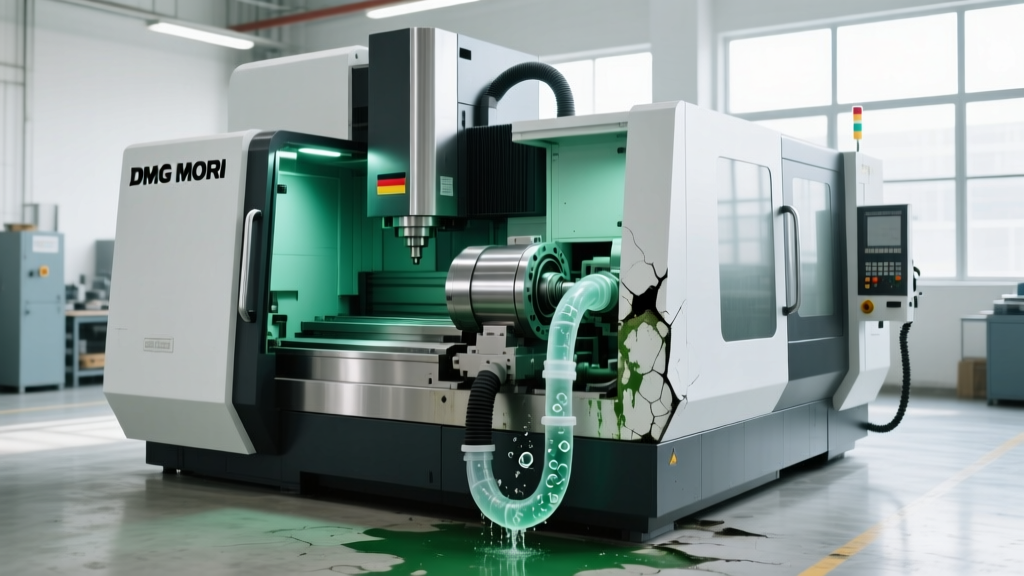
When maintaining top-tier German CNC machine brands such as DMG MORI, Hermle, Chiron, and Grob, technicians quickly realize that the enclosure and coolant systems are not mere afterthoughts; they are highly integrated, pressurized environments critical to maintaining sub-micron thermal stability. Unlike standard box-way mills, modern German 5-axis machining centers utilize high-pressure through-spindle coolant (TSC) routed through complex rotary unions, paired with hermetically sealed enclosures designed to manage extreme mist and thermal expansion.
Troubleshooting these systems requires moving beyond basic leak detection. A coolant pressure drop on a Hermle C42U or a mist containment failure on a Chiron FZ 16 mill-turn center directly impacts tool life, surface finish, and spindle bearing longevity. This guide provides advanced diagnostic frameworks for resolving enclosure breaches, high-pressure pump cavitation, and rotary union failures specific to German engineering architectures.
⚠️ High-Pressure Safety Warning: German OEMs frequently specify TSC systems operating between 70 bar (1,015 psi) and 150 bar (2,175 psi), with specialized deep-hole drilling setups reaching 400 bar. Never attempt to loosen hydraulic fittings, rotary union housings, or pump accumulators without executing a full lockout/tagout (LOTO) and bleeding the secondary pressure valves. Residual pressure in DMG MORI CELOS-controlled systems can remain trapped for hours after power-down.Diagnosing High-Pressure Rotary Union Failures
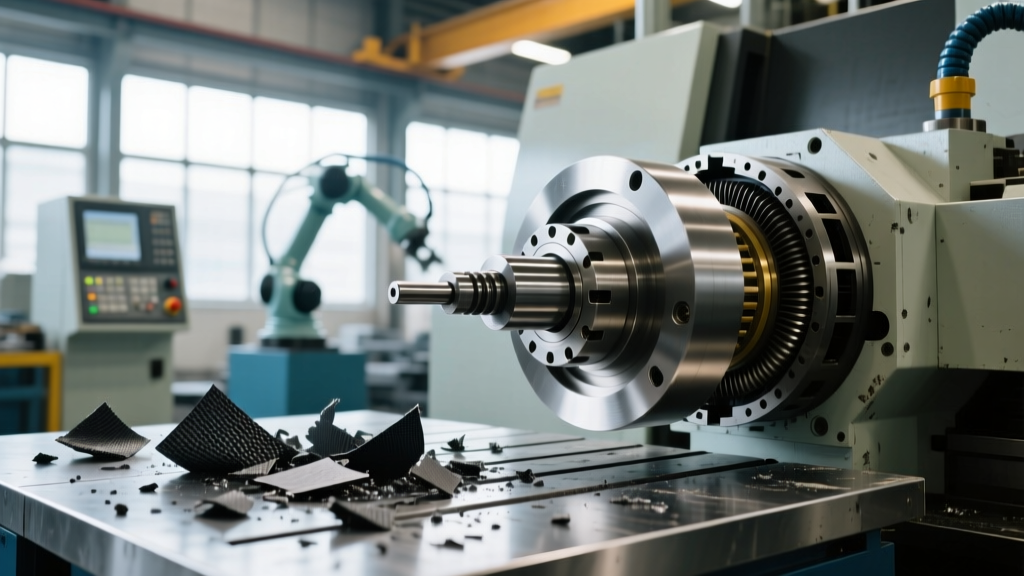
The rotary union is the critical junction where stationary high-pressure coolant lines meet the rotating spindle. German CNC machine brands predominantly rely on precision-engineered unions from suppliers like OTT-JAKOB or Deublin. When coolant leaks into the spindle housing or pressure drops at the tool tip, the union is the primary suspect.
Symptom Isolation: Internal vs. External Leaks
- External Leakage (Visible at the spindle nose): Typically indicates wear on the outer mechanical face seals. On Hermle C-series machines, check the spindle air purge system. If the air purge pressure drops below 2.5 bar, coolant can bypass the primary seal during high-pressure TSC activation.
- Internal Leakage (Coolant mixing with spindle oil/air-oil mist): A catastrophic failure mode. If the internal O-rings or secondary labyrinth seals fail, coolant migrates into the spindle bearing housing. Diagnostic step: Extract a sample from the spindle air-oil exhaust line. A milky emulsion confirms internal coolant migration. Immediate spindle teardown is required to prevent ceramic bearing degradation.
'German spindle manufacturers design rotary unions with a deliberate 'leak-to-drain' architecture. If you find coolant pooling in the external catch tray beneath the spindle nose, do not immediately condemn the union. First, verify that the drain line back to the coolant tank is not clogged with swarf, which causes hydrostatic backpressure and forces fluid out of the secondary weep holes.' — Field Service Engineering Directive, Spindle Dynamics
Enclosure Seal Degradation and Way Cover Breaches
The enclosure systems on German machining centers are designed to maintain a specific negative pressure to prevent aerosolized metalworking fluids (MWF) from escaping into the shop environment. Way covers (telescopic steel covers and polyurethane bellows) are the most common failure points for both coolant leaks and enclosure pressure loss.
Material-Specific Failure Modes
German OEMs specify exact elastomer compounds for enclosure seals based on the coolant chemistry in use. Replacing a seal with the wrong material guarantees rapid failure.
| Seal Material | Compatible Coolants | Failure Mode if Mismatched | Common Application |
|---|---|---|---|
| NBR (Nitrile) | Water-soluble, Semi-synthetic | Swells and turns to sludge in synthetic esters | Standard door seals, way cover wipers |
| FKM (Viton) | Synthetic esters, High-temp oils | Brittle fracture in low-temp aqueous solutions | TSC rotary unions, high-pressure pump seals |
| EPDM | Aqueous, Alkaline cleaners | Rapid dissolution when exposed to mineral oils | Mist collector ducting, enclosure gaskets |
Telescopic Way Cover Alignment and Wiper Replacement
On heavy-duty German horizontals like the Grob G550, the X and Y-axis way covers are subjected to immense mechanical stress. If the machine throws a 'Way Cover Over-travel' or 'Axis Following Error' alarm alongside a coolant leak beneath the saddle:
- Inspect the Polyurethane Wipers: The scraping lips must maintain a 0.5mm to 1.0mm interference fit against the steel cover. If they are curled or hardened, coolant will bypass the cover and wash away the linear guideway grease.
- Check the Brass Guide Shoes: German way covers utilize precision-machined brass or polymer guide shoes to maintain parallelism. If a shoe wears unevenly, the steel covers will 'shingle' (overlap incorrectly), creating a gap where high-pressure coolant directly impacts the linear rail.
- Re-tensioning: When reassembling way covers on a Chiron mill-turn, use a torque wrench set to the OEM specification (typically 12-15 Nm for M6 mounting brackets) to ensure uniform tension across the bellow folds.
Mist Extraction and Enclosure Negative Pressure Balancing
Modern German CNC machine brands integrate advanced mist collection systems (often supplied by LTA or Keller) directly into the machine enclosure. These systems do not just extract air; they manage the static pressure inside the machining zone. According to guidelines monitored by organizations like the Occupational Safety and Health Administration (OSHA), controlling MWF mist is critical for respiratory safety and shop floor visibility.
The Static Pressure Diagnostic
The enclosure must maintain a slight negative pressure (typically -15 to -25 Pascals) relative to the shop floor. If the enclosure is at positive pressure, mist will violently escape every time the automatic doors open.
- Symptom: Coolant mist billows out of the enclosure during tool changes.
- Root Cause 1: The primary HEPA or demister pad in the extraction unit is blinded with tramp oil and fine aluminum swarf, reducing CFM output by >40%.
- Root Cause 2: The make-up air louvers on the rear of the enclosure are blocked. German machines rely on calibrated passive louvers to allow filtered shop air in, balancing the extraction rate. If maintenance tapes over these louvers to 'stop drafts,' the extraction fan cavitates, and negative pressure is lost.
- Fix: Clean the demister pads using an alkaline wash. Verify make-up air louvers are unobstructed. Use a digital manometer to confirm the internal enclosure pressure reads between -15 Pa and -25 Pa while the spindle is at idle and the extraction fan is at 100% duty cycle.
Diagnostic Matrix: Coolant Pump Cavitation and Pressure Drops
High-pressure coolant pumps on German machining centers are highly sensitive to fluid viscosity, aeration, and inlet restrictions. Below is a diagnostic matrix for addressing pressure anomalies commonly flagged on DMG MORI CELOS and Siemens Sinumerik interfaces.
| CELOS / HMI Alert | Physical Symptom | Probable Root Cause | Corrective Action |
|---|---|---|---|
| TSC Pressure Drop > 15% | Pump whines; pressure gauge fluctuates rapidly | Pump cavitation due to clogged suction strainer or high fluid viscosity (cold shop) | Clean the 100-micron suction basket. Ensure coolant temp is >18°C (65°F) before engaging 70+ bar TSC. |
| Coolant Flow Error (No Pressure Build) | Pump runs silently; no coolant at tool tip | Sheared drive coupling between the servo motor and the pump gear set, or open bypass valve | Inspect the elastomeric spider coupling. Verify the M-code solenoid bypass valve is fully seating. |
| Tank Level Critical (False Positive) | Tank is visually full, but HMI triggers E-stop | Capacitive level sensor coated in tramp oil or conductive swarf sludge | Remove sensor, clean with isopropyl alcohol. Install a mechanical skimmer to prevent tramp oil buildup. |
OEM-Approved Fluids and Concentration Management
The German Machine Tool Builders' Association (VDW) and individual OEMs emphasize that warranty claims for spindle and pump failures are routinely denied if non-approved metalworking fluids are used. German high-pressure systems require fluids with exceptional anti-foaming characteristics and high lubricity to protect pump gears at 150 bar.
Refractometer Readings and pH Stability
Maintaining the correct concentration is non-negotiable for enclosure and pump longevity. Running a semi-synthetic fluid at 4% instead of the recommended 7-9% will cause the way cover wipers to swell and the pump internals to flash-rust during weekend shutdowns.
- Testing Protocol: Use a calibrated optical refractometer daily. Multiply the Brix reading by the fluid-specific multiplier (e.g., Fuchs Renocast or Castrol Alusol typically use a 1.0 to 1.4 multiplier).
- pH Thresholds: Maintain a pH between 8.8 and 9.4. If pH drops below 8.5, bacterial degradation is occurring, which produces acidic byproducts that eat through NBR enclosure seals and cause aluminum oxidation inside the machine's internal coolant galleries.
- Tramp Oil Skimming: German machines feature deep, sloped chip conveyors. If tramp oil from the hydraulic power unit (HPU) leaks into the coolant sump, it coats the enclosure interior, defeating the mist collector's demister pads. Install an automated belt skimmer operating on a 2-hour daily cycle to maintain < 0.5% tramp oil content.
For comprehensive service documentation and specific fluid approvals, always consult the technical data sheets provided by DMG MORI or the respective OEM portal, as formulations and approved supplier lists are updated annually to match new pump metallurgy and seal elastomers.