Fixing the Least Expensive CNC Machine for Composite Cutting
Troubleshoot and repair budget CNC routers cutting CFRP and GFRP. Fix spindle runout, Z-axis backlash, and delamination issues on entry-level machines.
Deploying the least expensive CNC machine for composite material cutting—typically a $2,500 to $4,500 benchtop router like the BobsCNC KL71 or a generic imported 6090 VFD model—is a common entry point for fabrication startups. However, Carbon Fiber Reinforced Polymers (CFRP) and Glass Fiber Reinforced Polymers (GFRP) are relentlessly abrasive. While machining aluminum might yield a five-year lifespan on a budget gantry, composites can destroy linear bearings and spindle internals in under 400 cutting hours if the machine is not meticulously maintained and upgraded.
CRITICAL ALERT: Conductive Dust HazardsCarbon fiber dust is electrically conductive. On budget machines with unshielded stepper drivers (like the TB6600) and exposed limit switches, CFRP dust ingestion will cause short circuits, phantom homing errors, and catastrophic driver failure. Always prioritize positive-pressure electrical enclosures before cutting carbon composites.
Diagnostic Troubleshooting Matrix
When surface finish degrades or dimensional accuracy fails on composite parts, use this matrix to isolate the mechanical fault on entry-level gantry systems.
| Symptom | Mechanical Root Cause | Repair Action | Est. Cost |
|---|---|---|---|
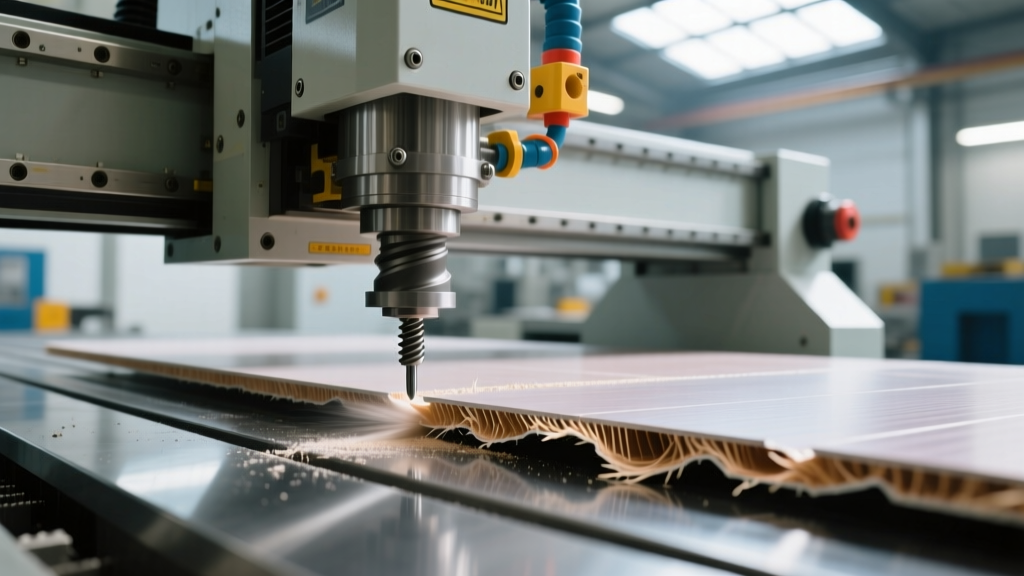
| Edge Delamination / Fraying | Spindle runout exceeding 0.0008" | Replace angular contact bearings | $85 |
| Z-Axis Plunge Chatter | Acme nut backlash / Z-gib wear | Re-shim Z-axis bronze gibs | $15 |
| Tool Pullout / Breakage | ER20 collet fatigue & slippage | Upgrade to AA-grade precision collet | $45 |
| X/Y Axis Stalling & Shifting | Conductive dust shorting drivers | Seal NEMA 23 steppers & upgrade to closed-loop | $220 |
Spindle Runout and Bearing Degradation
The standard 1.5kW water-cooled spindles found on the least expensive CNC machine models rely on entry-level P5 or P6 grade bearings. When subjected to the lateral forces of routing CFRP, these bearings develop micro-pitting. In composite cutting, spindle runout must remain below 0.0005 inches. Anything higher causes the cutting edge to impact the material rather than shear it, resulting in severe delamination and rapid tool wear.
Step-by-Step Spindle Bearing Replacement
- Measure Runout: Mount a dial indicator on the Z-axis plate. Insert a certified ground tool shank (not a cutting bit) into the ER20 collet. Rotate the spindle by hand. If deflection exceeds 0.0008", a rebuild is mandatory.
- Teardown: Remove the spindle from the Z-mount. Drain the coolant. Use a spanner wrench to remove the nose cone and collet nut.
- Extract the Rotor: Tap the shaft downward using a brass drift and a dead-blow hammer to avoid damaging the threads.
- Replace Bearings: Budget spindles typically use 7005C angular contact bearings. Discard the OEM bearings and press in NSK or SKF P4-grade precision angular contact bearings (approx. $85/pair). Ensure they are installed in a back-to-back (DB) configuration to handle axial plunge loads.
- Preload Adjustment: Reassemble and apply a precise axial preload using the top bearing nut. Under-preloading causes chatter; over-preloading causes thermal seizure at 24,000 RPM.
Linear Rail Ingestion and Z-Axis Backlash
Budget composite routers frequently utilize SBR20 round linear rails or low-tier HGR20 square rails. The open-carriage design of SC20UU linear bearings allows microscopic carbon and glass fibers to bypass the wiper seals, embedding into the ball retainer and scoring the shaft.
Furthermore, the Z-axis on entry-level machines often relies on Acme lead screws with Delrin or brass anti-backlash nuts. Composite routing requires high Z-axis rigidity, especially when using compression spiral bits that exert alternating up-cut and down-cut forces. As the nut wears, Z-drop occurs during plunge moves, ruining the part's top surface.
Pro-Tip: Z-Axis Upgrade PathDo not attempt to continually re-shim worn Delrin nuts. Replace the Z-axis drive with a 1605 or 1610 ballscrew and a preloaded double-nut assembly. This eliminates backlash entirely and provides the necessary rigidity for CFRP plunge routing. Cost: ~$110.
Tooling Slippage and Collet Failure
According to Sandvik Coromant's composite machining guidelines, cutting CFRP requires specialized tooling, primarily Polycrystalline Diamond (PCD) or diamond-coated solid carbide end mills. A single 1/4" PCD compression router bit costs between $65 and $140. If your collet slips, the tool drops, shattering the PCD brazed tip and destroying the workpiece.
The ER20 collets shipped with budget machines are often manufactured from soft, improperly tempered steel. After 50 tool changes, the collar deforms, losing clamping force. To troubleshoot and prevent slippage:
- Clean the Taper: Use isopropyl alcohol and a lint-free cloth to clean both the spindle taper and the collet exterior. Never use compressed air, as it forces dust into the spindle bearings.
- Verify Torque: Hand-tightening is insufficient. Use a calibrated ER20 torque wrench set to 75 Nm (55 ft-lbs).
- Upgrade to AA-Grade: Replace OEM collets with AA-grade precision collets (e.g., from Techniks or Parlec) which guarantee a TIR (Total Indicator Runout) of less than 0.0002".
"When machining abrasive composites on a budget gantry, your spindle is only as rigid as your collet. A $120 PCD tool held in a fatigued $8 collet will vibrate, generating heat that melts the epoxy matrix of the CFRP before the diamond edge can shear the carbon fiber."
— Tooling Application Engineer, Composites Fabrication Division
Electronics Protection and Stepper Upgrades
As noted in CompositesWorld's machining resources, managing the swarf and dust generated by composite trimming is a primary operational challenge. On the least expensive CNC machine models, the X and Y stepper motors are exposed. Carbon dust settles on the motor windings and the lead screw bearings, acting as a thermal insulator and an abrasive paste.
To troubleshoot chronic X/Y stalling during heavy roughing passes:
- Inspect the Drivers: Open the control box. If you find black, conductive dust coating the TB6600 or DM542 driver heat sinks, the drivers are likely thermal-throttling or shorting.
- Seal the Enclosure: Install a positive-pressure fan with a HEPA filter on the electronics enclosure to prevent dust ingress.
- Upgrade to Closed-Loop Steppers: Budget open-loop NEMA 23 motors will stall silently if the cutting forces of a 1/2" compression bit exceed their holding torque. Upgrading to closed-loop NEMA 23 steppers (approx. $55 per axis) provides position feedback, preventing lost steps and triggering an immediate alarm if the gantry binds.
Summary: Maximizing Budget Machine ROI
The least expensive CNC machine can successfully cut composite materials, but only if the operator treats it as a modular platform rather than a turnkey solution. By systematically replacing the spindle bearings with P4 angular contacts, upgrading the Z-axis to a preloaded ballscrew, enforcing strict ER20 torque protocols, and sealing the electronics from conductive dust, a $3,000 benchtop router can achieve the edge quality and reliability required for professional aerospace and automotive composite trimming.