CNC Screw Machines vs Desktop Lathes: Entry-Level Picks
Comparing true entry-level CNC screw machines against desktop CNC lathes for hobbyists. Explore costs, Swiss-type mechanics, and bar feeding alternatives.
The 'CNC Screw Machine' Misconception in Maker Spaces
When hobbyists and small-batch makers search for CNC screw machines to produce high volumes of small, precision turned parts (like custom titanium standoffs, brass nozzles, or micro-fasteners), they quickly hit a wall. True CNC screw machines—more accurately known as Swiss-type automatic lathes—are engineered for continuous, untended production of high length-to-diameter (L:D) ratio parts. However, the barrier to entry is not just financial; it is infrastructural.
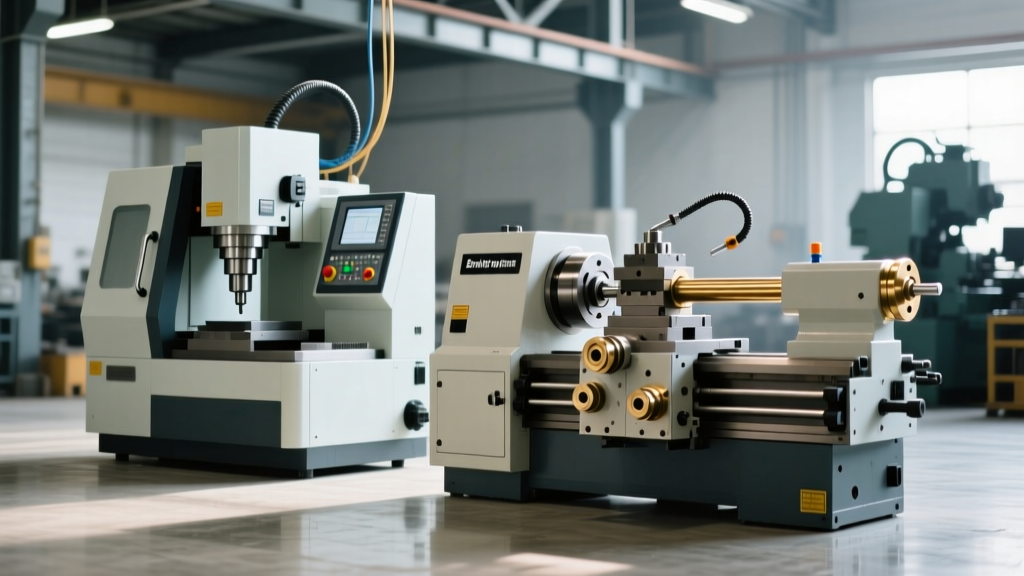
A new Citizen M12 or Tsugami BO12 costs upwards of $250,000. Consequently, the 'entry-level' market for makers is bifurcated into two distinct paths: acquiring used industrial single-spindle CNC screw machines, or adapting desktop CNC lathes with bar-pullers and subspindles to simulate screw-machine workflows. This analysis breaks down the mechanical realities, true costs, and production limits of both approaches for the 2026 maker economy.
⚠️ Infrastructure Reality Check: True CNC screw machines require 220V 3-phase power (often necessitating a $3,000+ rotary phase converter for residential shops), 100+ PSI compressed air for actuators, and a dedicated bar feeder (like an LNS Hydrobar) that adds another 6 feet to the machine footprint. Desktop lathes operate on standard 110V/220V single-phase and fit on a heavy-duty workbench.Path A: True Entry-Level CNC Screw Machines (The Used Market)
For makers producing parts with an L:D ratio greater than 3:1 (e.g., an M3x15mm screw), standard chucking fails due to part deflection. CNC screw machines solve this by supporting the material in a guide bushing located millimeters away from the cutting tool. As the tool cuts, the spindle feeds the bar stock through the bushing, ensuring zero deflection.
The Contender: Used Tsugami BO12-III / Citizen M12
In the 2026 secondary market, a well-maintained 2014-2018 Tsugami BO12-III (12mm capacity, 5-axis) typically trades between $38,000 and $55,000. While this is the 'entry-level' for actual Swiss machines, it demands serious technical overhead.
- Guide Bushing Clearances: You must purchase precision ground stock (e.g., h6 tolerance). Standard cold-rolled stock will jam the guide bushing, causing catastrophic spindle stalls.
- Remnant Management: Without a subspindle to catch the cutoff remnant, the final 80mm of every bar stock is wasted as scrap—a critical cost factor when machining expensive alloys like Ti-6Al-4V.
- CAM Complexity: Programming Swiss machines requires kinematic-aware CAM software (like Esprit or Fusion 360's advanced Swiss module) to manage overlapping toolpaths and prevent guide bushing collisions.
'The defining advantage of a CNC screw machine isn't just speed; it's the ability to hold ±0.0002-inch tolerances on a 20mm long, 2mm diameter pin without using a tailstock. You simply cannot replicate that rigidity on a standard desktop lathe.' — Senior Manufacturing Engineer, Precision Turned Parts Division
Path B: The Desktop CNC Lathe Alternative
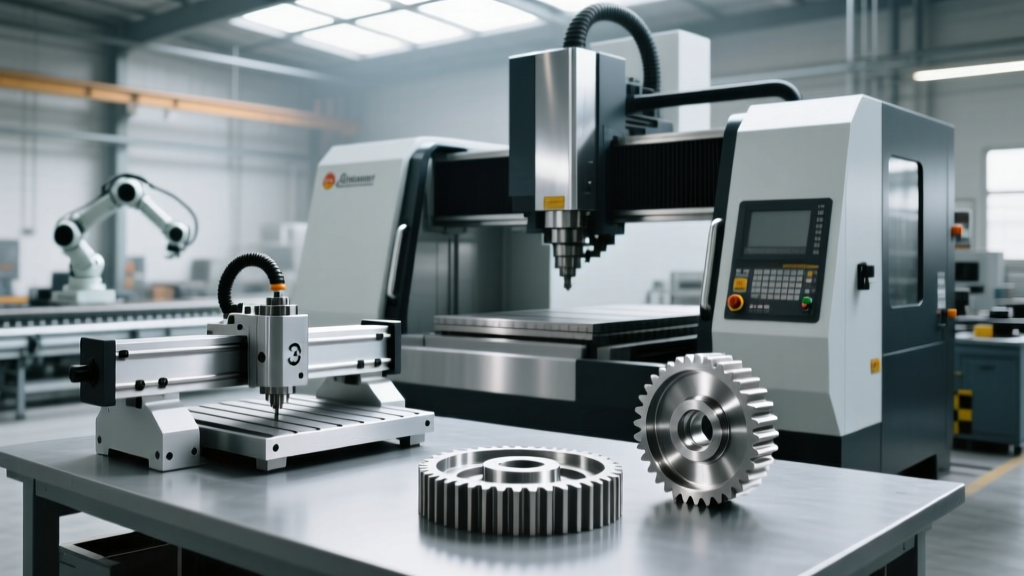
If your shop lacks 3-phase power or the $50,000+ capital for a used Swiss machine, the alternative is utilizing a high-end desktop CNC lathe equipped with a bar puller and, ideally, a subspindle. While they lack a guide bushing, modern desktop machines can automate small-batch screw production up to their Z-axis travel limits.
The Contender: Tormach 8L vs. Haas DS-10C
The Tormach 8L remains the dominant entry-level CNC lathe for hobbyists, priced around $9,490 (base). It handles up to 1-inch bar stock but requires manual bar advancement or a makeshift pneumatic pusher for automated runs. For makers needing true automation, the Haas DS-10C (approx. $68,000) offers a Y-axis, C-axis, and subspindle in a compact footprint, effectively bridging the gap between a desktop lathe and a full CNC screw machine.
Simulating Screw Machine Operations
To mimic a CNC screw machine on a Tormach 8L or similar benchtop lathe, makers use a gripper-style bar puller. The program turns the OD, grooves, and threads the part, then the bar puller grabs the finished part, pulls the raw stock out of the spindle to a programmed Z-stop, and the cutoff tool separates the finished screw. This works flawlessly for parts with an L:D ratio under 3:1.
Head-to-Head Comparison Matrix
| Feature | Used Tsugami BO12 (Swiss) | Tormach 8L (Desktop) | Haas DS-10C (Compact Production) |
|---|---|---|---|
| 2026 Market Price | $38k - $55k | $9.5k - $12k | $65k - $72k |
| Guide Bushing | Yes (Sliding Headstock) | No (Fixed Headstock) | No (Fixed Headstock) |
| Max L:D Ratio | 20:1+ | 2:1 (without tailstock) | 4:1 (with subspindle support) |
| Power Requirement | 220V 3-Phase (20A+) | 110V/220V Single Phase | 220V Single or 3-Phase |
| Automated Bar Feed | Required (Hydrobar/Magazine) | Manual / Bar Puller Only | Optional Servo Bar Feeder |
| Live Tooling (Milling) | Standard (Cross/End) | Limited (ATC Turret add-on) | Standard (Y-Axis capable) |
Troubleshooting: Chatter in Long-Diameter Parts
The most common failure mode when makers attempt to produce screws on desktop lathes without a guide bushing is harmonic chatter during threading or deep grooving. If you are restricted to a machine like the Tormach 8L, implement these specific mitigation strategies:
- Use a Floating Reamer / Tailstock Support: You must support the distal end of the part. If your desktop lathe lacks a CNC-controlled tailstock, you must manually set the tailstock for each bar pull, destroying cycle times.
- Optimize Insert Geometry: Switch from standard CCMT inserts to sharp, PVD-coated CCGT inserts designed for aluminum and soft steels. The lower cutting forces reduce the radial pressure that causes the unsupported stock to bend away from the tool.
- Spindle Speed Mapping: Run a tap test or use a smartphone accelerometer app to identify the natural resonant frequency of your specific bar stock overhang. Adjust your RPM to avoid the harmonic node (usually shifting RPM by ±15% eliminates the chatter instantly).
Decision Framework: Which Path Should You Take?
Choose a Used CNC Screw Machine (Tsugami/Citizen) IF:
- Your primary parts are >15mm long and <5mm in diameter (high L:D ratio).
- You are machining difficult materials (Inconel, Titanium, 316 Stainless) where constant guide bushing support prevents work-hardening and tool deflection.
- You require untended, overnight production runs of 5,000+ parts per batch.
- You have access to 3-phase power and 8+ feet of linear floor space.
Choose a Desktop CNC Lathe (Tormach 8L) IF:
- Your screws and fittings are relatively stubby (L:D ratio under 3:1).
- You are prototyping and iterating designs daily, where the 15-minute setup time of a desktop chuck beats the 2-hour guide bushing and collet changeover of a Swiss machine.
- Your budget is strictly under $15,000 and your shop is in a residential or light-commercial zone with single-phase power limits.
Final Tooling Note for Makers
Regardless of the machine chosen, investing in high-pressure coolant (HPC) is non-negotiable for small-diameter screw machining. In deep-hole drilling (e.g., center-drilling a 2mm screw for a cross-hole), standard flood coolant cannot penetrate the cutting zone. A 1,000 PSI HPC system clears the chips from the micro-flutes, preventing the flute-packing that instantly snaps micro-drills in Swiss and desktop operations alike.