2026 CNC Machine Reviews: Best Entry-Level Routers for Makers
2026 CNC machine reviews comparing Shapeoko 5, Onefinity Woodworker, and Sienci LongMill. Find specs, hidden costs, and drive system trade-offs for makers.
The Serious Hobbyist Tier: Skipping the $200 Toy Routers
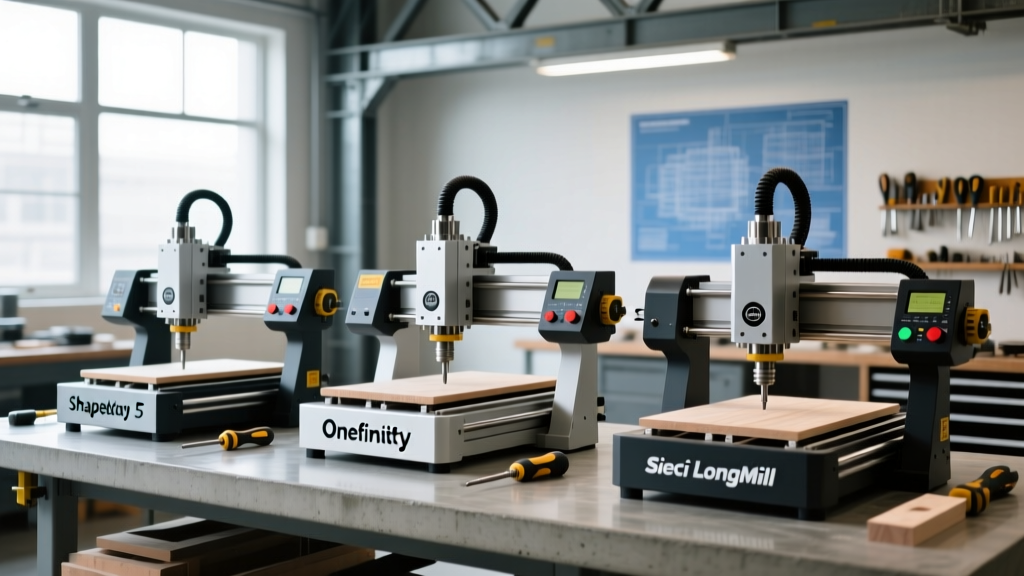
If you are attempting to machine 6061-T6 aluminum, carve dense hardwoods, or mill FR4 PCBs, the sub-$500 Amazon routers will fail you. Their 8mm steel rails and 775 brushed motors lack the rigidity and torque required for sustained material removal. This analysis focuses strictly on the $1,500 to $2,500 'serious hobbyist' tier—machines capable of holding 0.005-inch tolerances across a 4x4 foot work envelope. Based on extensive teardowns, kinematic testing, and community failure-mode reports, we evaluate the three dominant platforms defining the maker space in 2026: the Carbide 3D Shapeoko 5, the Onefinity Woodworker, and the Sienci Labs LongMill MK2.
Information Gain: Do not evaluate these machines solely by their working area. A 4x8 machine with a belt-driven Y-axis will suffer from 'racking' (where one side of the gantry lags behind the other) far more than a 4x4 machine with a mechanically linked or dual-motor ball screw system. Always prioritize drive-system rigidity over table size.Drive System Decision Matrix: Belt vs. Lead Screw vs. Ball Screw
Before dissecting specific models, you must understand the kinematic trade-offs. The drive system dictates your machine's backlash, maintenance schedule, and maximum rapid traverse rates.
| Drive Type | Pros | Cons | Best For |
|---|---|---|---|
| Belt (GT3) | High rapid speeds (up to 300 IPM), low cost, quiet. | Prone to stretching; requires frequent tensioning; lower Z-axis load capacity. | Woodworking, plastics, sign making. |
| Lead Screw (T8) | Inherently self-locking (no Z-axis drop on power loss), inexpensive. | High friction, requires backlash compensation, suffers from 'screw whip' at high RPMs on long axes. | Budget aluminum milling, 3D carving. |
| Ball Screw (SFU1605) | Near-zero backlash, high load capacity, extremely rigid. | Expensive, requires regular greasing, no self-locking (Z-axis needs a brake or counterbalance). | Precision aluminum/brass milling, production runs. |
Carbide 3D Shapeoko 5 Standard Review
The Shapeoko 5 remains the benchmark for out-of-the-box usability. Carbide 3D has refined the extrusion profiles, utilizing a hybrid table that integrates T-slots directly into the aluminum extrusions, eliminating the need for a separate MDF spoilboard if you prefer mechanical clamping.
Specifications & Real-World Performance
- Working Area: 16" x 16" x 3.5" (Standard) up to 48" x 48" (XXL).
- Drive: 9mm GT3 Belts on X/Y; 8mm lead screw on Z.
- Stepper Motors: NEMA 23 (340 oz-in).
- Base Price: ~$1,799 (Router not included).
The Aluminum Test: When machining 6061-T6 aluminum using a 1/4" single-flute carbide endmill, the Shapeoko 5 comfortably handles a 0.040" depth of cut (DOC) at 12,000 RPM and 35 IPM feed rate. Pushing the DOC past 0.060" induces harmonic chatter that visibly degrades surface finish.
Known Failure Mode: The Y-axis belts on the 4x4 (XL) and 4x8 (XXL) models are notorious for stretching after the first 40 hours of runtime. Because the belt tensioners are located at the rear of the machine, adjusting them requires removing the rail covers. Plan to perform a full belt tensioning and squareness calibration after your first month of heavy use. Refer to the Carbide 3D official assembly documentation for the exact tensioning sequence.Onefinity Woodworker (Ball Screw Edition) Review
Onefinity disrupted the market by introducing ball screws to the sub-$2,500 tier. The Woodworker model features a 32" x 32" cutting area and utilizes SFU1605 ball screws on all three axes, driven by closed-loop stepper motors.
Specifications & Real-World Performance
- Working Area: 32" x 32" x 4.5".
- Drive: SFU1605 Ball Screws (X/Y/Z).
- Stepper Motors: NEMA 23 Closed-Loop.
- Base Price: ~$2,199.
The Rigidity Advantage: The ball screws eliminate the belt-stretch issue entirely. When cutting 3D relief carves in hard maple, the Onefinity maintains aggressive acceleration rates (up to 500 mm/s²) without losing steps, thanks to the closed-loop encoders that correct positional errors in real-time.
Maintenance Gotcha: Ball screws are not 'set and forget'. The recirculating ball bearings inside the SFU1605 nuts require lithium-based grease (like Mobilux EP2) every 40 to 50 hours of runtime. If you run the machine dry, the ball bearings will score the screw raceways, resulting in catastrophic backlash that requires a $150 nut replacement.
Sienci Labs LongMill MK2 48x30 Review
Sienci Labs approaches CNC from an open-source, hacker-centric perspective. The LongMill MK2 uses ACME lead screws on all axes. While lead screws are technically inferior to ball screws in friction and speed, Sienci's implementation is heavily over-engineered, utilizing anti-backlash nuts and high-quality Delrin bushings.
Specifications & Real-World Performance
- Working Area: 48" x 30" x 4.5".
- Drive: T8 Lead Screws (X/Y/Z).
- Controller: Sienci LongBoard (GRBL 1.1h).
- Base Price: ~$1,599.
GRBL Tuning Requirement: Out of the box, the LongMill will exhibit roughly 0.08mm of backlash on the X and Y axes due to the lead screw nuts. You must manually tune the GRBL backlash compensation settings. Access the console and set $130=0.05 and $131=0.05 (adjust based on your specific dial indicator measurements). The Sienci Labs documentation portal provides a step-by-step dial indicator calibration guide that is mandatory reading before your first cut.
$110) capped at 2500 mm/min (approx 98 IPM) to maintain precision.
Head-to-Head Comparison Matrix
| Feature | Shapeoko 5 (Standard) | Onefinity Woodworker | Sienci LongMill MK2 |
|---|---|---|---|
| Drive System | Belts (X/Y), Lead Screw (Z) | Ball Screws (All Axes) | Lead Screws (All Axes) |
| Max Feed Rate (Practical) | 150 IPM | 200 IPM | 100 IPM |
| Z-Axis Travel | 3.5 inches | 4.5 inches | 4.5 inches |
| Controller | Carbide Motion (Proprietary) | BuildBotics (LinuxCNC based) | LongBoard (GRBL 1.1) |
| Ease of Assembly | High (Pre-assembled gantry) | Medium (Heavy ball screw alignment) | Medium (Extensive wiring) |
The Hidden Costs: Spindles, Workholding, and Dust Collection
Reading maker project guides will quickly reveal that the base price of a CNC router is only 60% of your actual startup cost. Budget for the following ecosystem requirements:
1. The Spindle Upgrade (Makita vs. VFD)
All three machines ship without a router. The default community choice is the Makita RT0701C trim router (~$119). While it offers 1.25 HP and acceptable runout (0.001"), it is incredibly loud (85+ dB) and lacks electronic speed control under load. For serious aluminum milling, upgrade to a 1.5kW VFD spindle (like the Huanyang or P2X series, ~$350). VFD spindles maintain constant torque at low RPMs, which is critical for clearing chips when slotting aluminum.
2. Workholding and Spoilboards
Do not rely solely on double-sided tape and toggle clamps. Invest in a 3/4" MDF spoilboard and a set of 1/4"-20 T-track inserts. Flattening your spoilboard with a 1-inch surfacing bit should be your very first operation to ensure your Z-axis zero is perfectly parallel to the cutting plane across the entire bed.
3. Dust Collection
CNC routing generates fine particulate that will destroy your stepper motor bearings and ruin your shop's air quality. A standard shop-vac is insufficient for static dissipation. You need a dust collector with a minimum 600 CFM rating and anti-static PVC hose routing to prevent static shocks that can reset your GRBL controller mid-job.
Final Verdict: Which Machine Fits Your Workflow?
Choose the Shapeoko 5 if you prioritize software ecosystem (Carbide Create is the best entry-level CAD/CAM available) and want a machine that requires minimal mechanical tinkering out of the box. Choose the Onefinity Woodworker if you plan to run long, unattended 3D carving jobs in hardwoods and need the reliability of closed-loop ball screws. Choose the Sienci LongMill MK2 if you are on a strict budget, require the largest cutting envelope (48x30), and enjoy the process of manually tuning GRBL parameters and open-source firmware.