Desktop CNC Prototyping: Sourcing Repair Services for CNC Machines
Evaluate top desktop CNC mills for prototyping. Learn to navigate repair services for CNC machines, calculate TCO, and diagnose common spindle failures.
The Prototyping Bottleneck: Maintainability in Micro-Machining
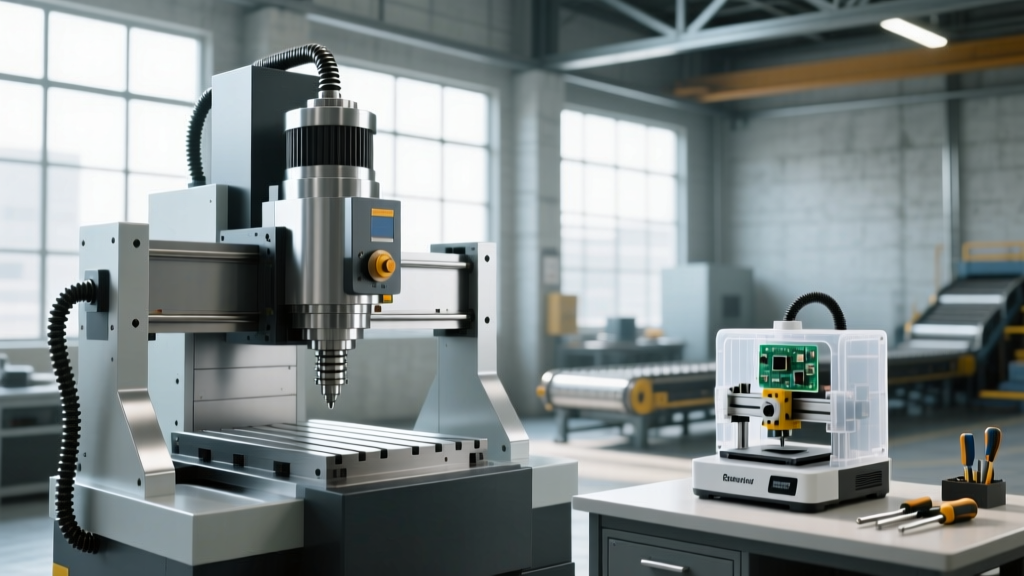
Desktop CNC machines bridge the critical gap between FDM 3D printing and full-scale industrial vertical machining centers (VMCs). For engineering teams producing functional metal or high-density polymer prototypes, desktop mills offer vital in-house capability. However, equipment selection guides frequently ignore the aftermarket support ecosystem. When a $4,000 desktop mill crashes a tool into the spoilboard, the downtime can halt an entire prototyping sprint. Unlike 10,000-lb industrial machines supported by localized OEM technicians, finding dedicated repair services for CNC machines in the sub-1,000-lb category requires a fundamentally different strategy.
Warning: The Plug-and-Play MythDesktop CNCs are often marketed as plug-and-play. In reality, micro-machining aluminum (6061-T6) or brass generates significant thermal load and vibration. Expect spindle bearing degradation and ball screw backlash to require calibration or component replacement within 1,500 to 2,000 cutting hours.
2026 Desktop CNC Market Snapshot & Repairability Matrix
Selecting a prototyping mill requires evaluating the machine's mechanical architecture alongside the availability of replacement parts. Below is an analysis of the three dominant platforms in the desktop prototyping space, graded on their serviceability.
| Machine Model | Base Price (2026) | Spindle / Motion System | Repairability Score |
|---|---|---|---|
| Bantam Tools Desktop CNC | $4,299 | 250W Brushless DC / NEMA 23 Steppers | High (Modular) |
| Pocket NC VMC-5 | $24,999 | 125W High-Freq / 5-Axis Harmonic Drives | Low (Proprietary) |
| Carbide 3D Shapeoko 5 | $2,499 | Makita Router / V-Wheel Gantry | Very High (Open) |
Navigating Repair Services for CNC Machines in the Micro-Class
When OEM warranties expire, sourcing reliable repair services for CNC machines of this size presents a unique economic challenge. Industrial machinery repair technicians typically charge $150 to $225 per hour, with minimum on-site call-out fees that can exceed the residual value of a desktop router. Therefore, the traditional heavy-machinery service route is financially unviable.
Instead, prototyping labs must pivot to adjacent technical disciplines. According to workforce data from SME (Society of Manufacturing Engineers), the most effective third-party repair services for desktop CNCs are often found in:
- Instrument Calibration Labs: Facilities that service CMMs (Coordinate Measuring Machines) and optical comparators possess the micron-level dial indicators and laser interferometers required to realign a desktop CNC's linear rails.
- Industrial Electronics Repair Shops: Technicians who rebuild PLCs and VFDs are best equipped to diagnose blown stepper drivers, faulty limit switch optocouplers, and spindle ESC (Electronic Speed Controller) failures.
- University Makerspace Technicians: Many academic fabrication labs employ master technicians who maintain fleets of Bantam and Shapeoko machines; they frequently take on private contract repair work.
Diagnostic Decision Tree: DIY Troubleshooting vs. Professional Repair
Before outsourcing to repair services for CNC machines, prototyping teams should run through a structured diagnostic sequence to isolate the failure domain. Misdiagnosing a software parameter as a mechanical failure leads to unnecessary shipping and RMA (Return Merchandise Authorization) delays.
Pro-Tip: The Dial Indicator BaselineKeep a 0.0001-inch resolution dial indicator mounted on a magnetic base in your prototyping lab. You cannot accurately communicate with repair technicians without quantified backlash and runout data.
Symptom 1: Severe Surface Finish Chatter in Aluminum
- Step 1 (DIY): Measure TIR (Total Indicator Runout) at the tool tip. If TIR exceeds 0.0005 inches, replace the ER11 collet and retention knob. Collets wear out after 400 hours of use.
- Step 2 (DIY): Check GRBL or Mach4 acceleration parameters. Reduce G-code jerk limits (J) by 20% to prevent micro-stalling.
- Step 3 (Call Repair Services): If runout persists with a new collet, the spindle cartridge bearings are pitted. This requires a clean-room spindle rebuild, necessitating professional repair services for CNC machines equipped with bearing presses and dynamic balancing rigs.
Symptom 2: Axis Positional Drift and Lost Steps
- Step 1 (DIY): Inspect the motor-to-leadscrew couplers. The set screws on aluminum helical couplers frequently loosen under the harmonic vibration of machining Delrin or POM.
- Step 2 (DIY): Use an infrared thermometer to check stepper motor casings. If temperatures exceed 80°C (176°F), the NEMA 23 motors are at risk of permanent neodymium demagnetization. Lower the DIP switch current limit on the stepper drivers.
- Step 3 (Call Repair Services): If motors run cool but drift occurs, the issue is likely EMI (Electromagnetic Interference) corrupting the step/direction signals. A technician must re-route shielded cables and install ferrite chokes.
According to guidelines published by NIST Advanced Manufacturing, maintaining strict environmental controls—specifically limiting ambient temperature fluctuations to less than 5°C during operation—can reduce thermal growth errors in desktop-class machine frames by up to 40%, significantly extending the interval between mechanical realignments.
Total Cost of Ownership (TCO) Calculator Framework
Equipment selection must account for the inevitable degradation of precision components. The following framework models a 3-year TCO for a high-utilization prototyping environment (approx. 1,500 cutting hours annually), factoring in estimated repair and calibration costs.
| Cost Category | Bantam Tools Desktop | Pocket NC VMC-5 | Shapeoko 5 Pro |
|---|---|---|---|
| Initial Hardware | $4,299 | $24,999 | $2,499 |
| 3-Yr Tooling & Collets | $1,450 | $3,200 | $900 |
| Est. Out-of-Warranty Repairs | $650 (Spindle rebuild) | $2,800 (Harmonic drive service) | $250 (V-wheels & belts) |
| Preventative Calibration | $300 | $1,200 | $0 (User-adjustable) |
| 3-Year TCO | $6,699 | $32,199 | $3,649 |
Establishing a Preventative Maintenance SLA
To minimize reliance on emergency repair services for CNC machines, prototyping labs should implement a strict Preventative Maintenance (PM) schedule. This shifts the operational model from reactive troubleshooting to proactive preservation.
- Weekly (8 Hours): Purge linear guide rails with compressed air. Re-apply ISO 68 way oil (e.g., Mobil Vactra No. 2). Never use WD-40 or dry PTFE sprays, which attract micro-fines and create an abrasive lapping compound.
- Monthly (40 Hours): Check ball screw preload. If axial play exceeds 0.001 inches, adjust the double-nut preload spacer or replace the Delrin anti-backlash nuts.
- Bi-Annually (500 Hours): Re-grease harmonic drives (specific to 5-axis desktop units) using specialized molybdenum disulfide (MoS2) greases. Standard lithium greases will break down under the high-shear environment of harmonic gearing.
By understanding the mechanical limitations of desktop-scale equipment and establishing relationships with specialized electronics and calibration technicians, engineering teams can maintain tight-tolerance prototyping capabilities without the overhead of full-scale industrial machine maintenance contracts.