CNC Punching Machines: Dust Collection & Chip Conveyor Maintenance
Master dust collection and chip conveyor maintenance for CNC punching machines. Learn exact CFM specs, filter schedules, and slug removal troubleshooting.
The Unique Waste Profile of CNC Punching Machines
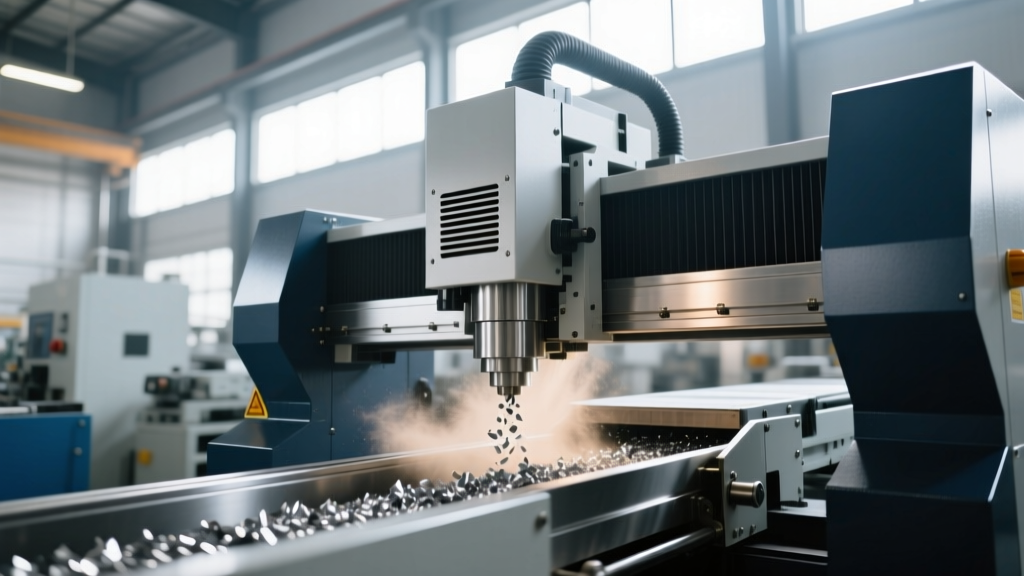
Unlike CNC milling centers that produce continuous, spiraled metal chips, CNC punching machines generate a fundamentally different waste stream. Equipment like the Trumpf TruPunch 5000 or Amada EM 3610 ZRT creates discrete, sharp metal slugs alongside ultra-fine, work-hardened shearing dust. This micro-dust is highly abrasive and, if left unchecked, infiltrates linear guideway blocks (such as THK or NSK carriages), causing premature recirculating ball bearing failure. Furthermore, the heavy slugs can jam standard hinge-belt conveyors, leading to catastrophic motor burnouts. Effective dust collection and chip management are not optional accessories; they are critical subsystems that dictate the uptime and longevity of your sheet metal fabrication cells.
⚠️ Critical Safety Warning: Aluminum, magnesium, and certain coated steel fines generated during high-speed punching are highly combustible. Failing to properly ground your ductwork or using standard cellulose filters instead of anti-static PTFE membrane cartridges violates OSHA combustible dust standards and risks catastrophic deflagration inside the collection hopper.Sizing and Specifying Extraction Systems
Undersized extraction systems lead to slug retention in the die and micro-dust settling on servo encoders. When specifying or auditing a dust collection system for CNC punching machines, you must calculate both Cubic Feet per Minute (CFM) and Static Pressure (SP) based on the machine's tonnage, table size, and whether it operates as a standalone punch or a laser-punch combo cell.
| Machine Class & Example Models | Required CFM | Static Pressure (SP) | Duct Velocity Target |
|---|---|---|---|
| Light Duty (<20 Ton) e.g., Amada AE 2510 |
800 - 1,200 | 2.0" w.g. | 3,500 FPM |
| Medium Duty (20-30 Ton) e.g., Trumpf TruPunch 3000 |
1,500 - 2,000 | 3.0" w.g. | 3,800 FPM |
| Heavy Duty / Combo (Laser+Punch) e.g., Salvagnini P4 / Trumpf TruMatic |
2,500 - 3,500 | 4.0"+ w.g. | 4,000+ FPM |
Maintaining a minimum duct velocity of 3,500 to 4,000 Feet Per Minute (FPM) is non-negotiable for metal dust. If velocity drops below this threshold, heavy slugs and dense fines will settle in horizontal duct runs, creating blockages that starve the machine hood of suction.
The Scrap Conveyor: Mechanics and Preventative Maintenance
The scrap conveyor is the first line of defense in chip management. Most modern CNC punching machines utilize either a heavy-duty hinge-belt conveyor or a magnetic slider-bed conveyor. Hinge-belt conveyors are prone to jamming when small, sharp slugs wedge between the belt hinges and the side frames.
500-Hour Conveyor Maintenance Checklist
- Belt Tension and Tracking: Check the take-up bearings at the tail pulley. The belt should have exactly 1/2 inch of deflection at mid-span when 10 lbs of downward force is applied. Over-tensioning accelerates head-shaft bearing wear, while under-tensioning causes the drive sprockets to skip teeth.
- Lubrication: Purge and re-grease the conveyor chain and head-shaft bearings. Use an NLGI #2 lithium complex grease (such as Mobilux EP 2). Avoid synthetic oils, which attract and bind micro-dust into a grinding paste.
- Wiper Blade Inspection: Inspect the polyurethane wiper blade at the head pulley. If the edge is rounded or chipped, slugs will carry over into the return path, eventually jamming the tail pulley. Replace wiper blades every 1,000 hours.
- Magnetic Head Pulley (If Equipped): Clean the magnetic separator bars. Wipe down the stainless steel sleeves to remove oily residue that reduces magnetic flux density, ensuring ferrous slugs are properly separated before the belt return.
Filter Media and Pulse-Jet Calibration
The heart of the dust collection system is the filter bank. For CNC punching machines processing mild steel, stainless steel, and aluminum, standard polyester cartridges are insufficient. You must utilize nanofiber or PTFE membrane cartridges (MERV 15 or higher) to capture sub-micron shearing dust.
"The most common failure in punch press dust collection isn't the filter media itself, but the pulse-jet cleaning system. If the compressed air isn't perfectly dry, moisture causes metal fines to cake onto the pleats, permanently blinding the cartridge in a matter of weeks."
Optimizing the Pulse-Jet Cleaning Cycle
The pulse-jet system uses high-pressure bursts of air to expand the filter cartridge and snap dust off the surface. To maintain optimal performance:
- Air Pressure: Maintain compressed air pressure between 90 and 100 PSI at the receiver tank. Pressures below 80 PSI will fail to fully flex the cartridge, leading to dust buildup deep in the pleats.
- Air Quality: Install a coalescing filter and desiccant dryer upstream of the pulse valves. Oil and water aerosols from the compressor will mix with metal dust to form a concrete-like sludge on the filters.
- Solenoid and Diaphragm Valves: Inspect ASCO Numatics or Goyen diaphragm valves every 2,000 hours. A torn diaphragm will cause continuous air bleeding, dropping system pressure and failing to clean downstream filters. Rebuild kits cost under $40 and take 15 minutes to install.
- Differential Pressure (DP): Monitor the Magnehelic gauge. A clean filter reads between 1.0" and 1.5" w.g. If the DP consistently exceeds 2.5" w.g. even after pulse cleaning, the cartridges are blinded and must be replaced immediately.
Troubleshooting Slug Retention and Conveyor Jams
When chip management fails, the symptoms manifest directly on the punch table. Use this decision framework to diagnose and resolve common extraction issues.
Symptom: Slugs Sticking to the Punch Tool or Die
Cause: Micro-welding from heat, or lack of localized extraction suction at the die base, allowing static-charged fines to act as an adhesive.
Fix: Install a localized die-vacuum ring connected directly to the main duct. Increase the static pressure at the hood by adjusting the manual blast gate by 0.5" w.g. Ensure punch-to-die clearance is strictly maintained at 15-20% of material thickness to reduce slug burring and micro-welding.
Symptom: Conveyor Belt Slipping or Stalling Under Load
Cause: Hydraulic oil leaks from the punch ram mixing with metal fines, creating a lubricated layer on the drive sprockets, or severe slug bridging in the scrap chute.
Fix: First, locate and seal the hydraulic leak (often a worn rod seal on the stripping cylinder). Clean the drive sprockets and belt hinges with an industrial alkaline degreaser. If bridging occurs in the chute, weld internal 1/4" steel baffles at 45-degree angles to break the slug flow and prevent interlocking jams.
Financial Impact: Preventative vs. Reactive Maintenance
Deferring maintenance on dust collection and chip conveyors yields a false economy. The financial data from sheet metal fabrication facilities clearly demonstrates that scheduled downtime for extraction maintenance is a fraction of the cost of reactive repairs.
| Maintenance Scenario | Estimated Cost | Machine Downtime |
|---|---|---|
| Preventative: Annual filter cartridge replacement, conveyor belt tensioning, and pulse-valve rebuild. | $850 - $1,400 | 4 - 6 Hours |
| Reactive: Replacing a linear guideway carriage destroyed by abrasive dust ingress. | $2,500 - $4,500 | 12 - 18 Hours |
| Reactive: Replacing a burned-out scrap conveyor drive motor and gearbox due to slug jamming. | $3,200 - $5,800 | 24+ Hours |
By adhering to strict 500-hour and 2000-hour maintenance matrices, facility managers protect high-value capital assets. Properly managing the dust and slugs generated by CNC punching machines ensures consistent part quality, protects operator health, and maximizes Overall Equipment Effectiveness (OEE) on the shop floor.