Safety Standards for a Portable CNC Machine for Hobbyist Field Work
Learn essential safety standards and compliance rules for operating a portable CNC machine for hobbyist field work, covering OSHA, NFPA 79, and PPE.
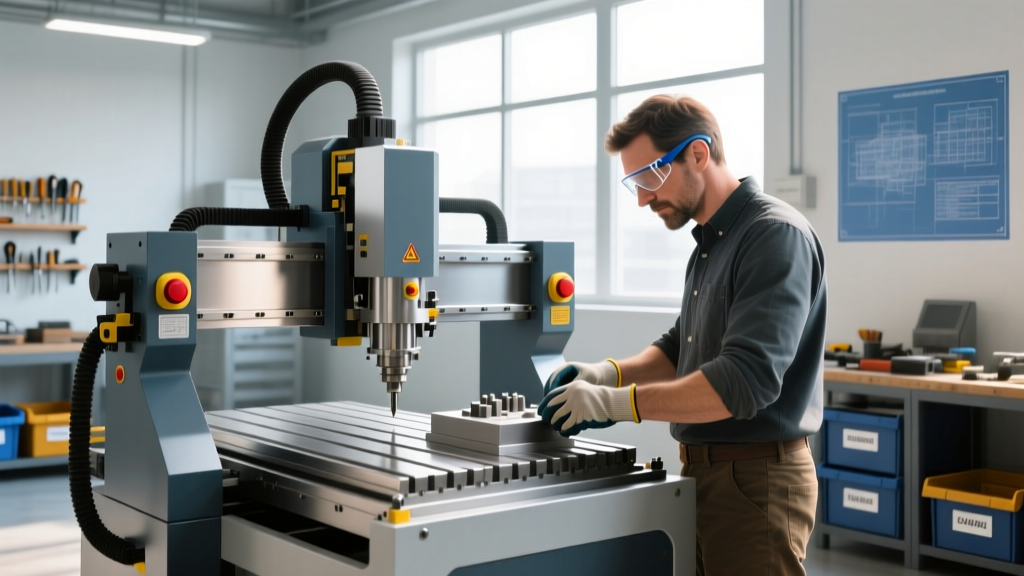
The transition from a controlled garage environment to an active, unpredictable job site introduces severe safety variables. While a standard cnc machine for hobbyist use is typically bolted to a heavy workbench in a climate-controlled space, portable variants—such as the Shaper Origin handheld router or the Langmuir Systems CrossFire portable plasma table—are increasingly deployed for on-site cabinetry, mobile welding prep, and remote repair. However, operating automated cutting tools in uncontrolled field environments bypasses the inherent safety of physical enclosures, requiring strict adherence to industrial compliance frameworks.
The Regulatory Gray Area: Hobbyist vs. Commercial Field Use
When a hobbyist takes a portable CNC tool to a job site to perform contracted work, the operation immediately falls under occupational safety jurisdictions. In the United States, the Occupational Safety and Health Administration (OSHA) does not regulate purely DIY home projects, but the moment compensation is involved, OSHA 1910.212 (General Requirements for All Machines) applies. This standard mandates that machines must be guarded to protect the operator and other employees from hazards such as rotating parts, flying chips, and sparks.
Portable CNCs inherently lack the polycarbonate enclosures found on industrial 3-axis mills. Therefore, the burden of compliance shifts from engineering controls (machine guarding) to administrative controls and Personal Protective Equipment (PPE), requiring a rigorous, documented safety protocol before the machine is powered on in the field.
CRITICAL WARNING: Operating any portable CNC cutting tool in damp or wet field conditions without a verified Ground Fault Circuit Interrupter (GFCI) and equipotential bonding plan is a severe electrocution risk. Never rely on standard extension cords for field deployment.Electrical Compliance: NFPA 79 and Portable Power
Field work rarely offers access to clean, stable grid power. Portable CNC systems rely on sensitive stepper drivers, DSP controllers, and vision systems that require precise voltage regulation. The NFPA 79 Electrical Standard for Industrial Machinery outlines strict requirements for machine grounding and overcurrent protection, which are notoriously difficult to maintain on temporary job sites.
When powering a portable CNC via a generator, Total Harmonic Distortion (THD) is the primary concern. High THD causes voltage spikes that can permanently damage the CNC's logic boards and cause erratic stepper motor behavior, leading to unpredictable toolpaths and potential tool breakage.
Generator Selection and Grounding Matrix
| Generator Type | THD Output | CNC Compatibility | Required Grounding Protocol |
|---|---|---|---|
| Standard Open-Frame (e.g., Generac GP3300) | 15% - 25% | FAIL - Will damage controllers | N/A |
| Inverter (e.g., Honda EU2200i) | < 3% | PASS - Safe for sensitive electronics | Floating neutral; bond neutral to ground if required by CNC manual |
| Solar/Battery Station (e.g., EcoFlow Delta Pro) | Pure Sine (0%) | OPTIMAL - Zero harmonic risk | Verify internal bonding; use external earth rod in damp soil |
For field deployments, an inverter generator rated at 2200W with a THD of less than 3% is the minimum acceptable power source for a 1.5kW spindle router. For portable plasma CNCs, which require high-amperage 120V/240V air compressors and plasma cutters simultaneously, dual-inverter parallel setups or heavy-duty battery stations are mandatory to prevent brownouts during arc initiation.
Mechanical Safeguards and ISO 13850 E-Stop Protocols
In a traditional shop, a CNC mill is surrounded by a physical perimeter. In the field, the perimeter is defined by caution tape and the operator's situational awareness. ISO 13850 dictates the functional requirements for Emergency Stop (E-Stop) devices. On portable systems like handheld CNC routers, the E-stop must be instantly accessible, hardwired to cut power to the spindle and drive motors, and require a manual twist-to-release reset.
Implementing Tethering and Proximity Safeguards
When operating a handheld CNC router on a ladder or elevated scaffolding, a drop or slip can result in the tool remaining engaged with the material while the operator falls. To comply with field safety best practices, implement a physical kill-switch tether. Attach a mechanical breakaway lanyard from the operator's harness to the CNC's external E-stop circuit. If the operator drops more than 18 inches, the lanyard pulls the E-stop plunger, instantly killing the spindle and engaging the router's electronic brake.
- Spindle Brake Latency: Ensure your portable router has an electronic braking system that halts the spindle in under 0.5 seconds. Free-spinning spindles can remain lethal for up to 15 seconds after power is cut.
- Vision System Calibration: Handheld CNCs rely on optical tracking. Field dust and changing sunlight angles can cause tracking loss, resulting in sudden, violent lateral movements. Always use the machine's UV or LED ring illuminators to maintain consistent contrast, regardless of ambient sun positioning.
Particulate Management and OSHA 1910.134 Compliance
Field environments often lack the infrastructure for centralized dust collection. Cutting materials like MDF, composite decking, or fiberglass on-site generates respirable crystalline silica and toxic formaldehyde particulates. According to the NIOSH Hierarchy of Controls, PPE is the last line of defense, but in mobile field work, it is often the only viable option.
Under OSHA 1910.134 (Respiratory Protection), employers (or self-employed contractors) must provide respirators that are appropriate for the specific hazard. An N95 mask is entirely insufficient for CNC routing of composite materials.
Field Respiratory Protocol: For portable CNC routing of engineered woods or composites, mandate a half-face elastomeric respirator (e.g., 3M 6200) equipped with P100 particulate filters and organic vapor cartridges (OV/P100). Standard dust masks fail to seal against sweat and facial hair common in outdoor field conditions.For portable CNC plasma cutting, the primary hazard is hexavalent chromium (when cutting stainless steel) and manganese fumes. Field wind can defeat local exhaust ventilation (LEV) hoods. In these scenarios, the operator must wear a Powered Air-Purifying Respirator (PAPR) integrated into a welding helmet, ensuring a positive-pressure airflow that prevents fume ingress even when crosswinds disrupt the extraction arm.
Pre-Deployment Field Safety Checklist
Before initiating a portable CNC cut on any job site, run through this mandatory compliance and safety verification framework:
- Surface Stability Verification: Confirm the work surface is level within 2 degrees. Portable CNCs with omnidirectional wheels or casters must have mechanical locks engaged on all axes to prevent creep during high-feed-rate movements.
- Equipotential Bonding (Plasma/Metal Cutting): Drive a copper ground rod into the soil and bond the machine chassis, the workpiece, and the generator frame together using minimum 8 AWG copper wire to prevent voltage gradients in damp conditions.
- Work Envelope Demarcation: Establish a physical barrier (not just visual tape) extending at least 4 feet beyond the maximum travel limits of the portable gantry or the radius of the handheld tether cord.
- Optical Sensor Audit: Wipe all tracking cameras and optical sensors with isopropyl alcohol. Verify that direct sunlight is not washing out the fiducial markers or domain tape.
- E-Stop Functional Test: Trigger the primary E-stop and any secondary tethered kill-switches while the spindle is at operating RPM to verify braking latency and power cutoff.
Operating a portable CNC in the field bridges the gap between hobbyist flexibility and industrial fabrication. However, the absence of a controlled environment means the operator must act as the primary safety interlock. By rigorously applying OSHA machine guarding principles, NFPA 79 electrical standards, and NIOSH particulate controls, mobile fabricators can maintain a zero-incident safety record while delivering precision work directly on the job site.