Budgeting for CNC Machines Operations: The Cost of Tolerances
Discover how accuracy and tolerance specifications impact the true cost of CNC machines operations. Learn to budget for precision without destroying ROI.
Most machine shop owners and manufacturing engineers budget for the iron—the base casting, the spindle horsepower, the axis travel, and the control package. They fatally underestimate the compounding capital expenditure required to hold specific accuracy and tolerance specifications. In precision manufacturing, the relationship between tolerance zones and financial outlay is not linear; it is aggressively exponential. Optimizing cnc machines operations requires a ruthless, data-driven approach to budget planning, ensuring you only pay for the precision your specific application demands.
The Tolerance Cost Multiplier
Industry axiom: Every time you divide a tolerance zone by 10 (e.g., moving from ±0.001' to ±0.0001'), the total cost of the operation does not increase by 10%. It multiplies by a factor of 3 to 5. This accounts for machine tool degradation, specialized tooling, environmental controls, and advanced metrology.
Decoding Machine Baselines: ISO 230 and Price Tags
When planning cnc machines operations budgets, you must align the machine's inherent geometric and positioning accuracy with the part's GD&T (Geometric Dimensioning and Tolerancing) requirements. The NIST Precision Engineering division and ISO 230 standards dictate how machine tool accuracy is measured, specifically focusing on positional accuracy and repeatability.
Consider the financial leap between a standard production mill and a high-precision linear-motor machine:
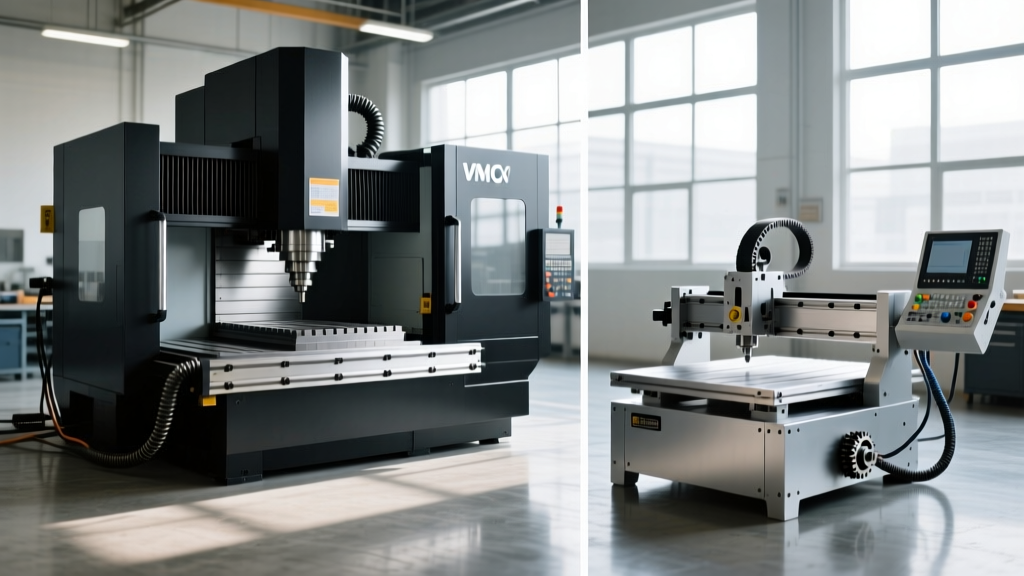
- Standard Production (e.g., Haas VF-2): Equipped with standard ball screws and rotary axis motors, a standard VF-2 offers a positional accuracy of roughly ±0.0002' (0.005 mm) and repeatability of ±0.0001'. The base machine cost hovers around $60,000 to $75,000 fully equipped. This is the workhorse for general tolerances (±0.001' to ±0.0005').
- High-Precision (e.g., DMG MORI HSC series or Kern Micro): Utilizing linear motors, direct-drive torque motors, and liquid-cooled ball screws/spindles to eliminate thermal growth, these machines achieve positioning accuracies of ±0.00004' (1 micron) or better. The capital expenditure jumps to $250,000 to $450,000+.
Budgeting mistake #1 is purchasing a $350,000 ultra-precision machine to hold ±0.0005' tolerances simply because 'it's a better machine.' The ROI on that capital expenditure will never materialize if the part print does not demand micron-level accuracy.
The Hidden Budget Drains in High-Precision Operations
The machine tool is only the entry fee. Holding tight tolerances in real-world cnc machines operations requires a holistic ecosystem, each component carrying a steep premium.
1. Thermal Stability and Facility Costs
Steel expands by approximately 0.0000064 inches per inch per degree Fahrenheit. On a 20-inch part, a mere 5°F temperature swing in the shop introduces 0.00064' of thermal growth—completely destroying a ±0.0002' tolerance zone. Standard machine shops operate at 68°F ± 5°F. High-precision operations require dedicated metrology and machining rooms held at 68°F ± 0.5°F. Upgrading from standard shop HVAC to a precision climate-control system with laminar airflow can add $80,000 to $150,000 to your facility budget.
2. Tooling and Workholding Premiums
Spindle runout and toolholder deflection are the silent killers of tight tolerances. Standard ER32 collet chucks ($50–$90 each) typically exhibit 0.0002' to 0.0004' of TIR (Total Indicator Runout) at 3x diameter projection. To hold sub-micron tolerances, operations must upgrade to hydraulic chucks or thermal shrink-fit holders ($150–$250 each), which guarantee less than 0.00005' TIR. Furthermore, shrink-fit systems require an induction heating/cooling unit, adding $12,000 to $18,000 to the initial tooling budget.
3. Metrology and Inspection Overhead
You cannot machine what you cannot measure. Verifying a ±0.001' feature requires a $200 digital micrometer. Verifying a ±0.0001' true position tolerance on a complex 3D contour requires a Coordinate Measuring Machine (CMM). A shop-grade Zeiss or Hexagon CMM easily commands $80,000 to $150,000, alongside the salary of a dedicated metrologist and annual calibration contracts costing $5,000+.
Cost Matrix: Standard vs. High-Precision Operations
The following matrix illustrates the true capital and operational expenditure required to support different tolerance tiers in modern manufacturing environments.
| Cost Category | Standard (±0.001' / 0.025mm) | High-Precision (±0.0002' / 0.005mm) | Ultra-Precision (±0.00004' / 0.001mm) |
|---|---|---|---|
| Machine Tool Capital | $50k - $90k | $150k - $250k | $300k - $500k+ |
| Toolholding System | ER Collets / Weldon ($50 ea) | Milling Chucks / Hydraulic ($180 ea) | Thermal Shrink + Induction Unit ($250 ea + $15k) |
| Facility / HVAC | Standard Shop (±5°F) | Zoned Enclosure (±2°F) | Cleanroom / Metrology Lab (±0.5°F) |
| Inspection Equipment | Calipers, Mics, Pin Gauges ($2k) | In-Machine Probing + Vision ($15k) | 5-Axis CMM + Laser Interferometer ($120k+) |
Decision Framework: Matching Tolerance to Application ROI
To prevent budget bleed, engineering and management teams must apply a strict decision framework before finalizing part prints or purchasing equipment. Do not default to tight tolerances out of an abundance of caution.
- Identify Mating Surfaces: Apply tight tolerances (±0.0002' or tighter) ONLY to features that interface with other components (e.g., bearing journals, aerospace sealing surfaces, optical mounts). Leave non-critical features at standard machining tolerances (±0.005' to ±0.010').
- Evaluate Assembly Adjustability: Can the assembly absorb the stack-up error? If an operator can use shims or adjustable brackets during assembly, machining the components to ultra-tight tolerances is a waste of capital.
- Consider the Material Factor: Budget for material-specific challenges. Machining 6061 Aluminum to ±0.0001' is vastly cheaper than machining Inconel 718 or Titanium to the same spec due to tool wear, cutting forces, and springback. If the material is gummy or work-hardening, increase the tolerance zone or budget for secondary grinding/honing operations.
'Precision is not a virtue in manufacturing; it is a cost. Apply it only where the function of the product absolutely demands it, and nowhere else.' — Principles of Design for Manufacturability (DFM)
Strategies to Optimize CNC Machines Operations Budgets
If your application genuinely demands high precision, you can mitigate the exponential cost curve through smart operational strategies rather than simply buying more expensive iron.
Implement In-Process Probing
Instead of relying entirely on post-process CMM inspection, integrate Renishaw machine tool probes and calibration systems directly into the CNC workflow. A $10,000 investment in an OMP60 touch probe allows the machine to automatically locate part datums, measure features mid-cycle, and update tool offsets in real-time to compensate for thermal drift and tool wear. This effectively turns a standard $80,000 machine into a much more capable asset, delaying the need for a $300,000 ultra-precision upgrade.
Custom Workholding and Soft Jaws
Clamping distortion is a primary cause of out-of-tolerance parts, especially in thin-walled components. Budgeting $2,000 for a set of custom-machined 6061 aluminum soft jaws or 3D-printed sacrificial fixtures distributes clamping forces evenly. This prevents the part from springing out of tolerance when removed from the vise, saving thousands in scrapped parts and secondary re-machining operations.
Routine Ballbar and Laser Calibration
Machine accuracy degrades over time due to ball screw wear, way lubrication breakdown, and crash damage. Allocating $8,000 annually for third-party laser interferometer calibration and ballbar testing (per ISO 230-4) ensures your machine is actually performing to its original spec sheets. Running high-precision cnc machines operations on an uncalibrated machine guarantees scrap rates that will obliterate your profit margins.
Ultimately, successful budget planning in CNC manufacturing requires decoupling the ego of 'making the most precise part possible' from the economics of 'making the required part profitably.' By understanding the true cost drivers of tolerance specifications, shops can allocate capital toward technology that yields a measurable return on investment.