Key Components of a CNC Machine: Industrial vs Consumer Grades
Compare core components of a CNC machine across industrial VMCs and desktop routers. Analyze spindles, drives, and controllers for 2026 buying decisions.
Structural Foundation: Cast Iron vs. Aluminum Extrusions
The most critical, yet frequently overlooked, component of any CNC machine is the frame. Rigidity dictates the machine's ability to absorb cutting forces without deflection, directly impacting surface finish and tool life.
Industrial VMC Architecture
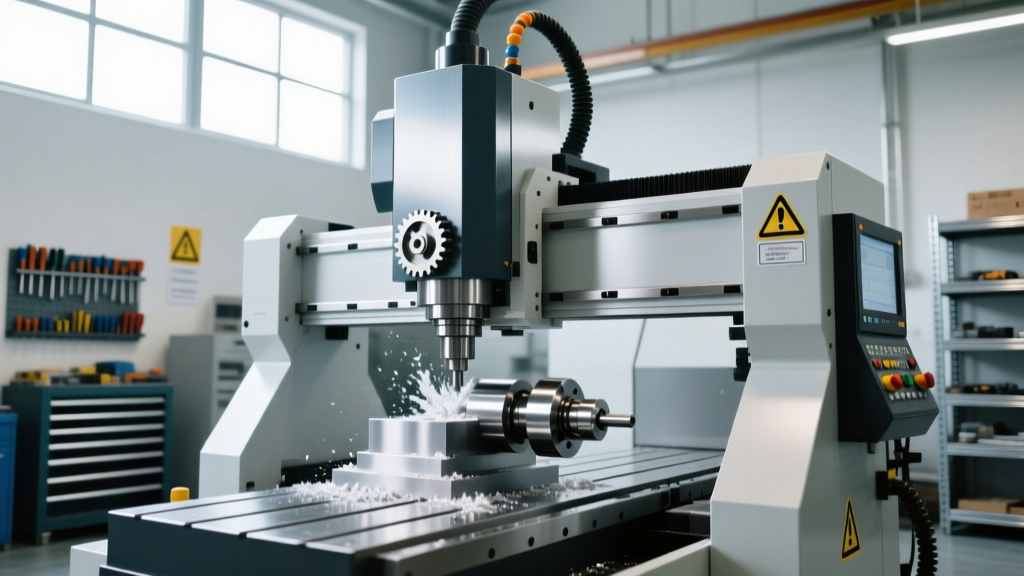
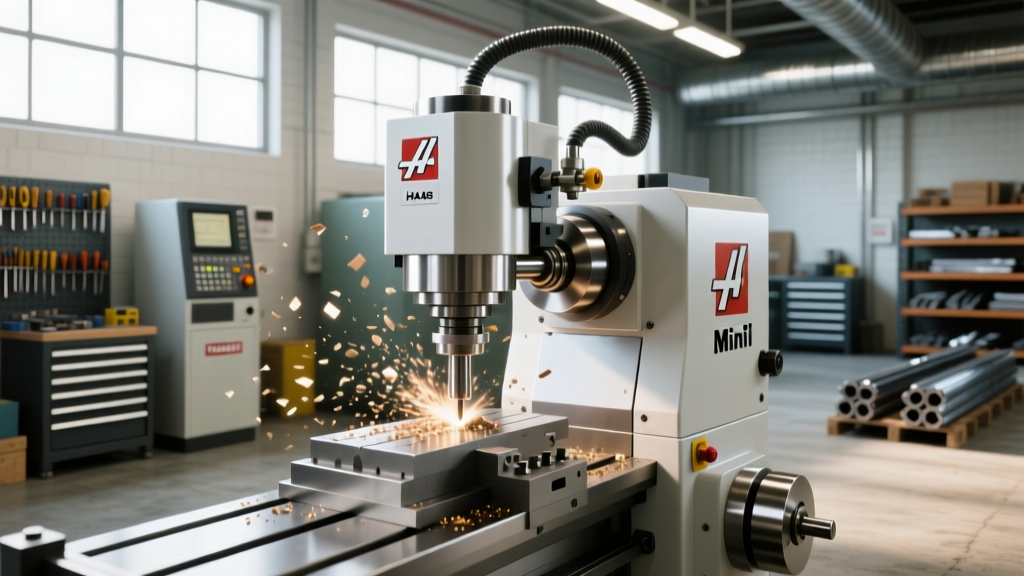
Industrial machines, such as the Haas VF-2, utilize Meehanite cast iron or polymer concrete (epoxy granite) for their base and column structures. Cast iron possesses a natural damping capacity approximately 10 times greater than steel or aluminum. This means high-frequency vibrations generated during heavy roughing passes (e.g., titanium or Inconel milling) are absorbed by the mass of the frame rather than transferring to the cutting tool. Furthermore, industrial frames feature wide, hardened box ways or massive preloaded linear guideways (45mm+ width) bolted to precision-machined mounting surfaces, ensuring geometric squareness within 0.0005 inches over the full travel.
Consumer/Desktop Architecture
Consumer-grade machines, like the Shapeoko 5 or Inventables X-Carve, rely on 6061-T6 aluminum extrusions (e.g., 80/20 T-slot profiles) and bent sheet metal. While aluminum is stiff for its weight, it lacks the mass and internal damping of cast iron. When a desktop router encounters hard materials like stainless steel, the frame acts as a tuning fork, amplifying chatter. This deflection forces operators to take shallow depths of cut (often under 0.5mm in steel) and rely on high spindle speeds to maintain acceptable cycle times.
Drive Systems: Servos, Steppers, and Ball Screws
The motion control components of a CNC machine determine positional accuracy, repeatability, and the ability to maintain torque at high feed rates.
Closed-Loop Servos vs. Open-Loop Steppers
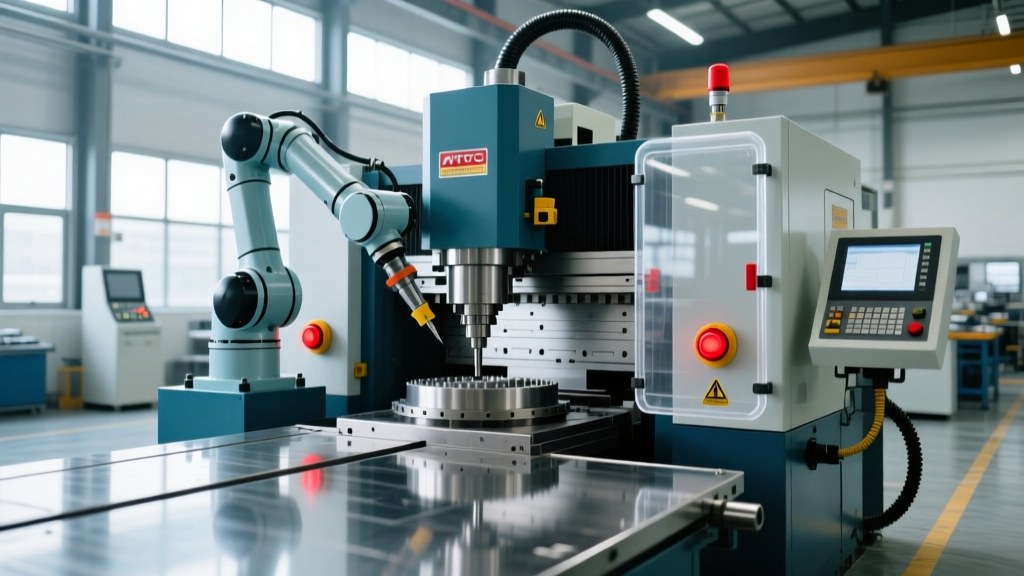
Industrial CNCs utilize closed-loop AC servo motors (e.g., Yaskawa or FANUC) equipped with high-resolution absolute encoders (typically 17-bit to 24-bit, yielding millions of pulses per revolution). If the cutting tool encounters a hard spot in the material and the motor lags, the encoder instantly detects the positional error and the drive injects additional current to correct it. This guarantees that the machine never 'loses steps' regardless of load.
Conversely, desktop CNCs predominantly use open-loop NEMA 23 or NEMA 34 stepper motors. Steppers operate by moving in discrete micro-steps without positional feedback. Under heavy lateral loads or rapid acceleration, the magnetic field can slip, causing the motor to lose steps. Because the controller has no feedback mechanism, the machine will continue executing the G-code from an incorrect coordinate, resulting in a scrapped part. While closed-loop stepper hybrids (e.g., ClearPath) are gaining traction in the prosumer space for 2026, they still lack the continuous torque curves and high-RPM velocity of true AC servos.
Ball Screw Accuracy Grades
Motion transfer is handled by ball screws, categorized by JIS (Japanese Industrial Standards) accuracy grades:
- C3 Grade (Industrial Standard): Offers a lead accuracy of 8 microns per 300mm. Industrial machines use preloaded, double-nut C3 or C5 ground ball screws. The preload eliminates axial backlash entirely, allowing for rigid tapping and precise reverse-direction contouring.
- C7 Grade (Consumer Standard): Offers a lead accuracy of 50 microns per 300mm. Desktop machines often use rolled C7 ball screws or, more commonly, V-belts and rack-and-pinion systems. Belts introduce micro-stretch and hysteresis, making tight-tolerance bore machining impossible.
Spindle Assembly and Bearing Tolerances
The spindle is the heart of the machine, and its internal bearing configuration dictates runout, thermal stability, and maximum cutting forces.
Thermal Growth Warning: In consumer trim routers running at 20,000+ RPM, friction in standard deep-groove bearings causes the spindle shaft to expand axially. This thermal growth can push the Z-axis zero point by 0.005" to 0.015" over a 30-minute warmup cycle, requiring constant manual Z-probing in precision woodworking or PCB milling.Industrial Spindles: VMCs utilize custom cartridge spindles housed in P4 (ABEC-7) precision angular contact bearings, arranged in back-to-back or face-to-face duplex pairs. This configuration handles both heavy radial cutting loads and massive axial thrust from drilling operations. Runout at the tool holder taper is strictly maintained below 0.0002 inches (5 microns). High-end models feature liquid-cooling jackets that circulate chilled glycol to maintain the spindle at a constant 20°C (68°F), neutralizing thermal growth entirely.
Consumer Spindles: Desktop routers typically integrate off-the-shelf trim routers (e.g., Makita, DeWalt) or compact brushless DC spindles (e.g., Carbide3D Compact Router). These rely on ABEC-3 deep groove ball bearings designed primarily for radial loads in handheld applications. They exhibit axial play and runout between 0.001" and 0.003", which accelerates endmill wear and prevents the use of delicate micro-tooling (under 1mm diameter) without frequent breakage.
Controller Architecture: Lookahead and Jerk Control
The brain of the machine interprets G-code and translates it into voltage signals for the drives. The Siemens SINUMERIK and FANUC 0i-F Plus controllers represent the industrial standard, while GRBL, FluidNC, and Mach4 dominate the consumer sector.
The Lookahead Bottleneck
Complex 3D contouring requires thousands of tiny, segmented linear moves (G1 commands). Industrial controllers feature massive lookahead buffers (1,000 to 5,000+ blocks). They analyze the geometry ahead, decelerating smoothly before sharp corners and accelerating out of them, maintaining a constant chip load on the tool.
Consumer controllers like GRBL v1.1 typically possess a lookahead buffer of only 15 to 30 blocks. When executing complex 3D toolpaths, the controller frequently runs out of data to process, forcing the machine to decelerate to a near-stop at the end of each micro-segment. This causes dwell marks on the workpiece surface and drastically increases cycle times.
Jerk Limiting and Kinematics
Industrial CNCs employ advanced kinematic algorithms, including 'jerk control' (the rate of change of acceleration). This prevents sudden mechanical shocks when the machine transitions from a rapid traverse to a cutting feedrate, protecting the ball screws and servos. Most open-source consumer firmware relies on basic trapezoidal or S-curve acceleration profiles, which can induce frame resonance and step-loss during aggressive direction changes.
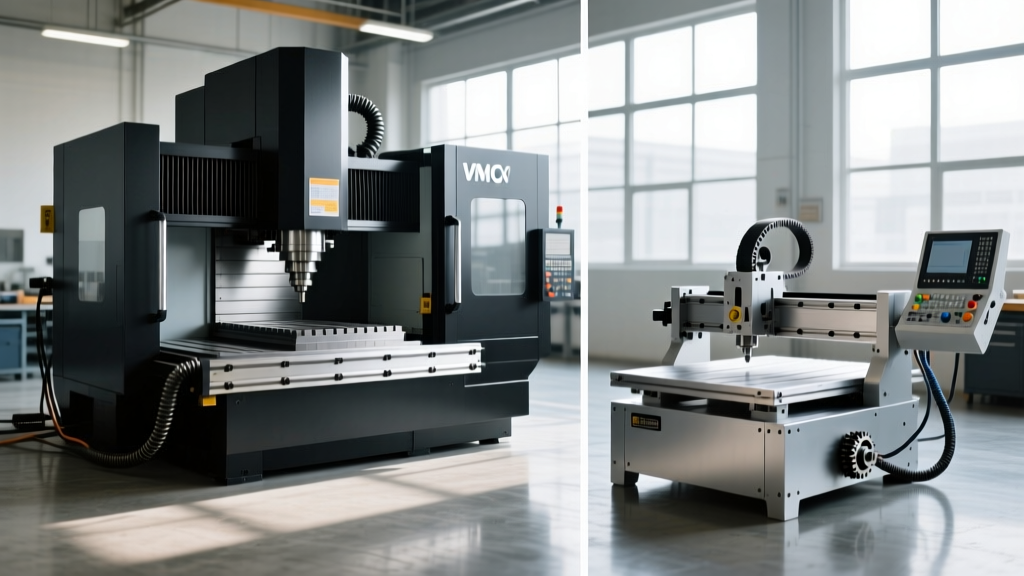
Component Comparison Matrix: VMC vs. Desktop Router
| Component Subsystem | Industrial VMC (e.g., Haas VF-2SS) | Desktop CNC (e.g., Shapeoko 5) |
|---|---|---|
| Frame Material | Meehanite Cast Iron / Polymer Concrete | 6061-T6 Aluminum Extrusion & Steel |
| Drive Motors | Closed-Loop AC Servos (Absolute Encoders) | Open-Loop NEMA 23/34 Stepper Motors |
| Transmission | C3 Precision Ground, Preloaded Ball Screws | V-Belts, Rack/Pinion, or C7 Rolled Screws |
| Spindle Bearings | P4 (ABEC-7) Angular Contact, Liquid Cooled | ABEC-3 Deep Groove, Air Cooled |
| Tool Runout | < 0.0002" (5 µm) | 0.001" - 0.003" (25 - 75 µm) |
| Controller Lookahead | 1,000+ Blocks with AI Contour Control | 15 - 30 Blocks (Basic S-Curve) |
| Typical 2026 Pricing | $85,000 - $160,000+ | $1,800 - $3,500 |
Decision Framework: When to Cross the Industrial Threshold
Determining when to upgrade from consumer-grade components to industrial machinery requires evaluating your specific manufacturing tolerances and material hardness. Apply this diagnostic framework:
Upgrade to Industrial VMC Components IF:
- Tolerance Requirements: Your parts require true positional tolerances below ±0.0005" (12 µm) over a 12-inch span.
- Material Hardness: You are routinely machining materials above 35 HRC (e.g., tool steels, titanium alloys) where cutting forces exceed 500 lbs, which will deflect aluminum extrusions and snap belts.
- Thread Milling & Rigid Tapping: Your operations require synchronized Z-axis and spindle rotation for rigid tapping, which demands zero-backlash preloaded ball screws and high-resolution servo feedback.
- Production Volume: Cycle times must be minimized. The lack of lookahead and jerk control on desktop firmware will add 30-50% to the cycle time of complex 3D aerospace contours.
Remain on Consumer/Desktop Components IF:
- Material Focus: Your primary workload consists of non-ferrous metals (6061 Aluminum, Brass), plastics (Delrin, UHMWPE), and woods, cut with high-speed, low-torque strategies.
- Footprint & Power: Your facility operates on standard 110V/220V single-phase power and lacks the floor space or rigging access for a 6,000 lb machine.
- Tolerance Band: Your acceptable dimensional variance is ±0.005" or greater, typical for signage, prototyping, and custom woodworking.
Understanding the exact mechanical and electronic components of a CNC machine prevents catastrophic purchasing errors. A desktop router is an exceptional tool for low-force, high-speed prototyping, but attempting to force it into a production environment demanding C3 ball screw accuracy and cast-iron damping will yield scrapped parts, broken tooling, and compromised profitability. Align your component requirements with your engineering tolerances to ensure long-term manufacturing viability.