Essential CNC Machine Parts for Desktop Prototyping Mills
Discover which CNC machine parts to upgrade on your desktop prototyping mill. Compare spindles, linear guides, and controllers for precision machining.
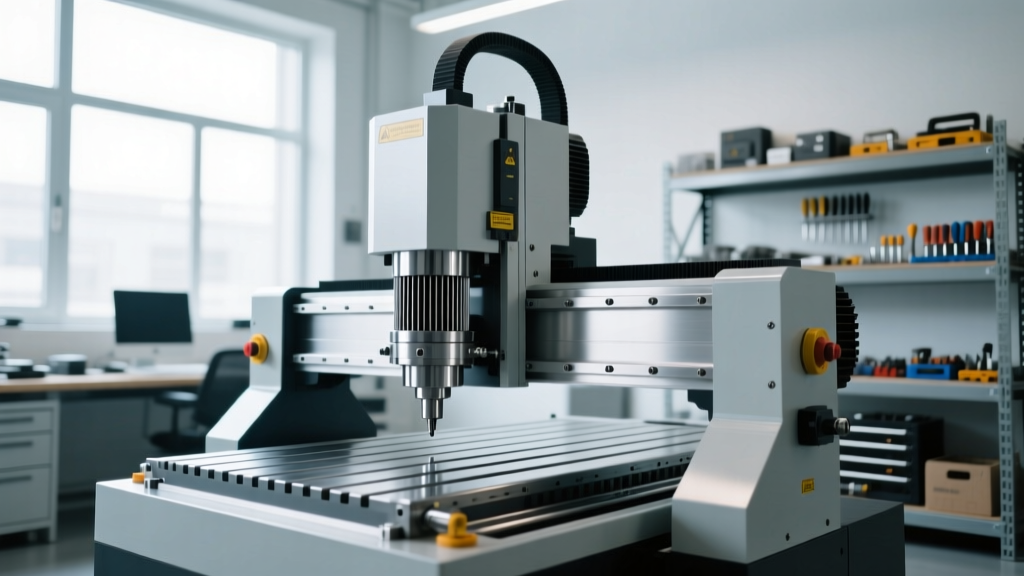
Desktop CNC machines have revolutionized rapid prototyping, allowing engineers and product designers to machine complex 6061-T6 aluminum, Delrin, and carbon-fiber-reinforced polymers right on the workbench. Platforms like the Bantam Tools PCB Milling Machine, Pocket NC V2-50, and Shapeoko 5X offer incredible accessibility. However, to meet the tight tolerances required for functional aerospace and medical prototypes—often within ±0.0005 inches—stock components frequently become the limiting factor. Upgrading specific CNC machine parts is the most cost-effective way to transform a hobbyist-grade router into a precision prototyping center.
⚠️ Critical Compatibility Warning: Before ordering replacement CNC machine parts, verify your control board's firmware architecture. Swapping an open-loop stepper for a closed-loop servo (like a ClearPath SDSK) without updating your GRBL or Mach4 configuration will result in axis inversion, missed steps, and immediate tool crashes. Always map your step/direction signals before physical installation.The Spindle Upgrade: Eliminating Runout in Micro-Milling
The spindle is the heart of any milling operation. Most entry-level desktop CNCs ship with trim routers (such as the DeWalt 611 or Makita RT0701C). While adequate for wood and plastics, these universal motors suffer from high Total Indicated Runout (TIR)—typically between 0.001 and 0.003 inches at the tool tip. When prototyping micro-features with 1/32-inch end mills, this runout causes uneven chip loads, premature tool breakage, and poor surface finishes.
HSD and Colombo Water-Cooled Spindles
Upgrading to a 1.5kW water-cooled spindle (like those manufactured by HSD or Colombo) reduces TIR to less than 0.0002 inches. According to the ISO 230-1:2014 standard for machine tool testing, minimizing geometric and thermal spindle errors is paramount for achieving repeatable precision. Water-cooled spindles maintain thermal stability during long 3D contouring cycles, preventing the thermal expansion that plagues air-cooled routers.
- Collet Selection: Upgrade from ER11 to ER16 or ER20 collets. ER16 provides a larger clamping range (up to 10mm) and superior grip strength, reducing tool slip during heavy roughing passes in aluminum.
- VFD Integration: Pair the spindle with a Variable Frequency Drive (VFD). This allows you to program acceleration and deceleration ramps, preventing tripped breakers on standard 120V/15A workshop circuits.
- Collet Nut Torque: Use a calibrated torque wrench. An ER16 collet nut requires exactly 25 Nm of torque to achieve optimal concentricity without deforming the collet slits.
Motion Systems: Linear Rails vs. V-Slot Wheels
Desktop CNCs often rely on Delrin V-slot wheels riding on aluminum extrusions. Over time, these wheels compress, develop flat spots, and introduce backlash—particularly on the Z-axis during aggressive plunge rates. Replacing these with industrial linear guides is the single most impactful structural upgrade you can make.
| Motion Component | Max Radial Load | Backlash / Play | Best Prototyping Application |
|---|---|---|---|
| Stock Delrin V-Wheels | ~15 lbs | 0.005" - 0.015" (wears over time) | Wood, PCBs, soft foams |
| Hiwin HGR20 Linear Rails | ~480 lbs (dynamic) | < 0.0002" (with C0 preload) | 6061 Aluminum, brass, titanium |
| SFU1605 Ball Screws | N/A (Drive mechanism) | 0.0003" (C7 grade) | High-speed 3D contouring |
When sourcing these CNC machine parts, specify C0 or C1 preload classes for the linear bearings. Preload eliminates internal clearance between the ball bearings and the rail raceway, ensuring the spindle carriage does not deflect under lateral cutting forces. As noted by the Society of Manufacturing Engineers (SME), structural rigidity directly dictates the achievable surface finish and tool life in CNC milling operations.
Stepper Motors and Closed-Loop Feedback
Standard open-loop NEMA 23 stepper motors are prone to losing steps if the cutting forces exceed the motor's holding torque—a common occurrence when a prototype end mill hits a hard inclusion in cast aluminum or engages too deeply in a corner.
"In desktop prototyping, losing steps on the Z-axis doesn't just ruin the part; it drives the end mill through the spoilboard and into the machine bed, causing catastrophic damage. Closed-loop systems are no longer optional for unattended machining."
— Precision Machining Institute, 2025 Tooling Report
Upgrading to closed-loop stepper motors, such as the Teknic ClearPath SDSK series, integrates a high-resolution encoder directly onto the motor shaft. If the motor detects a positional error (a missed step), it instantly corrects it or triggers a software E-stop via the controller. While these motors cost approximately $180 to $250 each, they provide servo-like reliability without the complexity of tuning analog servo drives.
Workholding: The True Prototyping Bottleneck
You can install a $2,000 spindle and aerospace-grade linear rails, but if your workholding deflects, your tolerances are gone. Standard T-slot nuts and double-sided tape are insufficient for milling engineering-grade polymers or metals.
Modular Fixturing Solutions
For high-mix, low-volume prototyping, invest in modular workholding. Mitee-Bite Pitbull clamps (approx. $85 per pair) utilize a low-profile toe-clamp design that grips the raw stock from the bottom edge, leaving the top and sides completely unobstructed for 5-sided machining. Alternatively, mount a 4-inch precision machinist vise (like the Glacern GPV-615) to a sub-plate. Pair this with machinable 6061 soft jaws that you can custom-profile to hold irregular, cast, or 3D-printed prototype blanks securely.
2026 Pricing & ROI Breakdown for Desktop Upgrades
Upgrading a desktop CNC requires capital, but the return on investment is realized through reduced scrap rates, eliminated secondary finishing operations, and the ability to charge premium rates for tight-tolerance functional prototypes.
| CNC Machine Parts Upgrade | Est. Cost (2026) | Installation Time | Primary ROI Benefit |
|---|---|---|---|
| 1.5kW HSD Spindle + VFD | $1,400 - $1,800 | 6 - 8 Hours | Enables micro-milling; 3x tool life |
| Hiwin HGR20 Linear Rail Kit | $350 - $500 | 10 - 14 Hours | Eliminates chatter; holds ±0.0005" |
| 3x ClearPath Closed-Loop Motors | $600 - $750 | 4 - 6 Hours | Zero scrap from lost steps |
| Mitee-Bite Pitbull Clamp Set | $170 - $220 | 1 Hour | Enables 5-axis/5-sided profiling |
Frequently Asked Questions: Desktop CNC Upgrades
Can I upgrade the spindle on my Shapeoko or X-Carve without changing the controller?
Yes, but with caveats. If you upgrade to a VFD-driven water-cooled spindle, you will need to wire the VFD's control pins to the spare I/O ports on your Carbide 3D or Inventables controller board to enable software-controlled start/stop and RPM scaling. You will also need to upgrade your main power circuit to handle the combined draw of the VFD and the vacuum system.
Are ball screws necessary for desktop prototyping, or are lead screws sufficient?
For 2D profiling and basic 3D contouring in plastics and soft aluminum, precision-rolled lead screws (like Acme threads with anti-backlash Delrin nuts) are sufficient and cost-effective. However, if your prototypes require high-speed 3D surfacing (e.g., injection mold cavities or aerodynamic surfaces), ball screws (specifically C5 or C7 ground grade) are mandatory to prevent stick-slip friction and ensure smooth velocity transitions.
How do I measure spindle runout after installing new CNC machine parts?
Use a high-precision dial test indicator (DTI) with a 0.0001-inch graduation. Mount the DTI on a rigid magnetic base attached to the machine bed. Bring the indicator tip to bear on the smooth shank of a brand-new, carbide end mill (never measure on the flutes). Rotate the spindle by hand in 90-degree increments. The difference between the highest and lowest readings is your TIR. If it exceeds 0.0003 inches, clean the collet and spindle taper with isopropyl alcohol and re-torque the nut.