CNC Machine: What Does It Do During Automatic Tool Changes?
Discover what a CNC machine does during ATC cycles. Learn ISO 16090 safety interlocks, retention knob torque specs, and compliance protocols.
The Core Question: CNC Machine, What Does It Do During an ATC Cycle?
When new operators ask, cnc machine what does it do during an M06 tool change command, they are usually unaware of the highly choreographed, multi-axis PLC sequence occurring behind the enclosure doors. An Automatic Tool Changer (ATC) is not merely a mechanical arm; it is a tightly regulated safety system governed by strict industrial compliance standards. Understanding the exact mechanical and electronic operations during a tool swap is critical for maintaining OSHA compliance and preventing catastrophic tool ejections.
At the most basic level, executing an M06 command triggers a macro program that halts spindle rotation, orients the spindle keyway (typically via an M19 command), retracts the Z-axis to a predefined machine coordinate, and actuates the tool exchange mechanism. However, from a safety and compliance perspective, the machine is simultaneously executing dozens of background interlock checks to ensure the operator is protected from high-velocity projectiles and crushing hazards.
⚠️ OSHA Compliance Warning: Under OSHA 1910.212 (General Requirements for All Machines), any point of operation that exposes employees to injury from rotating parts or flying chips must be guarded. Bypassing ATC enclosure door interlocks to speed up cycle times is a direct violation and a leading cause of severe amputation injuries in machine shops.ISO 16090 Compliance: The Anatomy of ATC Safety Interlocks
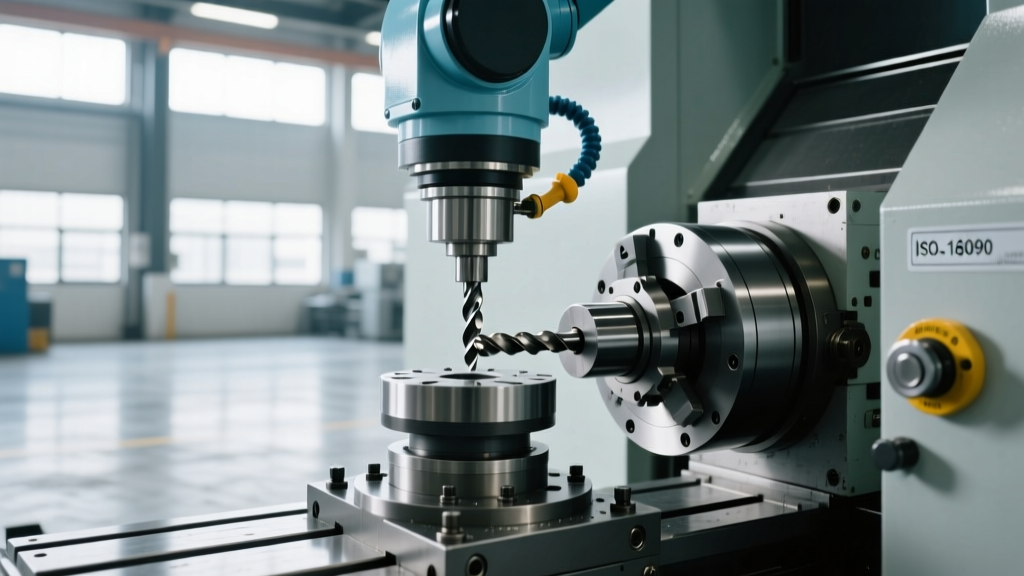
Modern machining centers are designed to meet ISO 16090:2017 (Machine tools safety — Machining centres and Milling machines). This standard dictates that the ATC zone must be isolated from the operator during the swap sequence. This is achieved through a network of safety-rated PLC inputs and physical interlocks.
The PLC Safety Logic Sequence
Before the ATC arm or umbrella mechanism is permitted to move, the machine's safety PLC must verify the following conditions within milliseconds:
- Spindle Zero Speed Confirmation: The spindle drive must feed back a verified 0 RPM signal. A broken encoder cable that falsely reports 0 RPM while the spindle is coasting at 500 RPM will trigger a Category 3 safety fault.
- Pneumatic Pressure Threshold: Most CAT and BT taper spindles use a pneumatic drawbar to clamp the retention knob. The PLC monitors a pressure transducer; if shop air drops below 5.5 bar (80 PSI), the drawbar cannot generate the required 1,500 to 2,000 lbs of clamping force. The PLC will inhibit the M06 command to prevent the tool from dropping mid-swap.
- Door Solenoid Locking: Magnetic safety switches (such as the Schmersal AZM400 series) lock the main operator doors. The solenoid will not release until the Z-axis is safely retracted and the ATC cam-box motor has returned to its home position.
Retention Knob Torque: The Hidden Ejection Hazard
The retention knob (pull stud) is the single most critical safety component in the ATC ecosystem. It is the only physical link between the heavy cutting tool and the spindle's internal drawbar. Improper torque application is a leading cause of ATC failures and safety incidents.
| Taper Type | Required Retention Knob Torque | Drawbar Clamping Force | Primary Failure Mode & Hazard |
|---|---|---|---|
| CAT40 / BT40 | 35 - 45 ft-lbs | ~1,500 lbs | Under-torquing causes knob pull-out; tool drops onto table or ejects during heavy cuts. |
| CAT50 / BT50 | 75 - 90 ft-lbs | ~2,500 lbs | Over-torquing swells the taper flange, causing poor TIR and potential tool seizure in the spindle nose. |
| HSK-63A | N/A (Integral Clamping) | ~4,000+ lbs (at speed) | Debris on the dual-contact face prevents full clamping; tool ejects at high RPM due to centrifugal force. |
Actionable Directive: Never use an impact wrench or an uncalibrated torque wrench on retention knobs. Shops must invest in dedicated retention knob torque stations (e.g., from Techniks or JM Performance Products), which cost between $800 and $1,500 but eliminate the liability of tool ejection.
Arm-Type vs. Umbrella ATC: Distinct Compliance Profiles
The physical design of the ATC dictates the specific guarding and maintenance protocols required by safety auditors.
Arm-Type (Swing Arm) ATC Safety Protocols
Common on VMCs with 20+ tool magazines, arm-type ATCs use a cam-box mechanism to simultaneously extract the tool from the spindle and the magazine. Compliance Focus: The primary hazard is the high-speed rotational swing of the arm. Maintenance teams must strictly adhere to lockout/tagout (LOTO) procedures when cleaning the magazine pots. If the machine is powered on but E-stopped, residual pneumatic pressure in the cam-box can cause the arm to swing unexpectedly if a limit switch is manually depressed during cleaning.
Umbrella-Type ATC Safety Protocols
Common on entry-level or compact CNC routers and mills, the umbrella ATC requires the spindle to move directly up into the magazine carousel to deposit and retrieve tools. Compliance Focus: Because the spindle physically travels into the magazine, the Z-axis ball screw and way covers are subjected to heavy chip contamination. If chips build up on the Z-axis limit switches, the machine may fail to recognize the tool-change height, driving the spindle directly into the magazine carousel and shattering the enclosure. Daily verification of Z-axis way cover integrity is a mandatory safety checklist item for umbrella systems.
Troubleshooting ATC Safety Faults: A Step-by-Step Decision Tree
When an ATC sequence halts and throws a safety alarm, technicians must follow a logical diagnostic path rather than bypassing interlocks. Use this decision tree to resolve common compliance-related faults:
- 🔴 Fault: 'ATC Arm Not in Home Position'
- Check 1: Is the cam-box proximity switch covered in coolant mist? Action: Wipe the sensor with isopropyl alcohol. Do not adjust the sensor distance without a feeler gauge (target gap: 0.5mm - 1.0mm).
- Check 2: Did the pneumatic cylinder fail to fully retract? Action: Check the inline flow control valves. If air pressure is stable at 6.0 bar, rebuild the cylinder seals (Kit cost: ~$150).
- 🔴 Fault: 'Spindle Orientation Error (M19 Timeout)'
- Check 1: Is the spindle drive belt slipping? Action: Check belt tension. A slipping belt prevents the spindle from locking precisely into the keyway alignment, causing the ATC arm to crash into the tool flange.
- Check 2: Is the orientation sensor misaligned? Action: Use the OEM parameter page to recalibrate the spindle orientation offset. Never force the arm into the spindle manually.
Upgrading Legacy ATCs to 2026 Safety Standards
Many machines built prior to 2018 rely on mechanical limit switches and basic relay logic for ATC safety. Upgrading these legacy systems to modern, servo-driven ATCs (such as those integrated by Weiss or Gilman) is a major compliance improvement. A direct-drive servo ATC upgrade typically costs between $14,000 and $25,000, including installation and PLC reprogramming. The ROI is realized not just in cycle time reduction (dropping swap times from 4.5 seconds to 1.2 seconds), but in the elimination of mechanical cam-box wear. Cam boxes degrade over time, leading to micro-misalignments that cause retention knobs to scrape the spindle keyway—a severe safety hazard that can result in a tool dropping at 10,000 RPM. Servo-driven systems utilize closed-loop torque monitoring, instantly halting the swap if the insertion force exceeds a programmed safety threshold, thereby protecting both the operator and the machine spindle.
"Safety in CNC machining is not just about guarding the operator from the cutting zone; it is about ensuring the automated material handling systems within the enclosure operate with predictable, monitored force. An unmonitored ATC is a stored-energy hazard waiting to fail."
Ultimately, understanding the intricate safety mechanisms of your CNC machine's automatic tool changer transforms it from a black-box convenience into a verifiable, compliant asset. Regular auditing of retention knob torque, pneumatic pressure thresholds, and door interlock solenoids ensures your shop remains compliant with OSHA and ISO mandates while protecting your most valuable asset: your personnel.