Decoding CNC Machine Names: A Buyer’s Guide to Multi-Function Mill-Turn Centers
Navigate complex CNC machine names for multitasking centers. Compare mill-turn vs turn-mill specs, current pricing, and hidden costs for equipment buyers.
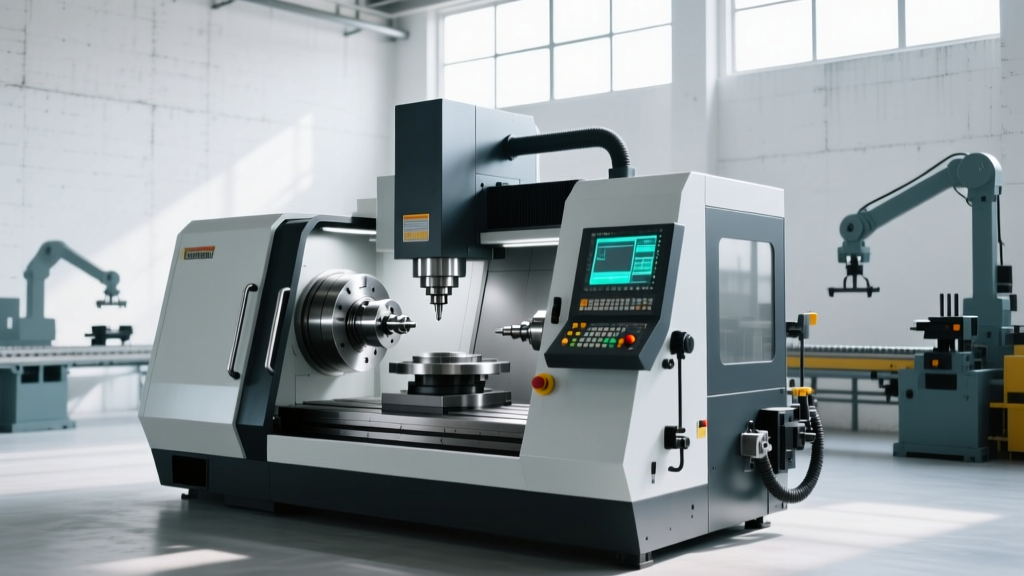
When sourcing advanced manufacturing equipment, the sheer volume of CNC machine names can obscure critical kinematic differences. Sales literature frequently uses terms like 'multitasking center,' 'mill-turn,' 'turn-mill,' and '5-axis B-axis machine' interchangeably. However, for a manufacturing engineer or procurement manager, confusing these names can result in purchasing a machine incapable of holding the required geometric tolerances for complex aerospace or medical components.
This guide decodes the terminology surrounding multi-function milling and turning centers, providing a technical framework to match specific kinematic configurations to your part families, complete with current market pricing and hidden integration costs.
The Kinematic Divide: Turn-Mill vs. Mill-Turn
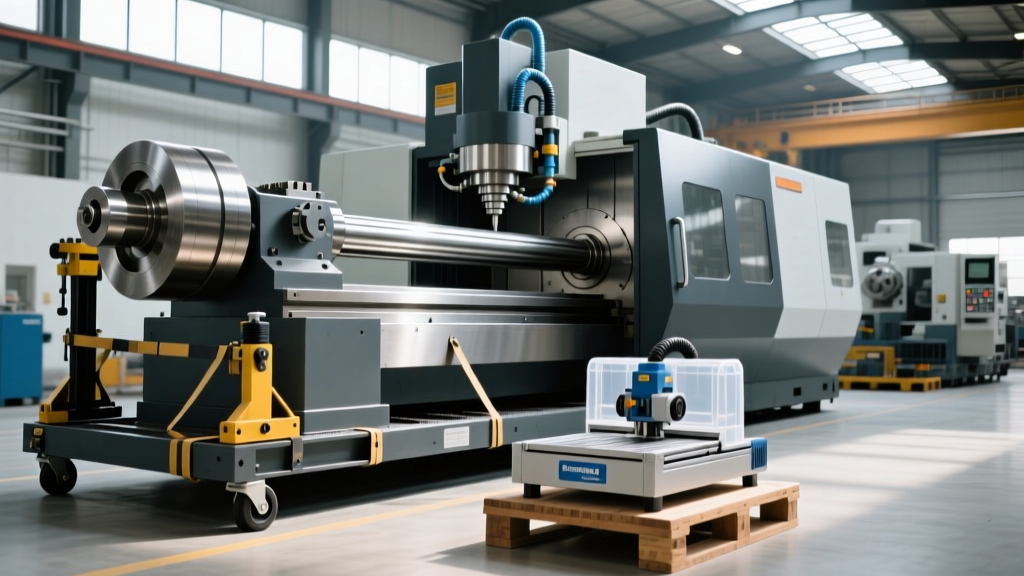
The most common trap when evaluating multitasking CNC machines is assuming all hybrid machines share the same foundational architecture. The distinction lies in the primary casting and the way the workpiece is supported.
| Feature | Turn-Mill Center (Lathe-Based) | Mill-Turn Center (Mill-Based) |
|---|---|---|
| Base Casting | Slant-bed lathe design | Vertical column or traveling gantry |
| Workpiece Support | Headstock and tailstock (shaft-oriented) | Workholding tombstone or trunnion table |
| Ideal Part Geometry | Long, cylindrical parts with radial/axial features (e.g., camshafts, landing gear struts) | Blocky, prismatic parts requiring deep turning bores and heavy 5-face milling (e.g., valve bodies, impellers) |
| Chip Evacuation | Excellent (gravity drops chips away from part) | Moderate (requires aggressive washdown coolant systems) |
The B-Axis vs. C-Axis Milling Distinction
Many lower-tier machines are marketed as 'mill-turns' but only possess a C-axis (spindle orientation) and a Y-axis. While a C-axis allows for contouring and off-center drilling, it forces the milling tool to remain perpendicular to the spindle centerline.
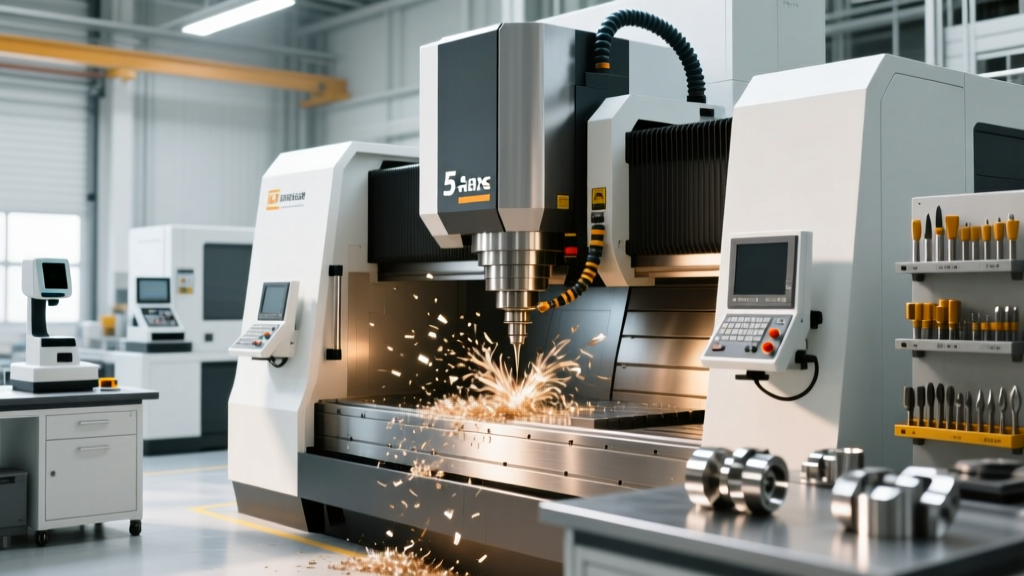
Technical Callout: Why the B-Axis is Non-Negotiable for AerospaceIf your parts require angled features, compound contours, or single-setup 5-axis simultaneous milling on a cylindrical surface, you must specify a machine with a B-axis milling head. A B-axis tilts the milling spindle (typically ±120 degrees), allowing the tool to approach the workpiece at optimal cutting angles. Furthermore, look for a C-axis locking resolution of 0.0001 degrees via a Hirth coupling or direct-drive torque motor to prevent chatter during heavy interrupted cuts.
2026 Equipment Benchmarks: Models and Pricing
Capital expenditure for multi-function machines varies wildly based on the integration of automation, high-pressure coolant (HPC), and tooling interfaces. Below is a benchmark of current market leaders in the multitasking space, reflecting fully loaded pricing (including bar feeders, 1000+ PSI HPC, and tool setters).
| Manufacturer & Model | Machine Type | Key Specifications | Est. Loaded Price (USD) |
|---|---|---|---|
| Haas DS-30Y | Turn-Mill (Entry-Level) | Y-axis travel: ±50mm, C-axis, No B-axis, 30-HP spindle | $195,000 - $230,000 |
| Mazak Integrex i-200S | Turn-Mill (Mid-Tier) | B-axis tilt, Capto C6 tooling, 20,000 RPM milling spindle | $420,000 - $485,000 |
| DMG MORI NTX 2000 | Turn-Mill (Premium) | B-axis, lower turret with Y-axis, CELOS control, AI thermal compensation | $550,000 - $680,000 |
| Okuma MULTUS U3000 | Turn-Mill (Heavy Duty) | OSP-P500 control, Thermo-Friendly Concept, high-torque B-axis | $480,000 - $560,000 |
For shops machining high-temperature alloys like Inconel 718 or Titanium Ti-6Al-4V, the DMG MORI NTX series and Mazak Integrex lines dominate due to their structural damping and integrated high-pressure coolant delivery directly through the B-axis spindle.
Hidden Costs in Multitasking Procurement
The base machine price is only the beginning of the financial commitment. Multi-function machines require specialized ancillary equipment and software to achieve the promised 'done-in-one' part completion.
1. High-Pressure Coolant (HPC) Systems
Standard flood coolant (300 PSI) is insufficient for multitasking centers cutting exotic alloys. You must specify a variable-displacement piston pump delivering 1,000 to 2,000 PSI at 3 to 5 GPM. This is required for chip-breaking at the main spindle and for clearing chips from deep-cavity milling operations where gravity cannot assist. Budget an additional $25,000 to $40,000 for a integrated HPC package.
2. Tooling Interfaces: Capto vs. KM vs. VDI
Multi-tasking machines rely on quick-change tooling to minimize setup times. The Coromant Capto interface (specifically C5 or C6 sizes) is the industry standard for B-axis milling heads due to its high torsional rigidity and dual-contact face-and-taper clamping. Stocking a full suite of Capto C6 turning holders, milling arbors, and reduction sleeves can easily cost $40,000 to $75,000 before you purchase the actual cutting inserts.
3. CAM Software and Post-Processors
You cannot program a 5-axis B-axis mill-turn machine efficiently using manual G-code. You require advanced CAM software (such as Mastercam Mill-Turn, ESPRIT, or hyperMILL) capable of collision detection between the main spindle, sub-spindle, lower turret, and B-axis head.
Warning: The Post-Processor TrapDo not assume your existing 3-axis CAM license covers multitasking. Mill-Turn CAM modules often require separate licensing (adding $10,000 - $18,000). Furthermore, a custom, machine-specific post-processor verified via kinematic simulation software (like VERICUT) is mandatory. Running unverified code on a $500,000 machine risks a catastrophic crash that can misalign the B-axis head, resulting in a $30,000+ repair bill and weeks of downtime.
Decision Framework: Selecting the Right Configuration
Use this matrix to align your production requirements with the correct machine architecture:
- Choose a C-Axis/Y-Axis Turn-Mill (e.g., Haas DS-30Y) if: Your parts are primarily shafts or flanges requiring off-center cross-drilling, keyway milling, and simple contouring. Budget is under $250,000, and cycle time reduction via secondary operations is the main goal.
- Choose a B-Axis Mill-Turn (e.g., Mazak Integrex) if: You are machining complex aerospace fittings, medical bone screws, or hydraulic manifolds from bar stock or forgings. Parts require 5-axis simultaneous milling on cylindrical surfaces, and you need to complete the part in a single chucking to maintain concentricity tolerances under 0.0005 inches.
- Choose a Twin-Turret / Twin-Spindle Configuration if: You are running high-volume production (e.g., automotive transmission shafts). The lower turret allows simultaneous rough turning on the main spindle while the upper B-axis turret finishes features on the sub-spindle, effectively cutting cycle times by 40%.
Final Procurement Checklist
Before signing the purchase order for any multi-function CNC center, verify the following specifications with the OEM:
- Thermal Stability: Does the machine feature active thermal compensation (e.g., Okuma's Thermo-Friendly Concept or Mazak's AI Thermal Shield)? Multitasking machines have complex kinematic chains; a 5°C shop temperature swing can shift the B-axis tool center point (TCP) by up to 0.002 inches without compensation.
- Bar Feeder Compatibility: Is the spindle liner sized for your maximum bar diameter, and does the control support synchronized sub-spindle part catching without requiring manual M-code intervention?
- Chip Conveyor Design: Multi-function machines generate a mix of long, stringy turning chips and fine, abrasive milling dust. Specify a hinge-belt conveyor with a built-in wedge-wire filtration drum to prevent fine chips from recirculating into the coolant tank and destroying the HPC pump.
- Service Level Agreement (SLA): Multitasking machines require specialized service technicians. Verify that the OEM has B-axis calibration specialists within a 4-hour drive of your facility, as general CNC techs often lack the laser-interferometry tools required to realign a crashed B-axis head.
By looking past the marketing nomenclature and focusing on kinematic structures, tooling interfaces, and software requirements, manufacturing leaders can confidently navigate the complex landscape of CNC machine names and deploy multitasking centers that deliver genuine done-in-one profitability.
For further reading on advanced machining strategies, refer to the Society of Manufacturing Engineers (SME) CNC Machining resources.