Troubleshooting CNC Machine Cabinet Dust Ingress in Composite Cutting
Diagnose and repair CNC machine cabinet dust ingress when cutting CFRP and GFRP composites. Protect VFDs, servos, and spindles from abrasive failures.
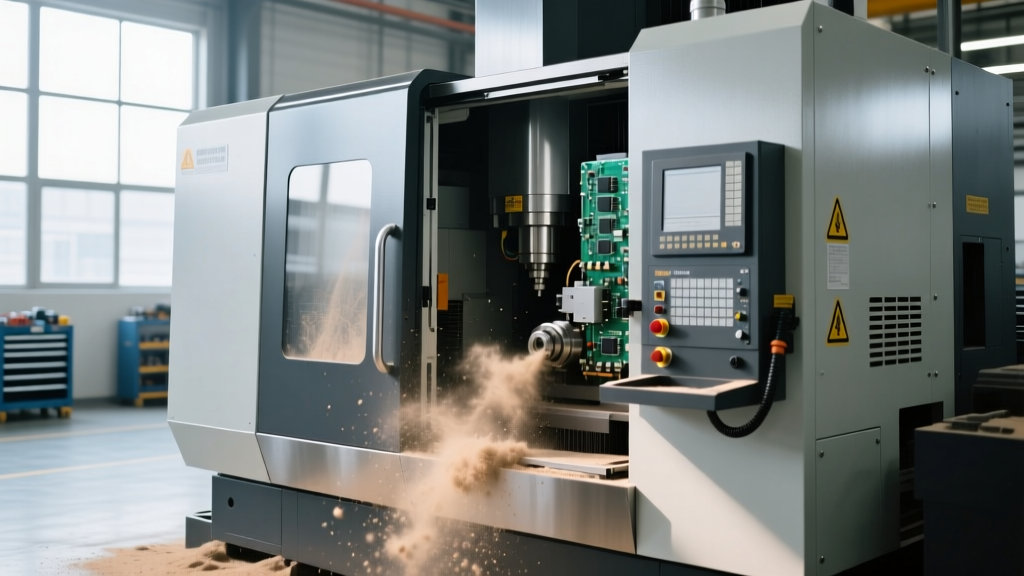
Cutting carbon fiber reinforced polymers (CFRP) and glass fiber reinforced polymers (GFRP) generates particulate matter that behaves fundamentally differently from aluminum or steel swarf. Composite dust is highly abrasive, electrostatically charged, and in the case of carbon fiber, electrically conductive. Particle sizes frequently range between 10 and 50 microns, allowing them to bypass standard filtration. When the cnc machine cabinet fails to maintain its environmental seal, this dust infiltrates the control electronics, ball screws, and spindle bearings, leading to catastrophic and expensive failures.
⚠️ CRITICAL WARNING: Conductive Dust Short CircuitsCarbon fiber dust is electrically conductive. If it breaches the control cabinet and settles on the printed circuit boards (PCBs) of servo drives or Variable Frequency Drives (VFDs), it will bridge the gaps between IGBTs and logic gates. This causes immediate short circuits, often destroying drives costing between $4,500 and $8,500 per axis. Never use compressed air to clean the interior of a cabinet suspected of CFRP ingress; this forces conductive particles deeper into the drive heatsinks.
Diagnostic Matrix: Cabinet Ingress Symptoms vs. Component Failure
Troubleshooting composite dust ingress requires mapping the machine's electrical and mechanical faults to specific physical breaches in the enclosure. Use the following diagnostic matrix to isolate the failure point.
| Symptom / Alarm Code | Suspected Cabinet Breach | Diagnostic Action | Estimated Repair Cost |
|---|---|---|---|
| Intermittent Servo Faults (e.g., Siemens F31100 / Fanuc 401) | Control cabinet door seal degradation or cable gland failure | Megger test motor cables; inspect door gaskets for embedded abrasive grit | $150 (seals) to $7,500 (drive replacement) |
| Axis following error / rough surface finish on contours | Way cover bellows tear or wiper seal failure | Inspect telescopic covers with UV light; check linear scale glass for dust | $800 - $2,400 (bellows and wipers) |
| Spindle thermal alarm / high-frequency vibration | Spindle labyrinth seal air purge failure | Check positive pressure PSI at spindle nose; verify air dryer dew point | $6,000 - $18,000 (spindle rebuild) |
| Tool changer arm jamming / ATC misalignment | ATC enclosure door proximity sensor fouled by dust | Clean inductive sensors with IPA; verify actuator target distance (1-2mm) | $85 (sensor) to $450 (pneumatic cylinder) |
Upgrading to Positive Pressure Enclosures
Standard CNC enclosures are typically rated IP54, which protects against splashing water and limited dust ingress. However, according to NIOSH guidelines on composite particulates, the fine nature of CFRP and GFRP dust requires a higher threshold of protection. For dedicated composite cutting cells, the CNC machine cabinet must be upgraded to a positive pressure environment.
Sizing and Implementing Positive Pressure
A positive pressure system works by continuously pumping filtered air into the control cabinet, creating an overpressure that physically pushes dust out of any micro-gaps in the seals. To achieve this effectively:
- Target Overpressure: Maintain a continuous internal overpressure of 0.1 to 0.2 bar (1.5 to 3.0 PSI) relative to the ambient shop floor.
- Filtration Requirements: The intake air must pass through a HEPA filter rated at 99.97% efficiency for 0.3-micron particles. Standard HVAC filters (MERV 8-13) will not stop sub-10-micron carbon fiber particulates.
- Thermal Management: Because composite cutting generates high ambient heat, pair the positive pressure intake with a closed-loop cabinet cooling unit (such as a Pfannenberg or Rittal top-mounted chiller) to prevent the drives from overheating while maintaining the pressure differential.
Do not feed shop compressed air directly into the cabinet for positive pressure. Shop air contains oil aerosols and moisture that will coat the drive PCBs, creating a sticky surface that traps any dust that does breach the seal. Always route the air through a desiccant dryer achieving a -40°F pressure dew point before it enters the HEPA intake.
Cable Gland and Penetration Failures
The most frequently overlooked breach point in any CNC machine cabinet is the cable entry zone. When technicians route new coolant lines, add probing sensors, or replace motor feedback cables, they often use cheap plastic grommets or leave unused knockouts partially open. In a composite cutting environment, this is a fatal error.
All cable penetrations must utilize IP68-rated cable glands. For composite applications where electrostatic discharge (ESD) is a concern, use nickel-plated brass glands with integrated grounding tags, such as the Lapp SKINTOP INOX series or Pflitsch UNI series. These glands feature multi-layer elastomer inserts that compress tightly around the cable jacket, preventing both dust ingress and the vibration-induced loosening common in high-speed 5-axis composite routers.
Sealing Unused Knockouts
Never leave an unused cabinet knockout open or covered with standard electrical tape. Use threaded metal blanking plugs with an integrated O-ring seal, tightened to the manufacturer's specified torque (typically 3-5 Nm) to ensure the O-ring compresses evenly without extruding.
Way Cover and Bellows Material Selection
While the control cabinet protects the electronics, the way covers protect the mechanical axes. Glass fiber reinforced polymers (GFRP) produce swarf that acts like microscopic razor blades. Standard PVC or unsupported polyurethane bellows will be shredded within weeks of continuous GFRP cutting.
'When machining GFRP or Kevlar composites, the abrasive nature of the fibers requires way covers reinforced with aramid (Kevlar) fabrics or heavy-duty nitrile rubber. Standard materials will experience micro-lacerations that rapidly propagate into full bellows tears under the high-speed traverse rates of modern composite routers.'
For 5-axis composite trimming centers (like the Onsrud 5-axis series or Thermwood multi-axis routers), specify telescopic steel covers with replaceable polyurethane wiper blades for the X and Y axes. The wiper blades must have a durometer hardness of at least 85A to resist cutting from glass fibers, and they must be inspected for edge fraying exceeding 1mm.
Preventative Maintenance Protocol for Composite CNCs
To maintain the integrity of the CNC machine cabinet and mechanical seals, implement the following strict maintenance schedule. Adherence to this protocol reduces unplanned downtime from dust-related electrical faults by over 80%, aligning with OSHA hazard guidelines for industrial dust mitigation strategies.
Daily Tasks (Operator Level)
- Verify Positive Pressure: Check the magnehelic gauge on the control cabinet door. The reading must be strictly above 1.5 PSI. If it drops below 1.0 PSI, halt operations and inspect the HEPA pre-filter for blinding.
- Spindle Purge Check: Confirm the spindle air purge flow meter indicates the correct CFM (typically 2-4 CFM depending on the spindle manufacturer).
Weekly Tasks (Maintenance Technician)
- Gasket Decontamination: Wipe down all control cabinet door EPDM rubber gaskets with isopropyl alcohol (IPA). Embedded abrasive grit acts as lapping compound, degrading the rubber and destroying the seal when the door is closed.
- Sensor Cleaning: Wipe all ATC and tool-breakage optical/inductive sensors with a lint-free microfiber cloth and optical-grade cleaner.
Monthly Tasks (Facilities / Advanced Maintenance)
- Cable Gland Torque Check: Use a calibrated torque screwdriver to verify all IP68 cable glands on the cabinet base and rear panels remain at spec. Vibration from heavy roughing passes can loosen them over time.
- HEPA Filter Replacement: Replace the positive pressure intake HEPA filters based on differential pressure drop, not just a calendar schedule. A drop exceeding 1.0 inch of water gauge (w.g.) indicates the filter is blinded and starving the cabinet of cooling airflow.
- Way Cover Inspection: Fully retract and extend all axes to inspect the underside of telescopic covers and bellows for accumulated composite dust dams that can block wiper seals.