CNC Machine Body Vibration Fixes for Composite Cutting
Diagnose and repair CNC machine body resonance during composite cutting. Actionable fixes for CFRP chatter, frame damping, and dust ingress.
Machining carbon fiber reinforced polymers (CFRP), G10 Garolite, and fiberglass subjects the CNC machine body to high-frequency harmonic excitations that standard aluminum-cutting routers cannot absorb. When the natural frequency of a welded steel or cast iron frame aligns with the cutting forces of a 24,000 RPM spindle, the resulting chatter causes severe edge delamination, accelerates way-bearing wear, and compromises dimensional accuracy. Troubleshooting these issues requires isolating the CNC machine body as the root cause rather than blaming tooling or spindle runout.
Diagnostic Matrix: Frame Resonance vs. Tooling Failure
| Symptom | Likely Root Cause | Verification Test |
|---|---|---|
| Frayed edges on one specific axis travel direction | Axis-specific CNC machine body resonance or loose kinematic mount | Perform modal bump test on the affected axis ballnut housing |
| Uniform delamination across all cut vectors | Incorrect tool geometry (e.g., using standard carbide instead of PCD diamond-coated) | Inspect tool flank wear under 40x magnification |
| Audible high-pitch ringing during plunge | Global frame chatter; lack of structural damping in the CNC machine body | Mount accelerometer to the spindle housing and analyze FFT frequency peaks |
The Physics of Frame Resonance in Composite Cutting
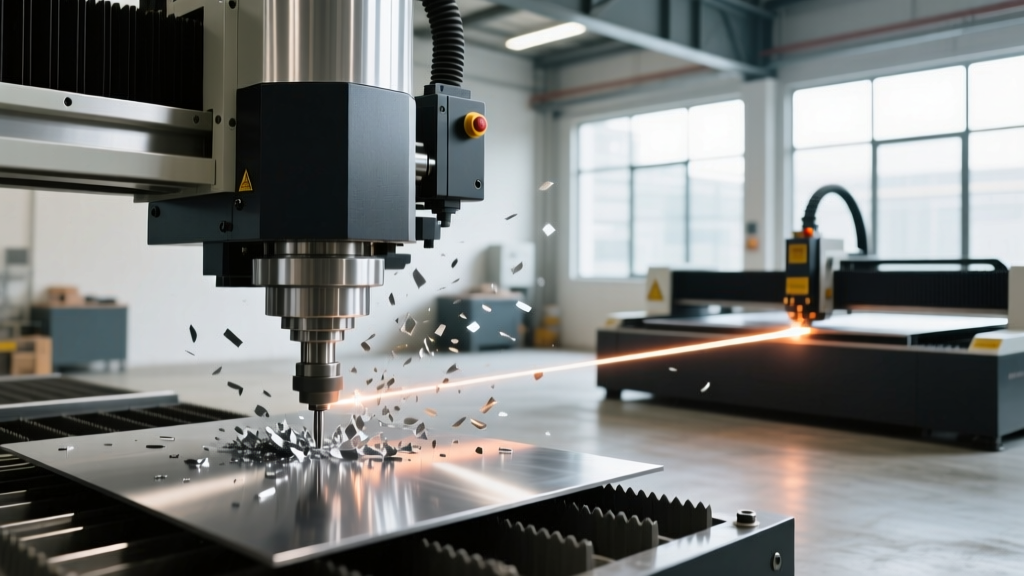
Unlike aluminum or steel, which produce continuous chips that dampen cutting forces, composite materials generate abrasive dust and require high spindle speeds (18,000 to 24,000 RPM) paired with high feed rates (200 to 400 IPM). According to CompositesWorld, the discontinuous nature of CFRP cutting creates intermittent impact loads on the tool. If the CNC machine body lacks sufficient internal damping, these micro-impacts compound into macro-vibrations.
Standard 4x8 and 5x10 CNC routers often utilize welded tubular steel frames. While steel offers high stiffness, its internal damping coefficient is notoriously low (approximately 0.001 compared to cast iron's 0.05). When cutting 1/4-inch CFRP with a 1/4-inch polycrystalline diamond (PCD) compression router, the cutting forces easily excite the natural frequency of a lightweight steel frame, which typically sits between 80 Hz and 120 Hz. This resonance transfers directly through the spindle Z-axis plate, causing the tool to oscillate laterally and tear the composite matrix rather than shearing it cleanly.
The Modal Bump Test Protocol
Before ordering replacement parts or altering toolpaths, verify the CNC machine body's structural integrity using a modal bump test. This isolates frame resonance from spindle bearing defects.
- Equipment Setup: Mount a triaxial piezoelectric accelerometer to the spindle nose using a magnetic base. Connect it to a dynamic signal analyzer or a laptop running FFT analysis software (such as CutPro or open-source alternatives like OpenModal).
- Excitation: Use a calibrated modal impact hammer with a medium-hardness plastic tip. Strike the CNC machine body's primary structural welds, the Z-axis column, and the gantry crossbeam.
- Data Analysis: Observe the Frequency Response Function (FRF). A sharp, narrow peak between 80 Hz and 150 Hz indicates a highly resonant, under-damped frame. A broad, flattened curve indicates healthy structural damping.
- Isolation: If the peak shifts significantly when the gantry is moved from the center of the bed to the extreme Y-axis limits, the issue is a lack of torsional rigidity in the gantry crossbeam, not the base frame.
Structural Retrofits for the CNC Machine Body
If the bump test confirms inadequate damping, you must increase the mass or the energy dissipation of the frame. As detailed in Modern Machine Shop, controlling chatter requires shifting the natural frequency away from the cutting excitation frequency. Below are the most effective retrofits for composite-cutting routers.
| Retrofit Method | Application | Estimated Cost | Downtime |
|---|---|---|---|
| Epoxy Granite Injection | Filling hollow tubular steel bases and gantry columns with a quartz-aggregate epoxy matrix. | $3,500 - $6,000 | 3-5 days (curing time) |
| Viscoelastic Constrained Layer Damping | Applying damping tape (e.g., 3M ISD-112) between the steel frame and bolted-on steel stiffening plates. | $800 - $1,500 | 1-2 days |
| Active Mass Dampers (Tuned) | Installing electromechanical shakers on the Z-axis carriage to output anti-phase vibrations. | $12,000+ | 1 week (integration) |
| Kinematic Isolation Mounts | Replacing rigid concrete anchor bolts with tuned elastomeric vibration isolation pads (e.g., Fabreeka). | $400 - $900 | 4 hours |
For most mid-sized production shops running Thermwood or Onsrud routers, epoxy granite injection yields the highest return on investment. The composite epoxy increases the damping ratio of the CNC machine body by up to 10 times compared to bare steel, effectively killing the high-frequency chatter that causes CFRP delamination.
Sealing the Machine Body from Abrasive CFRP Dust
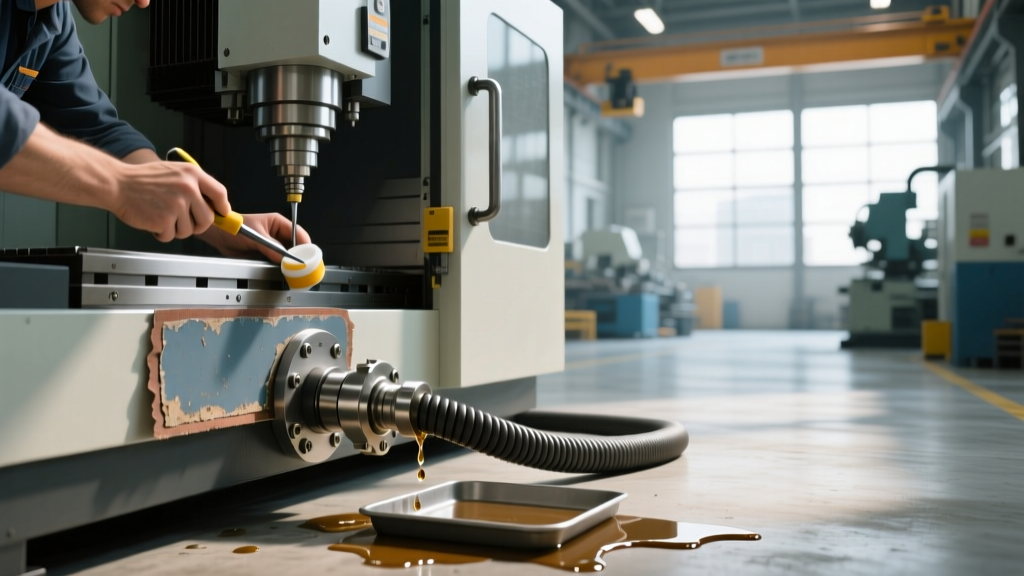
Vibration is only half the battle. Carbon fiber dust is highly abrasive, with a Mohs hardness that easily scores linear guide rails and ball screws. When microscopic CFRP particles bypass the way covers and infiltrate the CNC machine body's moving joints, they mix with lubricating grease to form a lapping compound. This increases friction, alters the axis tuning parameters, and eventually triggers servo following errors.
Way Cover and Wiper Seal Upgrades
Standard PVC or nylon bellows way covers degrade rapidly under the sharp, needle-like structure of carbon fiber dust. To protect the machine body's internal kinematics, implement the following upgrades:
- Stainless Steel Lamella Covers: Replace X and Y-axis bellows with overlapping stainless steel telescopic covers. These prevent dust from settling on the linear rails entirely. Expect to pay between $1,200 and $2,500 per axis for custom-fitted lamella covers.
- Polyurethane Wiper Seals: Upgrade the standard nitrile rubber wiper seals on the linear bearing blocks to high-durometer polyurethane (90A or higher). Polyurethane resists the cutting action of carbon fibers, maintaining a tight seal against the rail profile for up to 4,000 machining hours before requiring replacement.
- Positive Pressure Air Purge: Install a low-PSI (5-10 PSI) clean, dry air (CDA) purge system inside the ballnut housings. This creates a positive pressure barrier that physically blows abrasive dust away from the recirculating ball bearings.
Toolpath Adjustments to Protect the Frame
While structural repairs address the physical CNC machine body, adjusting the CAM toolpaths prevents the excitation of the frame's natural frequencies in the first place. When cutting composite materials, avoid slotting (100% radial engagement). Slotting generates maximum radial cutting force, which directly transfers into the gantry and excites frame resonance.
Instead, utilize adaptive clearing or trochoidal milling strategies. By maintaining a constant radial engagement of 10% to 15% of the tool diameter, you drastically reduce the lateral load on the CNC machine body. For a 1/4-inch PCD compression bit cutting 1/4-inch CFRP, set the radial stepover to 0.025 inches and increase the feed rate to maintain a chipload of 0.004 to 0.006 inches per tooth. This shifts the cutting forces primarily into the axial (Z) direction, which the machine column is structurally much better equipped to handle than lateral Y-axis forces.
Expert Troubleshooting FAQ
Q: Why does edge fraying only occur when the gantry is at the extreme rear of the Y-axis bed?
A: This indicates a torsional twist in the CNC machine body. When the heavy Z-axis spindle carriage moves to the extreme rear (or front), it shifts the center of gravity, causing the unsupported ends of a lightweight gantry to deflect under cutting loads. The fix requires adding a secondary cross-brace to the gantry or upgrading to a moving-bridge design where the table remains stationary and the frame moves over it.
Q: Can I use standard flood coolant to dampen vibrations and reduce dust?
A: No. Flood coolant is highly discouraged for CFRP and G10. The resin matrix in many composites is hygroscopic and will absorb the coolant, causing the material to swell and delaminate from the inside out. Furthermore, coolant mixed with carbon dust creates a highly conductive, corrosive sludge that will short-circuit exposed limit switches and degrade the CNC machine body's electrical cabinets. Always use high-volume, high-velocity dry vacuum extraction (minimum 1,500 CFM) with HEPA filtration.