Beyond the CNC Machine Acronym: Workholding and Fixturing Case Studies
Explore real-world CNC workholding and fixturing case studies in aerospace and medical manufacturing, moving beyond the basic CNC machine acronym.
Decoding the CNC Machine Acronym: Where Software Meets Physical Reality
Every manufacturing professional knows the CNC machine acronym stands for Computer Numerical Control. However, understanding the software, G-code, and 5-axis kinematics is only half the battle in modern subtractive manufacturing. The physical interface between the raw material and the machine table—the workholding—dictates cycle times, surface finishes, dimensional tolerances, and ultimate scrap rates. As of 2026, with spindle speeds exceeding 30,000 RPM and adaptive control software becoming standard, the bottleneck in high-mix and high-volume production is rarely the cutting tool; it is the fixturing.
This analysis moves beyond the basic CNC machine acronym to examine real-world workholding applications. By dissecting specific case studies in aerospace titanium milling and high-volume medical device manufacturing, we can extract actionable frameworks for selecting, designing, and deploying advanced fixturing systems.
Case Study 1: 5-Axis Aerospace Impeller Milling (Ti-6Al-4V)
The Challenge: Thin-Wall Deflection and Harmonic Chatter
An aerospace tier-2 supplier was tasked with machining a complex Ti-6Al-4V titanium centrifugal impeller on a DMG MORI DMU 50 3rd Generation 5-axis machining center. The part featured deep cavities with finishing wall thicknesses of just 1.2mm. During the semi-finishing passes, standard 6-inch machinist vises and basic toe clamps induced harmonic chatter, resulting in a 22% scrap rate due to wall deflection and poor surface finish (exceeding the 32 Ra µin requirement).
The Fixturing Solution: Two-Phase Mechanical and Vacuum Workholding
The engineering team abandoned the single-setup vise approach in favor of a two-phase fixturing strategy, leveraging specific low-profile and vacuum technologies:
- Phase 1 (Roughing & Semi-Finishing): The raw forging was secured using Mitee-Bite Pitbull low-profile clamps. These clamps provided 2,500 lbs of downward holding force per point without obstructing the 5-axis toolpath. The low profile allowed the spindle to access deep undercuts without collet interference.
- Phase 2 (Finishing): Once the primary geometry was established, the part was transferred to a custom porous bronze vacuum chuck. A Venturi vacuum generator pulled a consistent 28 inHg (inches of mercury) across the part's internal contoured datum surface. Because atmospheric pressure is roughly 29.92 inHg, a 28 inHg pull distributes clamping force evenly across the entire surface area, eliminating localized stress points that cause thin walls to spring back after the tool passes.
Results and ROI
By implementing the vacuum finishing fixture (initial tooling cost: $14,500), the supplier reduced the scrap rate from 22% to under 1.5%. Cycle time for the finishing pass increased by 8% due to conservative feed rates, but the elimination of rework and scrapped titanium forgings (valued at $1,200 each) yielded a positive ROI within 45 production parts.
| Fixturing Method | Clamping Force Distribution | Setup Time | Toolpath Interference | Best Application |
|---|---|---|---|---|
| Standard 6" Vise | Highly Localized (Jaw contact) | 2-3 Minutes | High (Requires tall tool extensions) | Blocky geometries, roughing |
| Low-Profile Pitbull Clamps | Localized (Point contact) | 15-20 Minutes | Minimal (Ideal for 5-axis) | Complex forgings, deep pockets |
| Contoured Vacuum Chuck | Uniform (Surface area) | 5-8 Minutes | Zero (Top-down access only) | Thin walls, finishing passes |
| Hydraulic Expansion Mandrel | Radial (Internal bore) | 10 Seconds | Zero | Rotational symmetry, turning/milling |
Case Study 2: High-Volume Medical HMC Fixturing (Cobalt Chrome)
The Challenge: Lights-Out Machining of Orthopedic Implants
A medical device manufacturer producing ASTM F75 Cobalt Chrome (CoCr) tibial knee trays needed to transition from a manual-load vertical machining center (VMC) process to a lights-out Horizontal Machining Center (HMC) cell. CoCr is notorious for its high work-hardening rate and extreme abrasiveness, requiring massive rigidity to prevent tool deflection and premature insert failure. The VMC process required an operator to load two parts at a time, taking 14 minutes per cycle, making unattended weekend runs impossible.
The Fixturing Solution: 4-Sided Tombstone with Hydraulic Swing Clamps
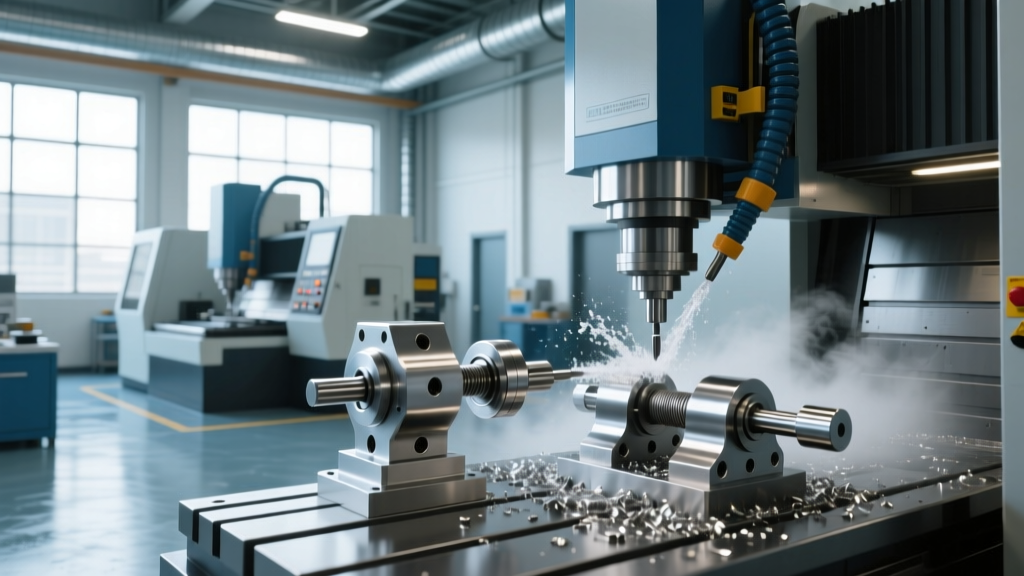
The facility upgraded to a Makino a61nx HMC equipped with a Kitagawa B210 rotary table. The workholding solution was a custom 4-sided twin-tombstone designed to hold 32 parts simultaneously (8 parts per face).
Data Highlight: HMC Tombstone Economics
Fixture Investment: $22,500 (Custom cast iron tombstone + 64 hydraulic swing clamps + manifold plumbing).
Load/Unload Time: 18 minutes for all 32 parts (performed by a single operator or cobot).
Spindle Utilization: Increased from 42% (VMC) to 89% (HMC lights-out).
Cost Per Part Reduction: 38% reduction in direct machining labor costs within the first year.
To ensure the cobalt chrome parts did not shift under the aggressive cutting forces of a Sandvik CoroMill face mill, the tombstone utilized hydraulic swing clamps with a 45 kN pull-down force. The hydraulic manifold was integrated directly into the tombstone base, connecting to the machine's rotary union. This eliminated external hoses that could snag or limit the B-axis rotation of the tombstone.
Overcoming the Coolant Pressure Variable
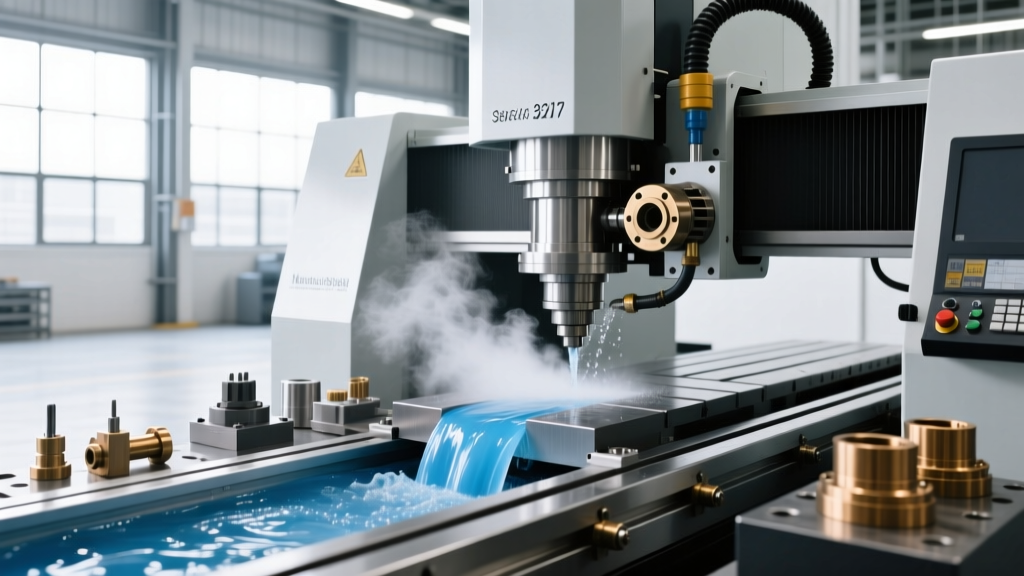
A critical, often-overlooked detail in HMC fixturing is the interaction between high-pressure through-spindle coolant (TSC) and workholding. At 1,000 PSI, TSC can physically lift lightly clamped parts. The engineering team solved this by incorporating 15-degree angled hydraulic clamps that pulled the parts down and inward against a hardened steel datum rail, counteracting the upward vector of the coolant blast.
Decision Framework: Modular vs. Dedicated Fixturing
When planning a new CNC workflow, shop managers must decide between modular fixturing systems (like Bluco or Mitee-Bite modular plates) and dedicated, welded/machined jigs. Based on 2026 production economics, use the following framework to make the capital expenditure decision:
When to Choose Modular Fixturing (e.g., Bluco Grid Plates)
- High-Mix, Low-Volume (HMLV): Job shops running 5 to 50 parts per batch. Modular kits cost between $12,000 and $18,000 for a comprehensive base setup but can be reconfigured in minutes.
- Prototyping and NPI: When the part geometry is still undergoing design for manufacturability (DFM) changes, dedicated fixtures will become obsolete scrap.
- Multi-Axis Trunnion Setups: Modular towers allow quick reconfiguration of riser blocks to clear 5-axis trunnion tables without custom machining.
When to Choose Dedicated Fixturing
- High-Volume Production: Batches exceeding 500 parts. Dedicated fixtures offer 20% to 30% faster load/unload times because operators (or robots) do not need to adjust strap clamps or locate modular stops.
- Severe Material Hardness: When machining Inconel 718 or hardened tool steels above 50 HRC, the microscopic flex in modular grid plates can cause chatter. A solid, stress-relieved cast iron dedicated fixture absorbs harmonic vibrations far superior to assembled modular components.
- Automated Cobot Loading: Robotics require exact, repeatable physical datums. Dedicated fixtures with integrated air-seating detectors (which verify the part is fully seated before the cycle starts) are mandatory for safe automated loading.
Troubleshooting Chatter via Workholding Adjustments
When a CNC process suffers from chatter, machinists often default to changing the cutting tool geometry or reducing the spindle speed. However, altering the workholding mass and stiffness is frequently the more effective solution. Consult this troubleshooting sequence before ordering new end mills:
- Check the Z-Axis Overhang Ratio: If the distance from the vise jaw to the top of the part exceeds 2.5 times the width of the clamped area, the part will act as a tuning fork. Switch to a fixture that supports the part from underneath (e.g., adjustable rest buttons or a custom milled sub-plate).
- Alter the Fixture Mass: Harmonic vibration requires energy. Adding mass to the fixture shifts the resonant frequency. Bolt the fixture directly to the machine table using maximum allowable T-slot bolts (e.g., 5/8"-11 UNC) rather than relying solely on the vise's base clamps.
- Implement Tuned Mass Dampers (TMD): For deep-cavity milling where internal fixturing is impossible, attach a passive tuned mass damper to the exterior of the part or the fixture. These devices, containing a heavy mass suspended in an elastomer, absorb the specific vibrational frequency generated by the cutting tool, effectively killing the chatter at the source.
The Future of Intelligent Workholding
The evolution of the CNC machine acronym's physical counterpart is rapidly advancing toward closed-loop intelligence. Leading fixturing manufacturers are now embedding piezoelectric strain gauges directly into the jaws of hydraulic vises and the bases of tombstones. These sensors feed real-time clamping pressure data back to the CNC controller. If a part begins to slip due to thermal expansion or cutting forces, the machine automatically pauses or adjusts the feed rate before the part is ejected or scrapped. For shops aiming to run unattended weekend shifts in 2026 and beyond, investing in smart, sensor-integrated workholding is no longer a luxury; it is a prerequisite for profitability.
For further reading on advanced clamping strategies and metallurgical interactions, refer to the SME Workholding Technology Hub and ongoing research published by the Modern Machine Shop Workholding Division.