CNC Grinding Machines vs. Mill-Turn Centers: 2026 Buyer's Guide
Compare dedicated CNC grinding machines with multi-function mill-turn centers. Explore pricing, tolerances, and 2026 buying frameworks for complex parts.
The Convergence of Grinding and Multitasking
Historically, achieving sub-micron surface finishes and tight cylindrical tolerances required moving a part from a turning center to a dedicated grinding machine. Today, the integration of high-speed grinding spindles into multi-function mill-turn centers has disrupted this traditional workflow. When procurement teams evaluate dedicated cnc grinding machines against multitasking mill-turn-grind centers, the decision hinges on a complex matrix of geometric tolerances, batch sizes, and hidden operational costs. This guide provides a technical and financial framework for selecting the optimal architecture for your production floor in 2026.
Executive Decision Matrix
- Choose Dedicated CNC Grinding Machines if: Your primary requirement is extreme roundness (< 1 µm), ultra-fine surface finishes (Ra < 0.1 µm), and high-volume throughput of geometrically simple shafts or bores.
- Choose Mill-Turn-Grind Centers if: You are machining complex, low-to-medium volume aerospace or medical components where eliminating secondary setups and maintaining datum references outweigh the need for absolute maximum grinding precision.
Dedicated CNC Grinding Machines: Uncompromising Precision
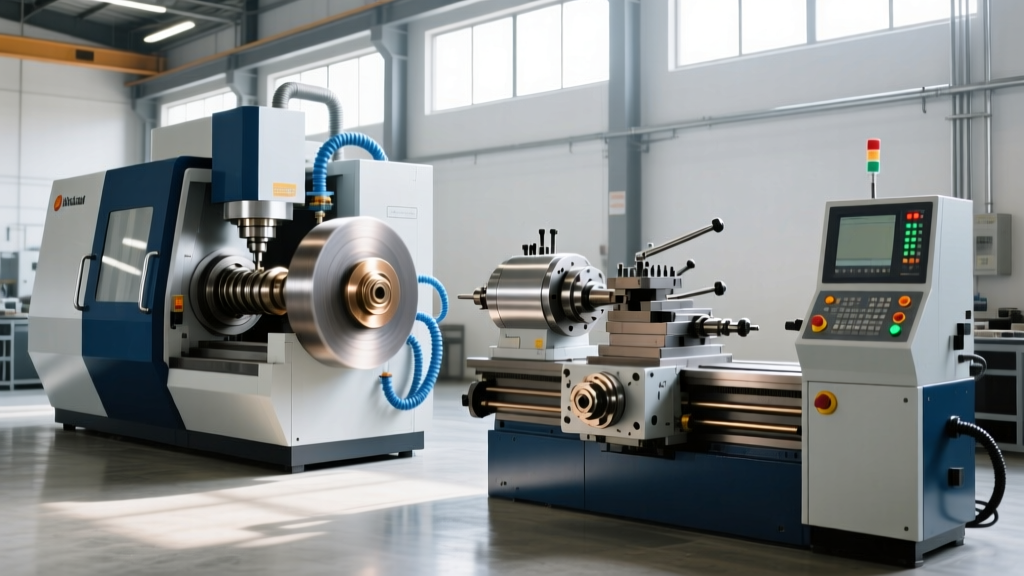
Dedicated cnc grinding machines, such as the Studer S141 cylindrical grinder or the Blohm PLANOMAT XT creep feed grinder, are engineered from the ground up for thermal stability, vibration dampening, and ultra-precise axis interpolation. The machine castings are typically heavily ribbed and filled with polymer concrete (like Granitan) to absorb the high-frequency vibrations inherent to abrasive machining.
Precision and Surface Finish Limits
A high-end dedicated cylindrical grinder routinely holds roundness tolerances of 0.2 to 0.5 µm and achieves surface finishes of Ra 0.05 µm. This is possible because the grinding wheelhead and workhead are mounted on a single, highly rigid bed with hydrostatic guideways. Furthermore, dedicated machines utilize integrated acoustic emission (AE) sensors for automatic wheel-to-part touch-off, eliminating operator error and reducing non-cutting time.
Capital Costs and Throughput Realities
In 2026, the capital expenditure for a fully equipped, production-ready cylindrical grinder ranges from $380,000 to $550,000. While the initial outlay is significant, the cycle times for high-volume batch processing are vastly superior to multitasking machines. According to manufacturing productivity data tracked by the Society of Manufacturing Engineers (SME), dedicated grinders can process continuous batches of identical shafts with automated gantry loaders at cycle times 40% to 60% faster than a mill-turn center attempting the same operation via interpolation grinding.
Multi-Function Mill-Turn-Grind Centers: The Single-Setup Advantage
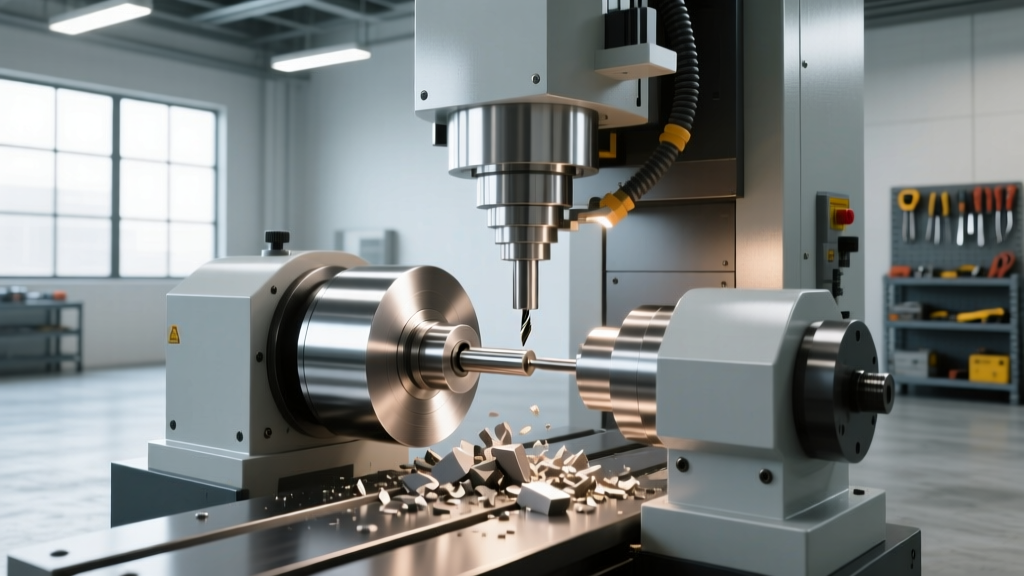
Multi-function machines like the DMG MORI NTX 2000 2nd Generation or the Mazak INTEGREX i-400S incorporate a grinding spindle (often mounted on the B-axis milling head or a dedicated lower turret) to perform cylindrical, internal, and face grinding operations without unclamping the part.
Integrated Grinding Spindles in Action
These integrated spindles typically operate at 10,000 to 15,000 RPM and utilize smaller, specialized CBN or diamond wheels. The primary advantage is the preservation of the part's datum reference. By turning, milling, and grinding in a single chucking, manufacturers eliminate the cumulative tolerance stack-up that occurs when moving a part from a lathe to a dedicated grinder. For complex aerospace landing gear components or medical bone screws, this single-setup capability reduces lead times from weeks to days.
Where Multi-Function Falls Short
The compromise for single-setup convenience is absolute precision. Mill-turn centers generally achieve roundness tolerances of 2.0 to 4.0 µm and surface finishes of Ra 0.2 to 0.4 µm during grinding operations. The machine structure, designed to handle the heavy interrupted cuts of milling, lacks the specialized micro-dampening characteristics of a dedicated grinder. Additionally, wheel dressing on a mill-turn often requires manual intervention or specialized B-axis mounted dressers, adding non-productive cycle time.
Head-to-Head Specification Matrix
| Feature | Dedicated Cylindrical Grinder (e.g., Studer S141) | Mill-Turn with Grinding (e.g., DMG MORI NTX 2000) |
|---|---|---|
| Primary Function | High-precision abrasive finishing | Complete part machining (Turn/Mill/Grind) |
| Roundness Tolerance | < 0.5 µm | 2.0 - 4.0 µm |
| Surface Finish (Ra) | 0.05 - 0.1 µm | 0.2 - 0.4 µm |
| Setup Count | Secondary operation (requires prior turning) | Single setup (Done-in-one) |
| Coolant Filtration Req. | Standard 20-micron paper band | Mandatory 10-micron centrifugal separator |
| Approx. Base Price (2026) | $400,000 - $550,000 | $950,000 - $1,400,000 |
The 4-Step Equipment Selection Framework
To determine which architecture fits your specific production environment, apply this four-step evaluation framework based on current industry standards and NIST Manufacturing Extension Partnership guidelines for smart manufacturing integration.
- Analyze Geometric Tolerance Thresholds: Pull the GD&T callouts from your top 20 highest-revenue parts. If cylindrical features demand true position or concentricity within 2 µm, a dedicated grinder is non-negotiable. If the tolerances sit comfortably between 5 µm and 15 µm, the mill-turn's interpolation grinding will suffice, allowing you to consolidate machines.
- Calculate Setup Economics and Batch Sizes: Multi-function centers shine in high-mix, low-volume (HMLV) environments. If your average batch size is under 50 pieces and setup time on a traditional lathe-to-grinder workflow exceeds 4 hours per batch, the ROI on a $1.2M mill-turn center will outpace a dedicated grinder due to massive labor and WIP (Work in Progress) reductions.
- Audit Floor Space and Utility Constraints: A dedicated grinder requires less physical footprint but necessitates a secondary turning center upstream. A mill-turn center requires a larger footprint (often exceeding 12 feet in length with bar feeders and chip conveyors) and demands higher peak electrical draw (up to 60 kVA) to support simultaneous milling and grinding spindle loads.
- Evaluate Automation Integration: Dedicated grinders easily integrate with standard pick-and-place gantry loaders for continuous lights-out shaft production. Mill-turn centers require more complex, articulated 6-axis robots to manage the varied geometries of complex milled and turned parts, increasing the initial automation integration cost by $40,000 to $80,000.
Critical Edge Cases: Coolant Filtration and Wheel Dressing
The most common failure mode when shops transition to grinding on a mill-turn center is the underestimation of abrasive swarf management. Standard mill-turn machines are equipped with 25-micron or 50-micron coolant filtration systems designed for metal chips and turning swarf.
Critical Warning: Integrating aluminum oxide or CBN grinding on a standard mill-turn without upgrading to a 10-micron centrifugal coolant separator or specialized paper band filter will result in catastrophic linear guide failure within 12 to 18 months. Fine abrasive dust bypasses standard drum filters, infiltrates the X/Z axis way covers, and acts as a lapping compound on the machine's precision ball screws and linear rails.
Furthermore, wheel dressing logistics must be addressed during the quoting phase. Dedicated grinders feature automated rotary diamond dressers with acoustic sensors. On a mill-turn center, dressing the grinding wheel often requires the machine to load a specialized dressing tool from the tool magazine, interrupting the automated cycle and requiring careful macro-programming to ensure the wheel geometry is accurately updated in the CNC control's tool offset table.
Final Procurement Directives
The choice between dedicated cnc grinding machines and multi-function mill-turn centers is not a matter of one technology being universally superior; it is a matter of process alignment. Procure dedicated grinding equipment when your competitive advantage relies on extreme precision, high-volume shaft production, and flawless surface finishes. Invest in mill-turn-grind centers when your market demands rapid turnaround of complex, low-volume components, and where eliminating secondary setups provides a decisive advantage in lead time and WIP reduction. Always mandate upgraded micro-filtration coolant systems and automated wheel-dressing macros when specifying grinding capabilities on any multitasking platform.