CNC Machine Coolant Cleaner ROI: Protecting Accuracy & Tolerances
Analyze the ROI of a CNC machine coolant cleaner. Learn how fluid filtration protects tight tolerance specs and reduces scrap costs in precision machining.
The Hidden Financial Cost of Tolerance Degradation
In high-precision manufacturing, maintaining tight CNC machine accuracy and tolerance specifications is not merely a technical requirement; it is a financial imperative. When a 5-axis machining center fails to hold a ±0.0002-inch (±0.005mm) positional tolerance on an aerospace titanium strut, the resulting scrap cost easily exceeds $4,500 in raw material and machine time. While operators often blame tool wear or spindle runout for these deviations, a frequently overlooked culprit is degraded metalworking fluid. Investing in a high-performance CNC machine coolant cleaner is a critical budgetary strategy for preserving machine geometry, preventing thermal drift, and protecting your bottom line.
⚠️ Warning: The Metrology Baseline TrapStandard CNC accuracy specifications (such as ISO 230-2) are measured at a baseline temperature of 68°F (20°C). If your coolant is contaminated with tramp oil, its heat-transfer efficiency drops, causing the workpiece to expand during machining. A part that measures perfectly in-temperature will shrink below the lower tolerance limit once it cools to the metrology baseline in the CMM room.
How Coolant Contamination Destroys CNC Accuracy Specifications
To justify the capital expenditure (CapEx) of a commercial filtration system, shop managers must understand the exact mechanisms by which dirty fluid degrades machine tolerances. Contamination impacts accuracy through two primary vectors: thermal instability and mechanical ingression.
Thermal Drift and Tramp Oil Insulation
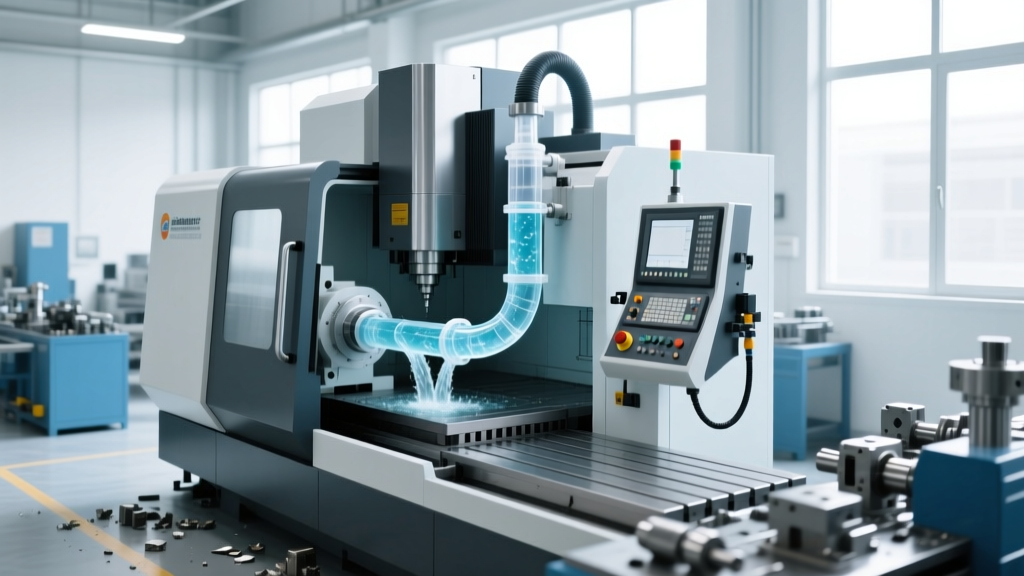
Water-soluble synthetic and semi-synthetic coolants rely on the high specific heat capacity of water to extract heat from the cutting zone and the machine's ballscrews. When hydraulic way-lube and spindle oils leak into the sump, they form a tramp oil layer. This oil coats the workpiece and the machine's linear scales, acting as a thermal insulator. According to research supported by the National Institute of Standards and Technology (NIST), thermal errors account for up to 75% of geometric errors in precision machined parts. By deploying a centrifugal CNC machine coolant cleaner that continuously removes tramp oil down to 0.5%, shops stabilize the fluid's refractive index and thermal conductivity, effectively eliminating thermally induced tolerance drift.
Particulate Ingression and Ballscrew Wear
Standard paper band filters on CNC machines typically capture particles down to 25 microns. However, sub-micron carbide and high-speed steel fines remain suspended in the fluid. Over a 6-month operational cycle, these microscopic abrasives infiltrate the telescopic way covers and ballscrew nut assemblies. This acts as a lapping compound, accelerating mechanical wear and increasing axial backlash. A machine originally specified for ±0.0001-inch repeatability can degrade to ±0.0004-inch repeatability purely due to particulate-induced mechanical wear. Vacuum and disc-stack centrifugal cleaners capture fines down to 2 to 5 microns, preserving the physical integrity of the machine's drive components.
Budgeting for Filtration: Cost Analysis Matrix
When planning your annual maintenance and accuracy-preservation budget, it is essential to compare the total cost of ownership (TCO) across different coolant management strategies. The table below outlines the financial impact of various CNC machine coolant cleaner technologies over a 3-year period for a mid-sized shop operating ten CNC machining centers.
| Filtration Strategy | Initial CapEx (Per Unit) | Annual OpEx (Consumables/Labor) | Impact on Tolerance Stability | 3-Year TCO (10 Machines) |
|---|---|---|---|---|
| Reactive Dumping (No Cleaner) | $0 | $18,500 (Coolant + Disposal) | Poor (Frequent thermal drift) | $555,000 |
| Belt Skimmers Only | $850 | $12,000 (Makeup fluid) | Fair (Fines remain) | $385,500 |
| Vacuum Filtration System | $11,500 | $4,200 (Filter media) | Excellent (2-micron clarity) | $241,000 |
| Centrifugal Disc-Stack Separator | $14,800 | $1,100 (Electricity/Seals) | Superior (Continuous <0.5% oil) | $181,000 |
While the upfront CapEx for a centrifugal separator is substantial, the 3-year TCO reveals a savings of over $370,000 compared to reactive dumping. More importantly, the superior fluid clarity directly protects the machine's ballscrews and linear guides, preserving the OEM accuracy specifications and preventing $50,000+ spindle and drive rebuilds.
Calculating the Break-Even Point for Precision Machining
To integrate a CNC machine coolant cleaner into your annual budget, calculate the break-even point using the scrap-reduction metric. In medical and aerospace job shops, the cost of a single scrapped complex component (e.g., an Inconel 718 turbine blisk) can range from $8,000 to $15,000.
💡 Budgeting Tip: The 1% Scrap RuleIf your shop generates $5,000,000 in annual revenue and operates at a 3% scrap rate ($150,000 lost), reducing your scrap rate to 2% by eliminating thermally induced tolerance failures yields $50,000 in recovered profit. A fleet of ten centrifugal CNC machine coolant cleaners (Total CapEx: $148,000) will pay for itself in under 3 years purely through scrap reduction, entirely ignoring the savings from extended coolant life and reduced machine downtime.
Regulatory and Operator Health Considerations
Budgeting for coolant cleanliness is not solely about machine accuracy; it is also a risk-management strategy against regulatory fines and worker compensation claims. Degraded coolant harbors anaerobic bacteria, leading to the generation of endotoxins and hydrogen sulfide gas. The Occupational Safety and Health Administration (OSHA) strictly monitors worker exposure to metalworking fluid aerosols. A high-quality filtration system that continuously removes tramp oil starves anaerobic bacteria of their food source, maintaining a pH above 9.0 and eliminating the need for expensive, toxic biocide additives. Factoring in the $4,000 annual cost of biocides and potential OSHA compliance fines further accelerates the ROI of a dedicated cleaning system.
Frequently Asked Questions: Accuracy and Fluid Management
How often should a CNC machine coolant cleaner be run to maintain tight tolerances?
For machines holding tolerances tighter than ±0.0005 inches, the coolant cleaner should be integrated into a continuous bypass loop, running 24/7. Batch-cleaning the sump only on weekends allows tramp oil and fines to accumulate during the workweek, causing cyclic thermal drift that ruins Monday morning setups.
Does coolant concentration affect CNC positioning accuracy?
Yes. If a cleaner removes too much water along with the tramp oil (a common issue with poorly calibrated coalescers), the remaining fluid becomes overly concentrated. High-concentration coolant becomes viscous, increasing the drag on the machine's way covers and altering the friction coefficients of the linear guideways, which can introduce stick-slip errors during high-speed contouring.
Can a coolant cleaner fix a machine that has already lost its accuracy specs?
No. A CNC machine coolant cleaner is a preventative maintenance tool. If sub-micron particulates have already lapped the ballscrews and increased backlash beyond the machine's repeatability specification, mechanical intervention is required. The machine must undergo laser interferometry calibration (per ISO 230-2) and pitch-error compensation updating. The cleaner's role is to prevent this degradation from occurring in the first place.