Carvera CNC Machine Spindle Speed and Feed Rate Optimization
Master spindle speed and feed rate optimization for the Carvera CNC machine. Learn chipload math, ER11 limits, and material-specific parameters.
The Carvera Spindle: Technical Baseline and Constraints
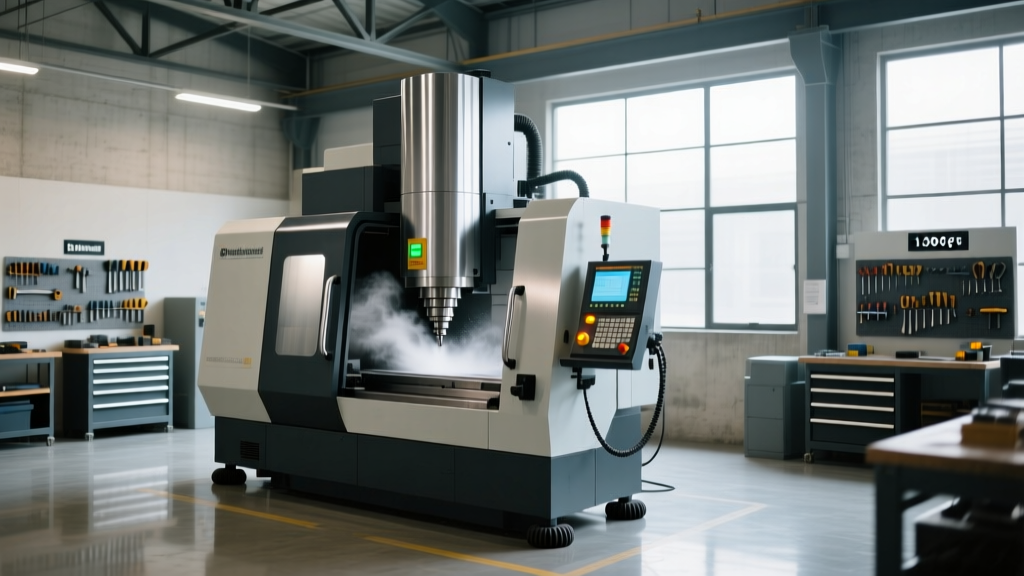
Optimizing toolpaths on a desktop CNC requires a fundamentally different approach than programming a 10,000-lb industrial VMC. The Makera Carvera CNC machine bridges the gap between hobbyist routers and light industrial mills, but extracting maximum Material Removal Rate (MRR) without triggering chatter or stalling the motor demands strict adherence to its mechanical realities. According to Makera's official Carvera technical documentation, the machine is equipped with a custom 800W BLDC (Brushless DC) spindle, an ER11 collet system, and a maximum rotational speed of 12,000 RPM.
Carvera Spindle Technical Baseline:- Motor Type: 800W BLDC (High torque at lower RPMs compared to brushed routers)
- Speed Range: 300 – 12,000 RPM
- Collet Standard: ER11 (Maximum shank capacity: 7mm / 0.275 inches)
- Runout Tolerance: ~0.012mm (0.0005") at the tool tip, assuming proper collet maintenance
- Machine Travel: 330 x 240 x 100 mm (X, Y, Z)
Unlike 2.2kW water-cooled spindles that maintain torque linearly up to 24,000 RPM, the Carvera’s 800W BLDC motor peaks in torque delivery between 6,000 and 8,000 RPM. This specific torque curve dictates that running the spindle at its absolute maximum 12,000 RPM is not always optimal for hard materials like aluminum or brass, where cutting forces can induce motor stall if the chipload exceeds the motor's holding torque at that specific RPM band.
Calculating Chipload and Cutting Speed (Vc)
The foundation of CNC optimization is moving away from guessing feed rates and instead calculating them based on chipload (the thickness of the material removed by a single cutting edge in one revolution) and cutting speed (Vc, measured in meters per minute). As detailed in CNC Cookbook's speeds and feeds master guide, dialing in these metrics prevents work-hardening in metals and melting in thermoplastics.
The Core Equations
To find your target Spindle Speed (RPM), use the metric cutting speed formula:
RPM = (Vc × 1000) / (π × Tool Diameter in mm)
Once the RPM is established, calculate the Feed Rate (mm/min) using the chipload formula:
Feed Rate = RPM × Number of Flutes × Chipload (mm/tooth)
Practical Example: You are machining Aluminum 6061 using a 3.175mm (1/8") 2-flute solid carbide endmill. The recommended Vc for uncoated carbide in aluminum is roughly 150 m/min.
1. RPM = (150 × 1000) / (3.1416 × 3.175) = 15,052 RPM.
Because the Carvera caps at 12,000 RPM, you must cap the spindle at 12,000.
2. Assuming a conservative chipload of 0.02mm/tooth for a desktop machine:
Feed Rate = 12,000 × 2 × 0.02 = 480 mm/min.
Material-Specific Parameter Matrix for the Carvera
The following matrix provides baseline parameters optimized specifically for the Carvera's rigidity and ER11 tooling limits. These values assume a sharp, high-quality solid carbide endmill and proper workholding.
| Material | Tool Dia (mm) | Flutes | Target Vc (m/min) | Chipload (mm/t) | Carvera RPM | Feed Rate (mm/min) | Max DOC (mm) |
|---|---|---|---|---|---|---|---|
| Aluminum 6061 | 3.175 (1/8") | 2 or 3 | 120 - 150 | 0.015 - 0.025 | 10,000 - 12,000 | 300 - 600 | 1.0x Dia (3.1mm) |
| Delrin (POM) | 3.175 (1/8") | 2 | 80 - 100 | 0.040 - 0.060 | 8,000 - 10,000 | 640 - 1,200 | 2.0x Dia (6.3mm) |
| Brass (C360) | 3.175 (1/8") | 2 | 90 - 120 | 0.020 - 0.030 | 9,000 - 11,000 | 360 - 660 | 1.5x Dia (4.7mm) |
| MDF / Hardwood | 6.350 (1/4") | 2 | 250 - 300 | 0.080 - 0.120 | 12,000 | 1,920 - 2,880 | 2.0x Dia (12.7mm) |
Advanced Tuning: Radial Chip Thinning
A frequent mistake made by Carvera operators is applying standard chipload math to finishing passes where the Width of Cut (WOC) is less than 50% of the tool diameter. When you engage less than half the tool's diameter, the chip geometry changes from a rectangular block to a crescent shape. This phenomenon, known as radial chip thinning, means your effective chipload is significantly thinner than your programmed feed rate suggests.
Warning: The Rubbing ZoneIf your effective chipload drops below the cutting edge radius of your endmill (typically 0.005mm to 0.01mm for micro-grain carbide), the tool stops cutting and starts rubbing. In aluminum, this instantly work-hardens the material and snaps the endmill. In Delrin, it melts the plastic, causing it to weld to the flutes.
The Fix: If your WOC is 10% of the tool diameter (e.g., a 0.3mm finishing pass with a 3.175mm endmill), you must increase your programmed feed rate by approximately 70% to 100% to maintain the correct chip thickness. Utilizing CAM software that features trochoidal milling or adaptive clearing toolpaths automatically compensates for this by maintaining a constant tool engagement angle, allowing you to run higher feed rates safely on the Carvera.
Overcoming Desktop Rigidity and Deflection
The Carvera features a robust aluminum extrusion frame and linear rails, but it lacks the cast-iron mass required to dampen high-frequency vibrations. When optimizing feeds and speeds, machine deflection is the ultimate limiting factor.
Depth of Cut (DOC) vs. Width of Cut (WOC) Tradeoffs
To maximize MRR without inducing chatter on a desktop CNC, prioritize Width of Cut over Depth of Cut.
- Slotting (100% WOC): Generates maximum radial and tangential forces. Limit DOC to 0.5x tool diameter in aluminum. Reduce feed rate by 30% compared to profiling.
- Adaptive Roughing (10-15% WOC): Radial forces are drastically reduced. You can safely increase DOC to 1.5x or 2.0x the tool diameter and increase the feed rate to the machine's maximum rapid limits (up to 3000 mm/min on the Carvera) to clear chips efficiently.
ER11 Collet Maintenance and Runout Management
Feed rate optimization is useless if tool runout destroys your chipload consistency. In an ER11 system, if the collet is not perfectly clean, the tool sits slightly off-center. A mere 0.02mm of runout means that in a 2-flute endmill, one flute is taking 100% of the cutting load while the other flute takes 0%. This instantly doubles the effective chipload on the engaged flute, leading to premature tool wear and catastrophic edge chipping.
Maintenance Protocol:
- Blow out the spindle taper and collet with compressed air before every tool change.
- Wipe the tool shank with isopropyl alcohol to remove microscopic oil films.
- Tighten the ER11 nut using the provided dual-wrench method to ensure even clamping pressure. Do not use pliers or overtighten, which distorts the collet cage.
- Replace ER11 collets every 6-12 months under heavy use, as the spring steel fatigues and loses concentricity.
Troubleshooting Common Edge Cases
Even with perfect math, real-world machining variables require acoustic and visual tuning. Use this diagnostic framework to adjust parameters on the fly.
- Symptom: High-pitched screaming or ringing (Chatter).
Cause: Harmonic resonance between the tool stickout and the machine frame.
Fix: Reduce tool stickout to the absolute minimum. If stickout cannot be reduced, alter the spindle RPM by ±10% to shift the frequency out of the harmonic node. Alternatively, reduce the DOC by 25%. - Symptom: Burn marks on MDF or melted edges on acrylic.
Cause: Feed rate is too slow, or the endmill is dull, causing friction instead of shearing.
Fix: Increase feed rate by 30%. Ensure you are using an O-flute or single-flute endmill designed specifically for plastics and wood to maximize chip evacuation. - Symptom: Spindle stalls or loses steps mid-cut in aluminum.
Cause: Chipload exceeds the 800W BLDC motor's torque capacity at the current RPM, or chips are packing in the flute.
Fix: Increase RPM to move into a higher torque band (if below 8,000 RPM), decrease WOC, or apply a mist lubricant (airblast + WD-40 or dedicated cutting fluid) to prevent chip welding.
Mastering the Carvera CNC machine requires treating it as a precision instrument rather than a brute-force router. By strictly calculating chipload, compensating for radial thinning, and respecting the physical limits of the ER11 spindle system, operators can achieve surface finishes and cycle times that rival much larger, significantly more expensive industrial equipment.