Scaling Small Workshops with the Carbide 3D Nomad 3 CNC Machine
Discover how the Carbide 3D Nomad 3 CNC machine transforms small workshop environments with real-world case studies, ROI data, and setup specs.
The Micro-Manufacturing Shift in Compact Job Shops
The landscape of small-batch manufacturing has fundamentally shifted. Facilities under 2,000 square feet are increasingly adopting automated micro-milling to capture high-margin, low-volume contracts that large machine shops reject. According to data from the NIST Manufacturing Extension Partnership (MEP), small and medium-sized manufacturers (SMMs) that integrate desktop automation reduce prototyping lead times by up to 40%. In this environment, the Carbide 3D Nomad 3 CNC machine has emerged as a critical bridge between hobbyist routing and light industrial vertical machining centers (VMCs).
This article examines two distinct real-world applications of the Nomad 3 in compact workshop environments, detailing the exact toolpaths, machine limitations, and financial ROI that shop owners must navigate to achieve profitability.
Case Study 1: High-Margin EDC Prototyping in Brass and Titanium
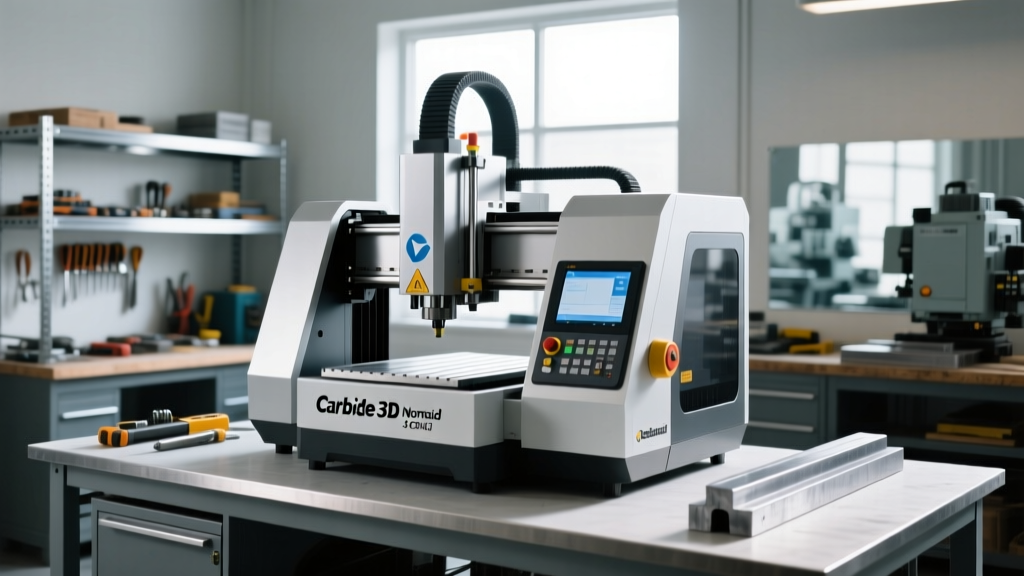
A custom Everyday Carry (EDC) manufacturer operating out of a 600-square-foot garage workshop needed to mill intricate pocket clips and titanium scales without the footprint or 3-phase power requirements of a Haas Mini Mill. The Nomad 3, with its 8" x 8" x 3" cutting volume and fully enclosed polycarbonate shell, fit precisely on a standard 30" x 60" workbench.
Feeds, Speeds, and Tooling Specifics
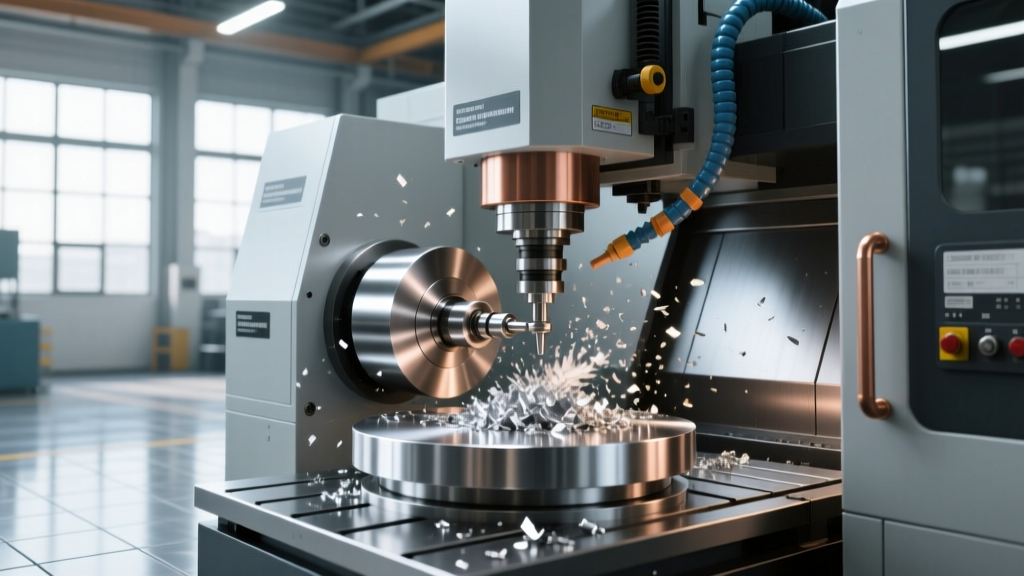
Machining Grade 2 Titanium and C360 Brass on a desktop router requires strict adherence to conservative material removal rates (MRR). The Nomad 3 features an integrated 24,000 RPM spindle, which provides the high surface speeds necessary for micro-tooling.
- Brass (C360): Using a 1/8" 3-flute carbide endmill (sourced from Harvey Tool), the shop ran the spindle at 18,000 RPM with a feed rate of 45 IPM. Depth of cut (DOC) was set to 0.015" with a stepover of 40%. Cycle time for a 3-inch pocket clip: 14 minutes.
- Titanium (Grade 2): Titanium requires high rigidity. The shop utilized a 1/8" 4-flute AlTiN coated endmill, dropping the spindle to 8,000 RPM and the feed rate to 12 IPM. DOC was restricted to 0.005" to prevent tool deflection and work hardening.
Unlike industrial VMCs that utilize precision ball screws, the Nomad 3 utilizes a belt-driven Z-axis. While this keeps costs and maintenance low, it introduces a specific failure mode: Z-axis stalling during aggressive plunging. If you attempt to ramp into 6061 aluminum at a 0.050" DOC, the Z-belt will skip steps, ruining the part and potentially damaging the tool. Solution: Always use helical ramping or shallow, high-feed adaptive clearing toolpaths (like those generated in Carbide Create Pro or Fusion 360) to keep Z-axis load minimal.
Case Study 2: Aerospace PEEK Milling and Thermal Management
A secondary case study involves a sub-tier aerospace supplier prototyping electrical insulators from PEEK (Polyether ether ketone). PEEK is an unforgiving engineering thermoplastic that requires high spindle speeds to achieve a clean shear cut; otherwise, the material melts and re-welds to the endmill.
The Nomad 3’s integrated VFD-controlled spindle excels here. By running a specialized O-flute plastics endmill at 22,000 RPM and 60 IPM, the machine cleanly shears the PEEK without generating excess thermal load. However, the fully enclosed nature of the Nomad 3 creates a secondary challenge: static dust accumulation.
Overcoming Static and Chip Evacuation
PEEK dust is highly electrostatic and will cling to the machine's lead screws and limit switches, eventually causing homing errors. The workshop implemented a targeted mitigation strategy:
- Installed an anti-static ionizing air gun to neutralize the workpiece before opening the enclosure.
- Upgraded the standard dust extraction to a 650 CFM cyclone dust collector with grounded, anti-static PVC hosing.
- Applied a dry PTFE lubricant to the Z and Y-axis lead screws weekly, avoiding wet oils that attract plastic swarf.
Capital Expenditure and ROI Matrix: Desktop vs. Light Industrial
For a small workshop owner deciding between scaling up to a used industrial mill or maximizing a fleet of desktop machines, the financial breakdown is stark. Below is a comparative analysis based on 2026 market pricing and operational costs.
| Metric | Carbide 3D Nomad 3 Fleet (x2) | Used Haas Mini Mill (1 Phase) |
|---|---|---|
| Base Equipment Cost | $5,998 ($2,999 each) | $22,000 - $28,000 |
| Facility Upgrades (Power/Rigging) | $0 (Standard 110V 15A) | $4,500+ (Phase converter, forklift rigging) |
| Footprint Required | 16 sq. ft. (benchtop) | 60+ sq. ft. (floor standing + clearance) |
| Setup & Commissioning Time | 4 hours | 2 - 4 days |
| Roughing Capability (6061 Al) | Low (Adaptive clearing required) | High (Aggressive DOC & MRR) |
The ROI calculation heavily favors the Nomad 3 for shops focused on prototyping, micro-machining, and low-volume production. The Haas Mini Mill only achieves a faster ROI when the shop's primary bottleneck is raw material removal rate (MRR) on large aluminum billets, which falls outside the Nomad 3's physical envelope.
Facility Requirements: Acoustics and Environmental Control
Integrating the Carbide 3D Nomad 3 into a mixed-use space (such as an attached garage or shared maker space) requires addressing acoustic and environmental factors. The official enclosure reduces high-frequency spindle whine, but low-frequency vibrations can still transmit through the workbench.
💡 Pro-Tip: Vibration Isolation FrameworkDo not place the Nomad 3 directly on a hollow-core wooden workbench. Construct a torsion box benchtop or place a 1-inch thick sorbothane vibration-dampening pad beneath the machine's feet. This prevents low-frequency harmonic resonance from transferring into the floor structure, keeping ambient noise levels below 65 dB during heavy aluminum roughing passes.
Software and Workflow Integration
For small shops, the software stack is just as critical as the hardware. The Nomad 3 operates via GRBL 1.1, which is universally supported. However, to maximize the machine's rigid but lightweight frame, shops should utilize CAM software that supports Adaptive Clearing or Dynamic Milling. These toolpaths maintain a constant tool engagement angle, preventing the sudden shock loads that cause belt-driven desktop machines to lose steps.
Final Operational Assessment
The Carbide 3D Nomad 3 is not a replacement for a 10,000-lb cast-iron VMC. It is a highly specialized, precision micro-milling platform. When deployed correctly—respecting the Z-axis belt limitations, utilizing high-RPM micro-tooling, and implementing strict chip evacuation protocols—it allows small workshops to capture lucrative, high-precision contracts in aerospace prototyping, custom EDC manufacturing, and medical device iteration. By keeping capital expenditure under $3,500 per station and requiring zero facility modifications, it remains one of the most financially efficient automation assets available to the modern micro-manufacturer.