Big CNC Machine Dust Collection: Maintenance & Chip Guide
Optimize chip management and dust collection maintenance on your big CNC machine. Learn CFM requirements, filter schedules, and conveyor troubleshooting.
The Hidden Cost of Poor Chip Evacuation on Large Gantry Mills
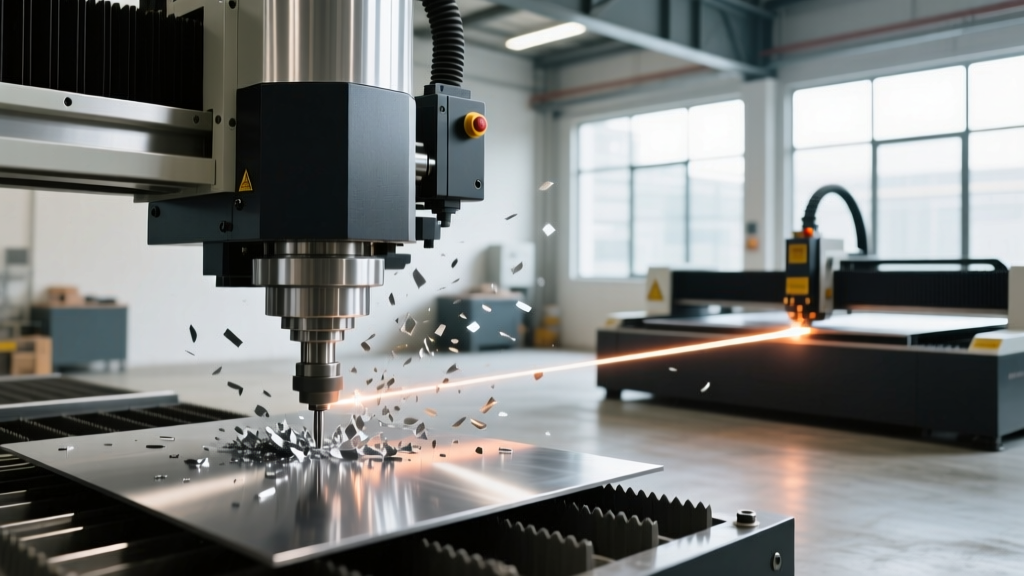
When operating a big CNC machine—such as a 5-axis Zimmermann FZ33 gantry mill, a Biesse Rover A nesting router, or a massive Thermwood composite profiler—swarf and particulate generation scale exponentially with table size and spindle horsepower. A standard 3-axis VMC might produce 50 lbs of aluminum chips per shift, but a large-format 5-axis machine machining aerospace composites or MDF core materials can generate hundreds of pounds of hazardous fines and stringy swarf daily.
If extraction fails, the consequences extend far beyond a messy shop floor. Silica and carbon fiber dust infiltrate spindle labyrinth seals, destroying $40,000 HSK-100 spindle bearings in months. Heavy chips accumulate under telescopic way covers, tearing the wiper seals and scoring the linear guideways. Proper dust collection and chip management are not ancillary accessories; they are critical machine preservation systems.
⚠️ NFPA 652 Compliance Warning: If your big CNC machine processes wood, MDF, or certain metal powders (like aluminum or titanium), the extracted dust is classified as combustible. According to the NFPA 652 Standard on the Fundamentals of Combustible Dust, failure to maintain proper duct velocities and explosion isolation (via rotary airlocks or flame front diverters) can result in catastrophic deflagration events and severe OSHA citations.Sizing the System: Duct Velocity and CFM Matrices
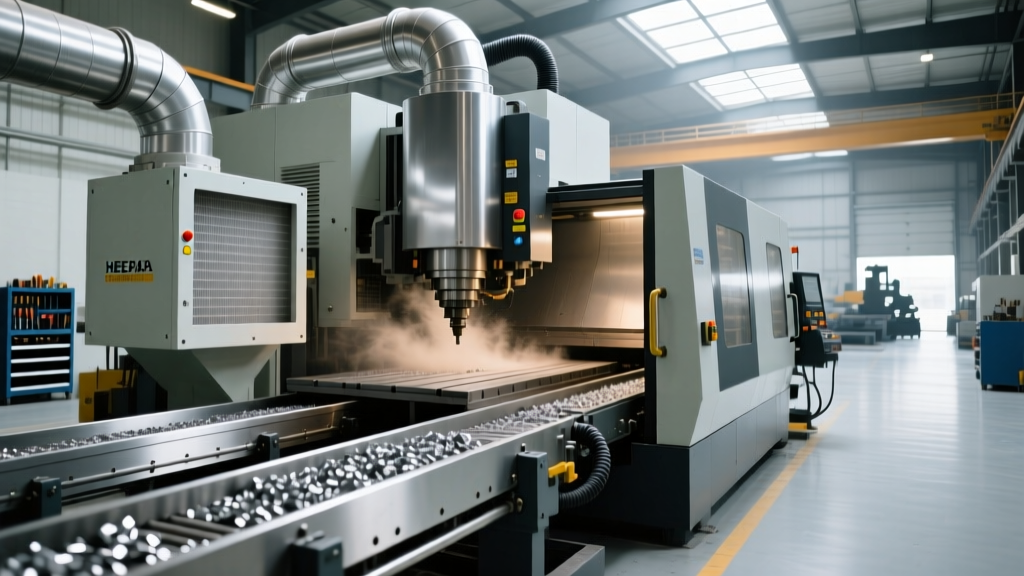
The most common failure point in large-format CNC extraction is undersized ductwork. Facility managers often look solely at the blower's CFM (Cubic Feet per Minute) rating, ignoring duct velocity (FPM - Feet per Minute). If velocity drops below the threshold required to keep particulate suspended, chips settle in the horizontal runs, creating blockages and fire hazards.
According to data published by the Engineering Toolbox regarding industrial duct velocities, you must size your main trunk lines and branch drops to maintain specific transport speeds based on the material being milled.
| Material Milled | Required Duct Velocity (FPM) | Typical Branch Duct Size | Estimated CFM per Hood |
|---|---|---|---|
| Dry Wood / MDF Dust | 4,000 - 4,500 FPM | 6" to 8" Diameter | 800 - 1,200 CFM |
| Sticky Plastics (Acrylic, UHMW) | 4,500 - 5,000 FPM | 6" Diameter (Smooth Wall) | 900 - 1,100 CFM |
| Aluminum Chips (Dry Misting) | 5,000 - 5,500 FPM | 8" to 10" Diameter | 1,500 - 2,500 CFM |
| Carbon Fiber / Composite Fines | 4,500 FPM (Min) | 6" to 8" Diameter | 1,000 - 1,400 CFM |
Pro Tip: Never use corrugated flexible hose for branch drops on a big CNC machine. The internal ridges create turbulence that drops effective velocity by up to 30%. Use snap-lock smooth-wall galvanized steel or welded stainless steel ducting, sweeping into the main trunk at a 45-degree angle to maintain laminar airflow.
Filter Media Selection: Standard Cellulose vs. PTFE Membrane
The dust collector's filter bank is the heart of the system. Standard cellulose filters (typically rated for 1.0 to 2.0 microns) are adequate for heavy wood shavings but will blind completely within 48 hours when subjected to the sub-micron fines generated by routing MDF or carbon-fiber-reinforced polymers (CFRP).
When to Mandate PTFE Membrane Cartridges
If your machine processes composites, fiberglass, or fine MDF, you must upgrade to PTFE (Polytetrafluoroethylene) membrane filters. The PTFE layer acts as a micro-mesh on the surface of the filter, capturing dust at 0.5 microns or smaller on the surface rather than embedding it deep within the media depth.
- Pulse-Jet Efficiency: PTFE allows the compressed air pulse-jet cleaning system to snap the dust cake off the filter cleanly. Standard cellulose retains embedded fines, causing differential pressure to climb permanently.
- Cost Analysis: A set of four standard cellulose cartridges (e.g., Donaldson Torit 14x48) costs roughly $350. The equivalent PTFE membrane set costs $750–$900. However, the PTFE set will last 3,000+ operating hours, while cellulose may require replacement every 400 hours in a composite environment, making PTFE significantly cheaper on an annualized basis.
The 12-Month Maintenance Cadence for Big CNC Extraction
Dust collection systems are not 'set and forget' infrastructure. A strict, documented maintenance schedule is required to maintain suction, protect the blower motor, and comply with OSHA combustible dust hazard guidelines.
Daily & Weekly Operator Checks
- Daily: Empty the collection drum. Never let the dust level reach the bottom of the filter cones; this re-entrains dust into the pulse-jet stream, destroying the filters.
- Daily: Check the Magnehelic differential pressure (DP) gauge. For PTFE filters, normal operating DP is 2.0 to 3.5 inches w.g. If it reads above 4.5 inches w.g., the pulse-jet system is failing or the filters are blinded.
- Weekly: Drain the pulse-jet compressed air receiver tank. Moisture in the air lines will cause dust to cake onto the filters like concrete.
Monthly & Annual Technician Servicing
- Monthly (Rotary Airlock Clearances): The rotary airlock at the bottom of the hopper maintains the system's vacuum seal while discharging chips. Measure the clearance between the rotor tips and the housing. If clearance exceeds 0.010 inches (for standard steel) or 0.015 inches (for UHMW polyurethane tips), suction drops drastically. Rebuild kits cost roughly $400 and should be installed immediately if tolerances are breached.
- Quarterly (Pulse Valve Diaphragms): Inspect the ASCO or Goyen pulse valve diaphragms. A torn diaphragm causes a continuous air bleed, dropping tank pressure and preventing the remaining valves from firing with enough force to clean the filters.
- Annually (Blower Motor & Bearings): Megger test the 10HP to 25HP blower motor windings. Grease the pillow block bearings on the fan shaft with high-temperature lithium complex grease. Vibration analysis should be performed to check for fan wheel imbalance caused by uneven dust buildup on the impeller fins.
Chip Conveyor Troubleshooting: Matching the Conveyor to the Swarf
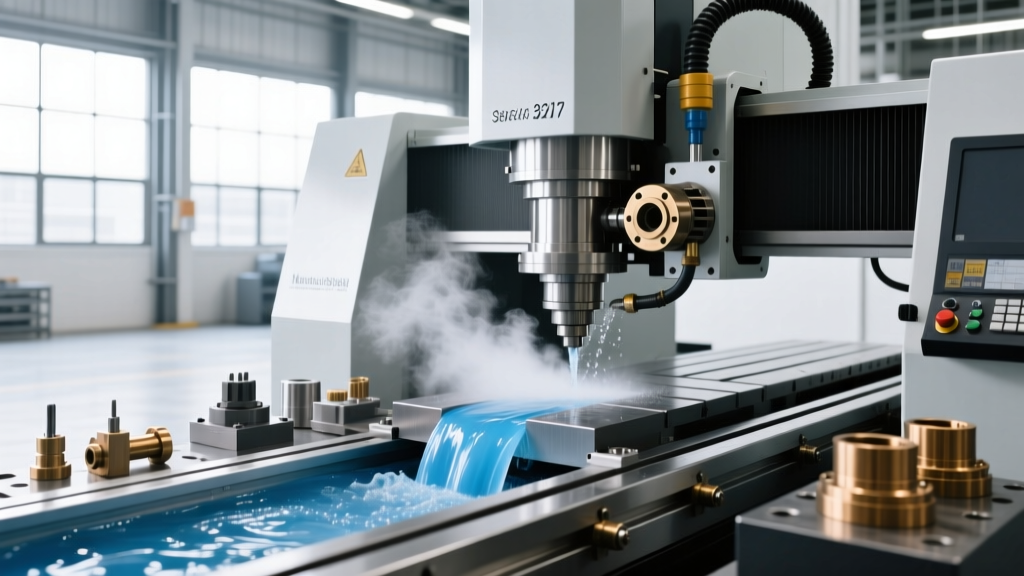
While dust collectors handle airborne fines, the machine's internal chip conveyor must handle the heavy, volumetric swarf dropped directly into the coolant pan or machine base. Selecting the wrong conveyor type for your specific material guarantees premature failure.
| Conveyor Type | Best Application | Primary Failure Mode | Maintenance Fix |
|---|---|---|---|
| Hinge Belt | Stringy aluminum (6061-T6), steel turnings | Fines jamming the hinge pins; belt tracking off-center. | Install wiper brushes under the return belt; adjust take-up bearings monthly. |
| Scraper / Drag | Cast iron fines, abrasive composites, sludge | Chain stretch causing the scraper flight to skip sprocket teeth. | Check chain tension weekly; replace flights if wear exceeds 15% of thickness. |
| Auger / Screw | Brittle chips (acrylic, brass), granular plastics | Stringy materials wrapping around the auger shaft, stalling the motor. | Never use for stringy metals. Clear wrapped debris; check shear-pin integrity. |
"On large horizontal boring mills and 5-axis gantry systems, chip volume often outpaces standard conveyor throughput. If you are running high-feed-rate roughing cycles in aluminum, you must spec a conveyor with a minimum 1/2 HP drive motor and a steep 45-degree discharge angle to prevent chip back-flow into the way covers."
Calculating the ROI of Upgraded Extraction
Upgrading a big CNC machine's extraction from a basic 5HP baghouse to a fully automated, 15HP reverse-pulse cartridge system with PTFE media and a VFD-controlled blower requires a capital expenditure of $18,000 to $28,000. However, the ROI is typically realized within 14 months. By maintaining strict differential pressure and eliminating airborne silica, shops avoid $15,000+ spindle rebuilds, reduce linear guideway replacement frequency by half, and eliminate the labor cost of operators manually shoveling chips from the machine enclosure. Treat your dust collection and chip management systems with the same rigorous PM schedule as the CNC spindle itself, and the machine will deliver decades of precision service.