How to Set Up the Best Small CNC Machine for 3-Axis Milling
Master 3-axis setup and capabilities for the best small CNC machine. Learn benchtop tramming, workholding, and operator best practices for precision milling.
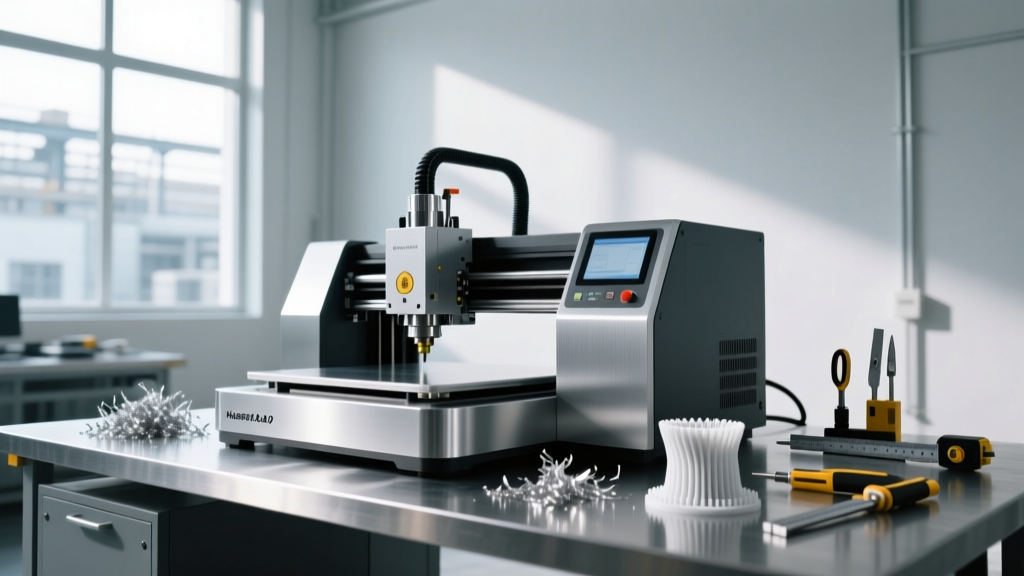
Selecting the best small CNC machine for a prototype lab, educational facility, or home workshop requires looking past marketing brochures to evaluate true mechanical rigidity and control architecture. Benchtop 3-axis mills like the Tormach PCNC 440 and the Bantam Tools Desktop CNC Milling Machine dominate this space, with fully equipped packages typically pricing between $4,500 and $7,500. However, extracting industrial-level precision from a machine weighing under 200 pounds demands rigorous setup protocols, specialized workholding, and strict operator discipline.
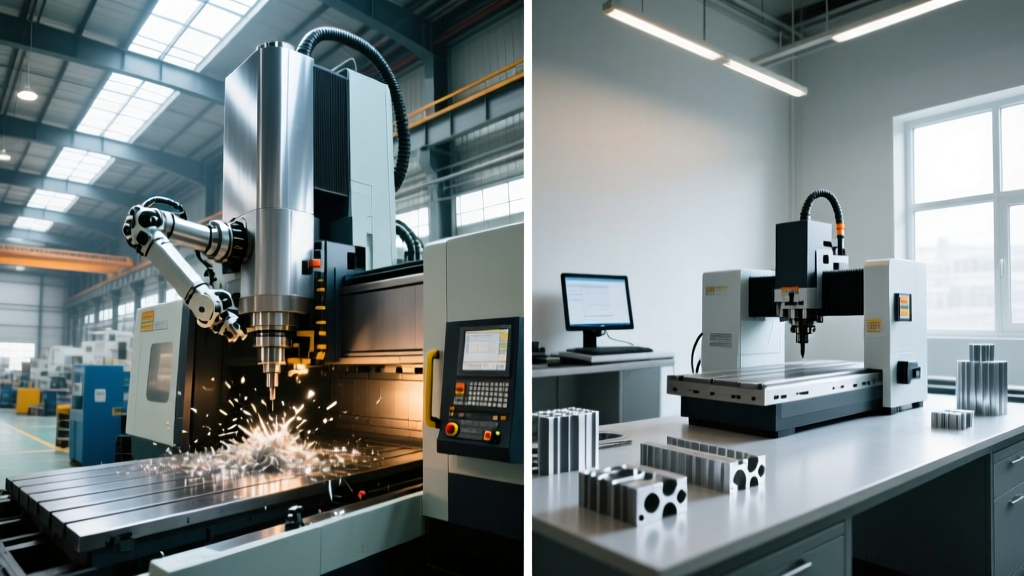
Operator Baseline: Small-format CNC machines are not simply scaled-down industrial mills. Their lower mass-to-cutting-force ratio means operators must compensate with higher spindle speeds, lighter radial depths of cut, and meticulous vibration dampening.Evaluating 3-Axis Capabilities in Benchtop Models
The capabilities of a small 3-axis CNC are defined by three critical mechanical factors: spindle runout, linear guide preload, and structural damping. When evaluating the best small CNC machine for precision 3-axis work, verify the spindle Total Indicator Runout (TIR). High-quality benchtop spindles should exhibit less than 0.0002-inch TIR at the collet nut. Anything exceeding 0.0005-inch will cause premature tool wear and poor surface finishes, especially when using micro-endmills under 1/8-inch in diameter.
Linear motion systems on small machines typically utilize profile linear guides or preloaded dovetails. Profile linear guides (like the HIWIN HGR series found on many premium benchtops) offer superior rigidity and lower friction, allowing for higher rapid traverse rates without losing positional accuracy. Conversely, traditional dovetail ways require precise gib adjustment to eliminate backlash but offer excellent vibration dampening for heavy interrupted cuts.
Machine Specifications and Tolerance Matrix
| Specification | Tormach PCNC 440 | Bantam Tools Desktop CNC | Operator Impact |
|---|---|---|---|
| Spindle Max RPM | 10,000 RPM | 20,000 RPM | Higher RPM enables smaller tooling and better finishes in aluminum. |
| Spindle Power | 0.75 HP (Peak) | 0.33 HP (Continuous) | Limits axial depth of cut; requires high-efficiency toolpaths. |
| Table Size | 16 x 8 inches | 7 x 9 inches | Dictates maximum vise size and workpiece envelope. |
| Positional Accuracy | +/- 0.001 inch | +/- 0.003 inch | Determines feasibility of tight-tolerance press fits. |
Step-by-Step Tramming and Calibration Protocol
Even the best small CNC machine will produce tapered walls and out-of-square parts if the spindle is not perfectly perpendicular to the table. Tramming must be performed monthly or after any machine relocation.
- Prepare the Sweep Tool: Mount a 0.0005-inch resolution dial test indicator in an ER collet or dedicated tramming bar. Avoid using standard endmill holders, as their inherent TIR will skew readings.
- Establish the Sweep Radius: Position the indicator so the plunger contacts the table (or a precision ground 1-2-3 block placed on the table) at a 4-inch radius from the spindle centerline. A wider radius amplifies angular errors, making them easier to detect and correct.
- Measure Nod and Tilt: Rotate the spindle 360 degrees. Record the deviation between the Y-axis (nod) and X-axis (tilt) positions. Acceptable tolerance for precision benchtop milling is 0.001-inch TIR across the full sweep diameter.
- Adjust the Head: Loosen the head mounting bolts slightly. Use the factory-provided tilt adjustment screws or carefully tap the head with a dead-blow mallet. Retighten bolts in a star pattern to 35 ft-lbs to prevent distortion, then re-sweep to verify.
Workholding and Tooling Configurations
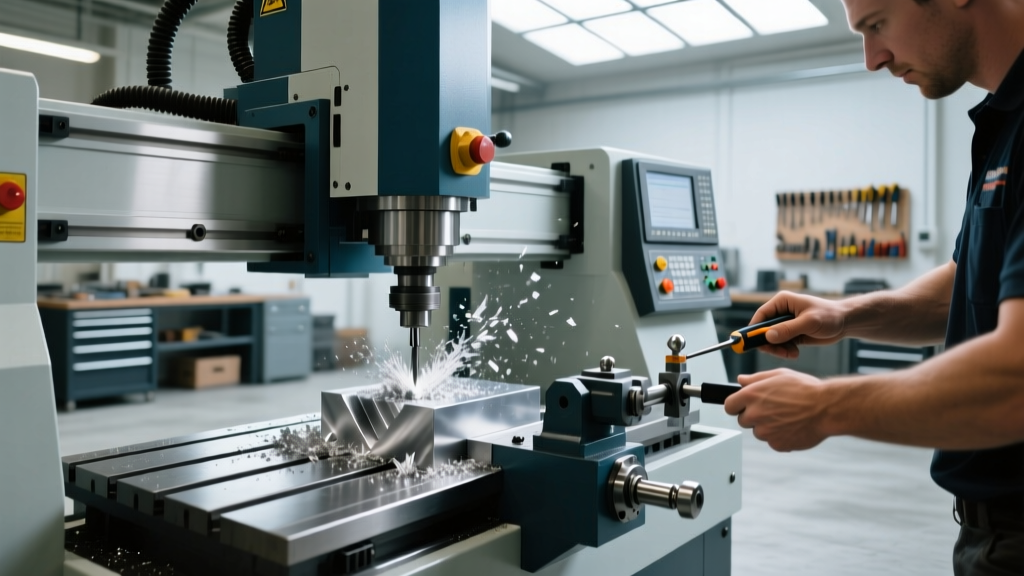
Workholding on small CNC tables presents a unique spatial puzzle. A standard 6-inch milling vise will consume nearly the entire Z-axis clearance and half the X-axis travel on a machine like the Tormach PCNC 440. Operators must adapt their workholding strategies to maximize the usable envelope.
Safety Warning: Small CNC machines often ship without full enclosures. Operators must adhere to OSHA's general requirements for machine guarding (1910.212) by installing polycarbonate chip shields and strictly enforcing safety glass usage to protect against high-velocity carbide shard ejections.Optimized Workholding Matrix
- Low-Profile CNC Vises: Use a 3-inch precision milling vise (such as the Tormach 3-inch CNC Vise or a Glacern GPV-30). These provide adequate clamping force (up to 3,000 lbs) while preserving crucial Z-axis height for longer tools.
- Direct-to-Table Fixturing: For production runs of flat parts, bypass the vise entirely. Utilize the machine's T-slot network (typically 1/2-13 threads on benchtop models) with low-profile toe clamps and precision machined aluminum fixture plates.
- Spoilboards and Vacuum Chucks: For non-ferrous sheet materials or PCB milling, a sacrificial MDF spoilboard or a specialized vacuum chuck provides uniform holding pressure without inducing mechanical distortion.
Feeds, Speeds, and Chip Evacuation
The fundamental limitation of the best small CNC machine is spindle torque. You cannot hog out material with a 1/2-inch endmill taking full-width passes. Operators must rely on high-efficiency milling (HEM) toolpaths, which utilize a small radial depth of cut (RDOC) and a high axial depth of cut (ADOC) to spread tool wear across the entire flute length while keeping cutting forces low.
"When machining 6061-T6 aluminum on a 0.75 HP benchtop spindle, limit your radial engagement to 10-15% of the tool diameter. This reduces lateral cutting forces, preventing spindle bearing deflection and eliminating the harmonic chatter that plagues lightweight machines."
Calculation Example: 3/8-Inch Carbide Endmill in Aluminum
Assume a 3-flute, 3/8-inch diameter carbide endmill with a recommended Surface Feet per Minute (SFM) of 800 and an Inch Per Tooth (IPT) chip load of 0.002.
- RPM Calculation: (800 SFM x 3.82) / 0.375 inch = 8,149 RPM
- Feed Rate Calculation: 8,149 RPM x 3 flutes x 0.002 IPT = 48.8 IPM
- Cutting Parameters: Set ADOC to 0.375 inch (1x diameter) and RDOC to 0.040 inch (approx. 10% engagement). This yields a high material removal rate while keeping spindle load under 40% capacity.
Troubleshooting Common Benchtop Failure Modes
Even with perfect setup, small-format CNC machines exhibit specific failure modes that operators must learn to diagnose and correct on the fly.
1. Chatter and Harmonic Resonance
Symptom: High-pitched squealing during cutting, resulting in a washed-out, reflective surface finish on aluminum.
Cause: Tool overhang exceeding 3x the tool diameter, or radial engagement that is too high for the machine's mass.
Fix: Shorten the tool stick-out. If depth requires long reach, switch to a variable helix endmill designed to break up harmonic frequencies, and reduce the RDOC by 50%.
2. Lost Steps and Positional Drift
Symptom: The machine loses its zero position mid-cycle, typically on the X or Y axis, resulting in scrapped parts.
Cause: Open-loop stepper motors stalling due to excessive cutting forces, rapid acceleration rates exceeding the motor's torque curve, or loose motor couplings.
Fix: Inspect the flexible shaft couplings between the stepper motors and ball screws; tighten set screws and apply Loctite 222. In the controller software, reduce the G00 rapid acceleration (jerk) settings by 20% to prevent inertial stalling.
3. Collet Slippage and Tool Pull-Out
Symptom: The endmill gradually pulls out of the collet during heavy Z-axis plunging.
Cause: Insufficient clamping force from standard ER collets, or failure to clean the collet taper.
Fix: Never use standard ER collets for heavy roughing. Upgrade to ER20 or ER32 collet chucks (depending on the spindle taper) and use a torque wrench to tighten the collet nut to the manufacturer's exact specification (typically 65-80 ft-lbs for ER20). Always wipe the collet and tool shank with isopropyl alcohol before seating.
Final Thoughts on Operator Discipline
Mastering the best small CNC machine is less about the hardware and more about the operator's willingness to respect the physics of lightweight machining. By adhering to strict tramming protocols, utilizing low-profile workholding, and calculating feeds and speeds that prioritize spindle preservation over brute force, operators can consistently hold tolerances within 0.001 inch. Treat the machine's mass as a fixed constraint, and let toolpath geometry do the heavy lifting.