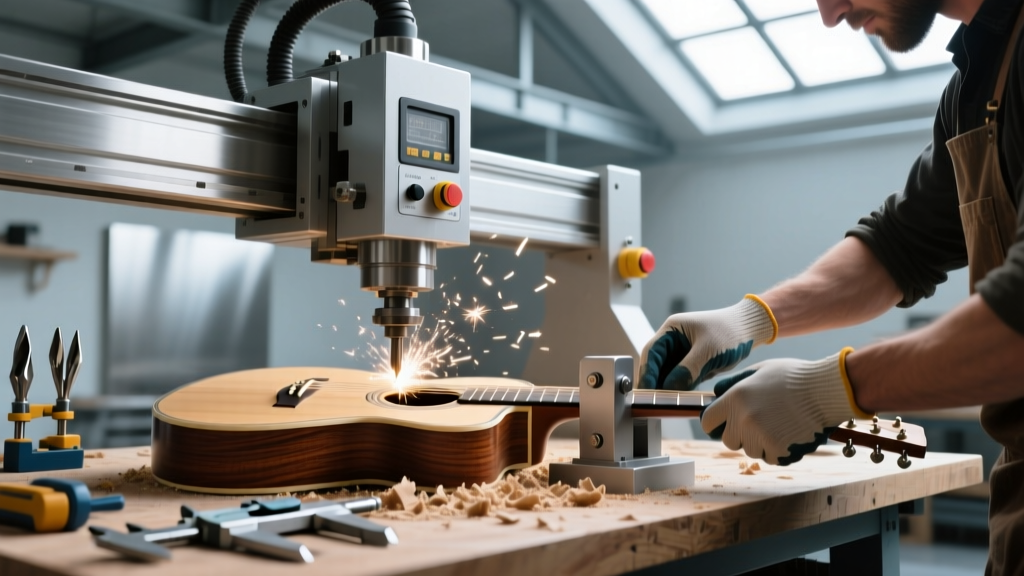
ATC Safety Standards for Flawless CNC Machined Products
Discover how Automatic Tool Changer (ATC) safety compliance and ISO standards prevent crashes and ensure precision in CNC machined products.
The Hidden Cost of ATC Failures in Production
An Automatic Tool Changer (ATC) malfunction is among the most catastrophic and dangerous events that can occur on a modern CNC shop floor. When producing high-tolerance cnc machined products, the ATC must execute thousands of precise swaps without deviation. A single misalignment during a tool change can result in a carousel crash, destroying the spindle bearings, shattering the tool magazine, and sending high-velocity carbide shrapnel into the operator zone. Beyond the immediate safety hazard, the financial toll is severe.
Financial & Safety Impact Data (2026 Estimates):- Average Carousel Crash Repair: $14,000 to $32,000 (including spindle rebuild and arm realignment).
- Downtime Cost: $1,200 to $2,500 per day in lost production of critical cnc machined products.
- Operator Injury Risk: High-velocity tool ejection can exceed 40 Joules of kinetic energy, bypassing standard polycarbonate window shields if not properly rated.
Ensuring the dimensional integrity of cnc machined products requires treating the ATC not merely as a convenience feature, but as a critical safety system governed by strict international compliance standards. Modern machine builders and retrofit integrators must adhere to rigorous frameworks to prevent these failures.
Core Safety Standards Governing ATC Systems
The safety architecture of an ATC is dictated by how the machine's Programmable Logic Controller (PLC) monitors and executes the tool change sequence. Compliance is not optional; it is a legal and operational mandate.
ISO 13849-1 Performance Levels (PL)
Under ISO 13849-1, safety-related parts of a control system are categorized by Performance Levels (PL). For an ATC system operating near human operators, the safety interlocks governing the tool magazine doors and the spindle orientation must achieve a minimum of PLd (Performance Level d), and ideally PLe. This requires dual-channel monitoring (Category 3 or 4 architecture). If a single proximity sensor fails to confirm that the ATC door is closed, the redundant channel must detect the fault and safely halt the Z-axis descent, preventing the tool from engaging the workpiece while the magazine is exposed.
ANSI B11.8 and OSHA Machine Guarding
In the United States, OSHA enforces general machine guarding requirements under 29 CFR 1910.212, while the specific technical criteria for CNC machinery are detailed in ANSI B11.8. These standards mandate that ATC guarding must prevent operators from reaching into the tool change envelope during the swap cycle. Modern 2026 CNC controllers achieve this via electronically interlocked guards tied directly to the safe-torque-off (STO) circuits of the ATC servo motors, rather than relying on easily defeated mechanical limit switches.
Mechanical Interlocks and Sensor Redundancy
The physical verification of tool seating and carousel position relies on a network of sensors. Relying on a single sensor type is a primary failure mode in legacy machines. Modern safety compliance demands sensor redundancy and diverse diagnostic capabilities.
| Sensor Type | Application in ATC | Common Failure Mode | Safety Mitigation Strategy |
|---|---|---|---|
| Inductive Proximity | Carousel pocket verification | Metal shavings bridging the sensing gap | Use flush-mounted, shielded sensors with IO-Link diagnostics |
| Hall Effect Magnetic | Tool clamp/unclamp confirmation | Magnetic degradation from heat | Pair with pneumatic pressure transducers in the drawbar cylinder |
| Optical Laser | Tool breakage detection post-change | Coolant mist obscuring the beam | Integrate automated air-blast purge cycles before measurement |
According to NIOSH machine guarding guidelines, integrating these sensors into a fail-safe PLC loop ensures that if coolant mist obscures an optical sensor, the machine defaults to a safe stop rather than assuming the tool is intact and proceeding to cut the part.
Tool Retention Force and Pull-Out Prevention
A critical, often overlooked safety and quality factor in producing cnc machined products is the drawbar retention force. If the ATC successfully loads a tool, but the spindle fails to grip it with adequate force, the tool will pull out during heavy milling operations. This ruins the workpiece and creates a severe projectile hazard.
Calculating Retention Force for High-Speed Spindles
Different toolholder tapers require specific minimum retention forces to counteract the axial cutting forces generated during machining:
- BT40 / CAT40 V-Flange: Requires a minimum of 2,500 lbf (11,120 N). Optimal safety margin dictates maintaining at least 3,000 lbf.
- HSK63A Hollow Shank: Relies on a dual-contact face-and-taper clamping system. Requires a minimum of 4,000 lbf (17,790 N) to maintain the critical face seal at high RPMs.
The drawbar relies on a stack of Belleville washers (disc springs) to generate clamping force. Over 1.5 million tool change cycles, these washers experience metallurgical fatigue, losing up to 30% of their nominal force. A drop below 1,800 lbf on a BT40 spindle will cause micro-movements in the toolholder during climb milling, resulting in chatter marks on cnc machined products and eventual catastrophic tool ejection.
Maintenance Protocols to Guarantee Compliance
Safety standards are only effective when backed by rigorous, documented maintenance. Shop floor managers must implement the following weekly and monthly auditing protocols to maintain ISO and OSHA compliance.
- Weekly Drawbar Force Verification: Use a digital drawbar force gauge (such as those manufactured by Techniks or Parlec, typically costing between $650 and $900) to measure the clamping force. Record the data in the machine's digital twin or CMMS software. If force drops by more than 10% from baseline, schedule a drawbar rebuild.
- Bi-Weekly ATC Arm Alignment Check: Insert a test mandrel into the spindle and the ATC gripper. Use a dial indicator to measure the runout and Z-axis deviation during the unclamp cycle. Misalignment exceeding 0.0005 inches (0.012 mm) will accelerate spindle taper wear and cause tool seating failures.
- Monthly Interlock Defeat Audit: Physically test the safety interlocks. Attempt to open the ATC guard while the carousel is in motion. The PLC must trigger an immediate Category 0 or Category 1 stop. If the door opens while the servo is still energized, the safety relay circuit requires immediate replacement.
- Quarterly Pneumatic Cylinder Inspection: The unclamp cylinder relies on shop air pressure (typically 85-100 PSI). Install a digital pressure switch with a hysteresis lockout that prevents the ATC cycle from initiating if air pressure drops below 80 PSI, preventing partial unclamping that damages the retention knobs.
Upgrading Legacy ATCs for Modern Safety
For facilities operating older vertical machining centers (VMCs) built prior to 2018, the ATC safety architecture often lacks dual-channel redundancy and modern IO-Link sensor diagnostics. Retrofitting these machines is a highly cost-effective alternative to purchasing new equipment.
Upgrading a legacy sidewinder or umbrella-style ATC with a modern safety PLC (such as a Pilz PNOZ or Siemens S7-1500F fail-safe controller) and integrating Safe Torque Off (STO) drives for the carousel and arm servos typically costs between $18,000 and $28,000. This investment not only brings the machine into compliance with current ANSI B11 and ISO 13849-1 standards but also drastically reduces the scrap rate of high-value cnc machined products by eliminating micro-crashes caused by sensor lag or single-point electrical failures. By treating the ATC as a mission-critical safety system rather than a simple mechanical accessory, manufacturers protect both their operators and their bottom line.