2026 Wood Cutting CNC Machine Innovations: AI & 5-Axis Automation
Explore 2026 wood cutting CNC machine innovations, including 5-axis automation, AI toolpath generation, and vision-based grain matching for industrial woodworking.
The Shift from 3-Axis to 5-Axis Contouring in Woodworking
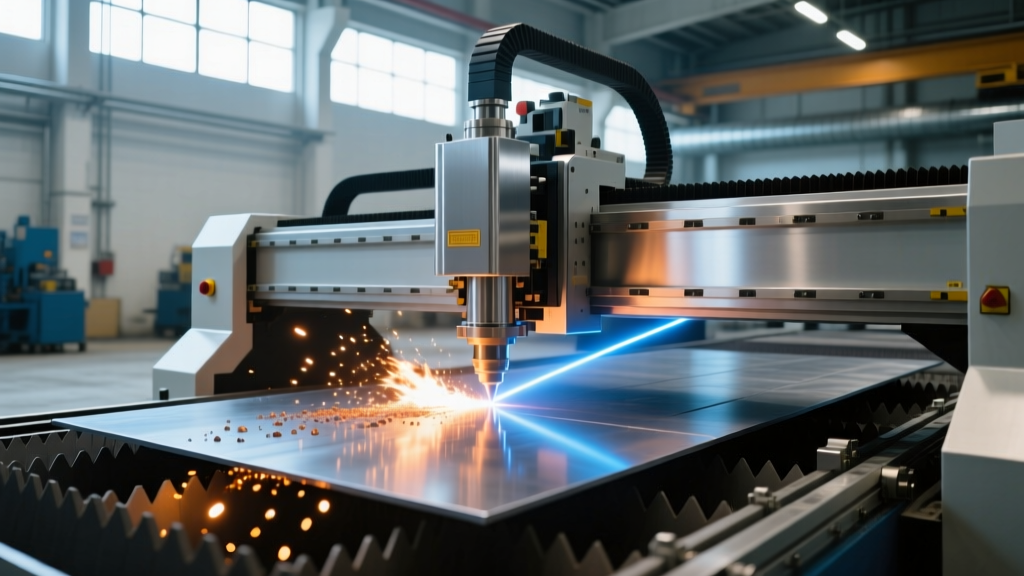
The industrial woodworking sector has crossed a definitive threshold in 2026. While nested-based manufacturing (NBM) on 3-axis routers remains the baseline for cabinet box production, the architectural millwork and high-end furniture sectors are rapidly adopting 5-axis wood cutting CNC machine configurations. The primary driver is the elimination of secondary manual operations. Modern 5-axis machining centers now execute complex compound angles, dovetails, and undercut joinery in a single fixturing, reducing part-handling time by up to 60%.
Mechanically, the industry has moved away from traditional worm-gear rotary tables, which introduced backlash and required frequent recalibration. Flagship 2026 models utilize direct-drive torque motors on the A and C axes. These motors deliver zero-mechanical-backlash rotation with repeatability tolerances of ±0.015mm, a critical requirement when machining tight-tolerance hardwood joinery where even a 0.1mm gap results in rejected glue joints.
Trend Alert: Liquid-Cooled Spindles as Standard
Air-cooled spindles are being phased out in industrial 5-axis wood routers. Continuous 24/7 operation on abrasive materials like MDF and high-pressure laminates generates excessive thermal growth. Manufacturers are now equipping machines with liquid-cooled HSD ES929 (or equivalent) 15kW spindles. By maintaining a constant thermal envelope, the spindle housing expands less than 3 microns during an 8-hour shift, preserving Z-axis accuracy without requiring warm-up cycles.
AI-Driven Toolpath Optimization and Adaptive Clearing
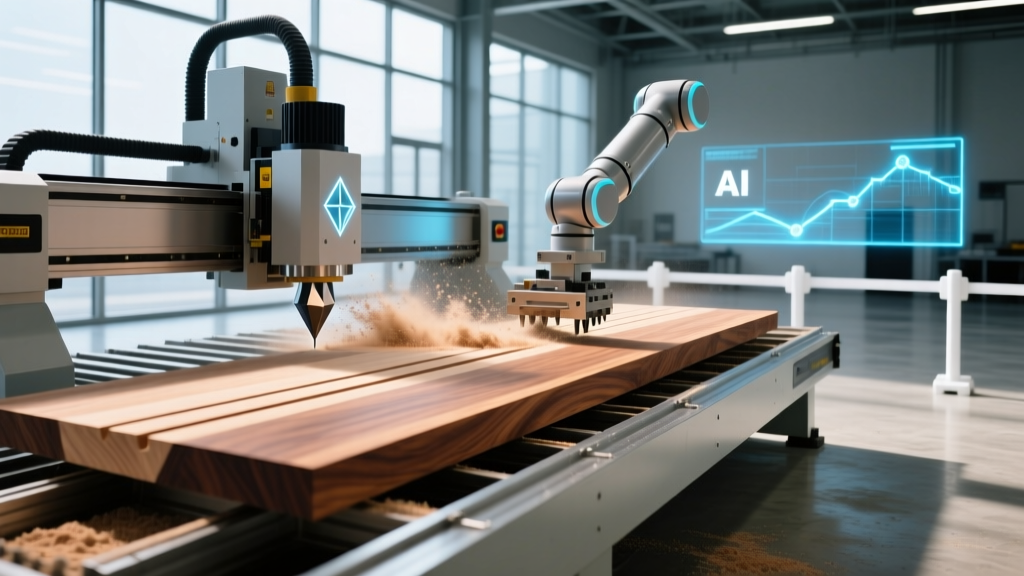
Software innovation has outpaced hardware in the current market cycle. The integration of AI algorithms directly into the CNC controller—most notably the Siemens Sinumerik One architecture—has fundamentally altered G-code execution. Rather than relying on static feed rates programmed in the CAM software, the controller now utilizes real-time spindle load feedback to perform adaptive clearing.
When the router bit transitions from a soft section of pine into a dense knot or a patch of hardened resin, the AI dynamically reduces the feed rate and adjusts the spindle RPM within milliseconds. This prevents micro-fractures in solid carbide compression bits and extends tool life by an average of 38%. Furthermore, AI-assisted CAM modules now automatically generate trochoidal toolpaths for deep slotting in solid hardwoods, maintaining a constant chip load and preventing the heat buildup that prematurely dulls nano-coated cutting edges.
Flagship 5-Axis Wood Cutting CNC Machine Comparison (2026)
Capital equipment buyers evaluating a 5-axis wood cutting CNC machine must weigh throughput against footprint and controller sophistication. Below is a technical comparison of three dominant industrial platforms currently defining the market.
| Manufacturer & Model | Spindle / Interface | Controller | Repeatability | Est. Price Range (USD) |
|---|---|---|---|---|
| Homag Venture BMG 311 | 15kW / HSK-F63 | Siemens / woodWOP | ±0.015mm | $195,000 - $240,000 |
| SCM tech Z 5-Axis | 13.5kW / HSK-F63 | OSAI / Maestro | ±0.020mm | $145,000 - $180,000 |
| Biesse Rover A Edge | 12kW / HSK-F63 | B_Solid / Fanuc | ±0.025mm | $130,000 - $165,000 |
Vision Systems and Automated Grain Matching
One of the most significant material-saving innovations integrated into modern wood cutting CNC machines is the adoption of industrial vision systems. Historically, operators relied on manual inspection to orient veneered panels or solid lumber, ensuring that knots, mineral streaks, or patched defects did not end up on visible part faces.
How Optical Scanners Reduce Material Waste
In 2026, overhead Cognex or SICK optical scanners map the entire board surface before the vacuum pods engage. The scanner identifies grain direction, defects, and color variations, transmitting this data directly to the nesting software. The software then dynamically rotates and shifts the nest to route around defects or align the grain pattern across adjacent cabinet doors. This automated grain-matching process reduces raw material waste by 12% to 18% in high-end veneer processing, paying for the vision system upgrade in under 14 months for high-volume shops.
"The integration of digital twins with optical scanning means the machine knows the exact topography and density map of a warped slab of black walnut before the spindle even turns on. It automatically adjusts the Z-axis probe routine to map the surface, ensuring a uniform 2mm skim cut without cutting through the veneer on the low spots."
— Advanced Manufacturing Review, Woodworking Technology Sector Report
Automated Material Handling and Pod Placement
The bottleneck in 5-axis CNC routing is rarely the cutting speed; it is the setup time. Manually positioning aluminum vacuum pods and suction cups for complex 3D fixturing can take 20 to 40 minutes per batch. The latest generation of wood cutting CNC machines features automated pod placement systems.
- Motorized Pod Positioning: Linear drives automatically slide vacuum pods along the X and Y rails to the exact coordinates dictated by the CAM program, locking them with pneumatic clamps.
- Automated Suction Cup Deployment: Robotic gantries or integrated pop-up cups activate only in the zones required for the specific part geometry, eliminating the need for manual foam gasket routing on MDF spoilboards.
- Tool Magazine Expansion: To support uninterrupted 5-axis contouring, 2026 models feature 24- to 36-position chain or matrix tool magazines, accommodating specialized undercut saw blades, aggregate heads, and diamond-profile cutters.
ROI and Purchasing Framework for 2026
Deciding whether to upgrade from a 3-axis NBM router to a 5-axis automated wood cutting CNC machine requires a strict analysis of part complexity and secondary labor costs. Use the following framework to evaluate capital expenditure:
When to Invest in 5-Axis Automation
Condition A: Your shop produces architectural millwork, curved stair components, or solid wood chairs requiring compound-angle joinery.
Action: Invest in a 5-axis machine with direct-drive torque motors and a 15kW liquid-cooled spindle. The elimination of 5-axis secondary routing and manual sanding will yield an ROI in 18-24 months.
Condition B: Your production is 90% flat-panel cabinet boxes, melamine, and standard MDF shaker doors.
Action: Do not buy a 5-axis machine. Instead, invest the $180,000 budget into two high-speed 3-axis nested-based routers with automated loading/unloading gantries and a dedicated edgebander. Throughput on flat panels will vastly outpace a single 5-axis center.
Condition C: You process high-value, highly variable natural hardwoods or live-edge slabs.
Action: Prioritize a machine equipped with an optical vision scanner and adaptive Z-axis surface mapping software, even if limited to 3-axis or 4-axis configurations. Material savings on $40/board-foot lumber will outvalue the mechanical benefits of a 5-axis head.
Maintenance and Calibration Realities
Operating a 5-axis wood cutting CNC machine in 2026 demands rigorous environmental control. Wood dust, particularly from composite materials containing urea-formaldehyde resins, is highly abrasive and corrosive to exposed linear guideways. Machines must be specified with fully enclosed, positively pressurized way-covers and automatic central lubrication systems that inject micro-doses of PTFE-based grease every 4 hours of spindle runtime. Furthermore, shops must maintain an ambient temperature of 68°F to 72°F (20°C to 22°C) to prevent thermal expansion of the machine casting, which can compromise the ±0.015mm tolerances required for precision hardwood joinery.