CNC Laser Machine Maintenance: Intervals, Costs & Checklist
Maximize uptime with our comprehensive CNC laser machine maintenance schedule. Discover daily, weekly, and annual service intervals, costs, and checklists.
The True Cost of Neglected CNC Laser Machine Maintenance
Unplanned downtime on a high-power fiber CNC laser machine costs fabrication shops between $500 and $1,200 per hour in lost throughput, delayed shipments, and idle operator wages. When a 6kW to 12kW fiber laser source fails catastrophically due to ignored cooling system maintenance or back-reflection damage, replacement costs for the resonator alone can exceed $40,000. Preventative maintenance is not merely a regulatory suggestion; it is a critical margin-protection strategy.
This guide details the exact service intervals, component lifespans, and edge-case failure modes for modern CNC laser cutting systems, including platforms like the Trumpf TruLaser 3030 fiber, Bystronic ByStar Fiber, and Mazak Optiplex Nexus series.
⚠ Critical Safety Prerequisite: Class 4 Laser Hazards
Before performing any internal maintenance on a CNC laser machine, operators must execute strict Lockout/Tagout (LOTO) procedures and verify the absence of stored electrical and optical energy. Maintenance on Class 4 laser systems must comply with OSHA Laser Safety Guidelines and the Laser Institute of America (LIA) Z136 standards. Never bypass safety interlocks to clean optical paths while the system is energized.
Daily & Shift-Level Maintenance: The Operator Domain
Daily maintenance relies on the machine operator's tactile and visual inspection skills. These tasks take 15 to 20 minutes per shift and prevent 80% of common cut-quality degradation issues.
- Protective Window Inspection: Fiber laser cutting heads (e.g., Precitec ProCutter or RayTools) utilize sacrificial protective windows. Inspect the window for spatter or pitting. A pitted window will absorb laser energy, heat up, and eventually crack the collimating lens beneath it. Replace windows at the first sign of micro-spatter. Cost: $20 to $80 per window.
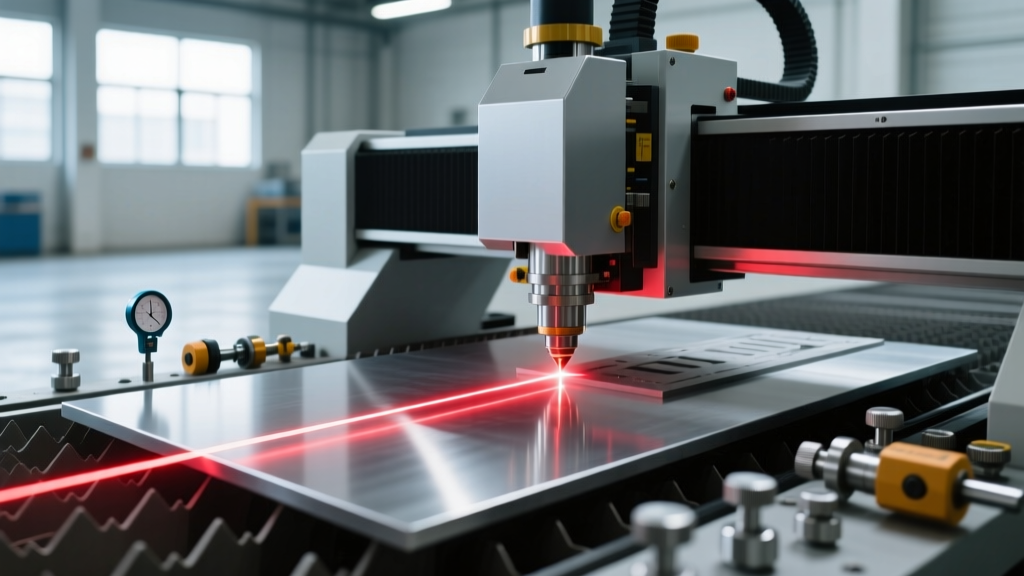
- Nozzle Concentricity & Condition: Check the copper or brass nozzle for slag buildup. Run a tape test (taping over the nozzle and firing a low-power pulse) to verify beam concentricity. The beam must strike within 0.02mm of the nozzle center. Misalignment causes uneven kerf widths and excessive dross on the cut edge.
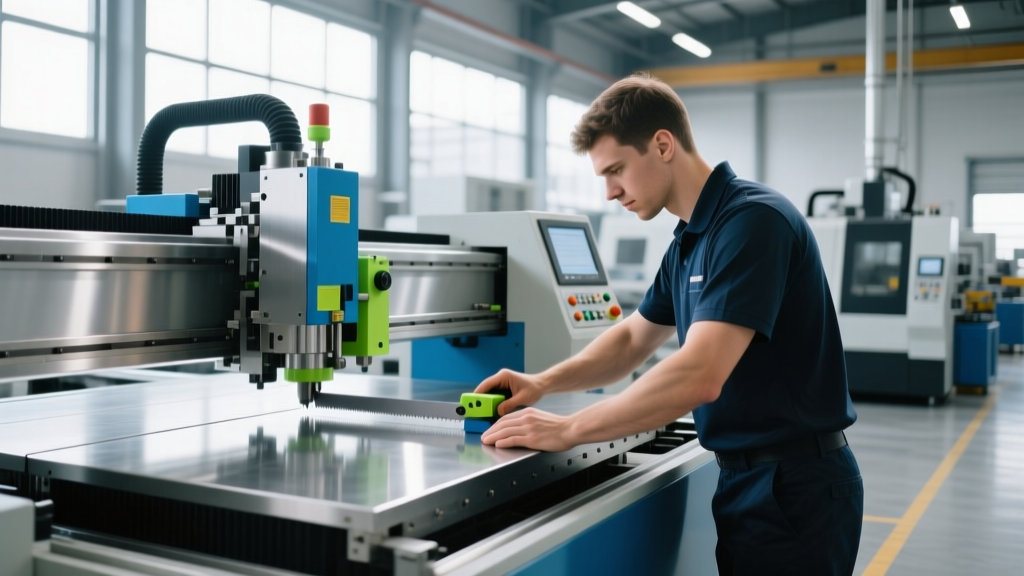
- Capacitive Height Sensor Calibration: Verify the Z-axis height sensor by placing a calibrated feeler gauge (typically 0.5mm or 1.0mm) between the nozzle and a flat sheet. If the machine's digital readout deviates by more than ±0.05mm, recalibrate the sensor ring to prevent nozzle crashes during high-speed piercing.
- Chiller Temperature Verification: Confirm the dual-circuit chiller is maintaining the laser source at 22°C to 24°C (±0.5°C) and the cutting head optics at 28°C to 30°C. Fluctuations outside this range indicate a failing compressor or clogged condenser fins.
Weekly & Monthly Intervals: Fluid and Drive Systems
Weekly tasks focus on the assist gas delivery and motion systems. Monthly tasks address the cooling infrastructure.
Assist Gas and Pneumatics
Check the inline filters on your Nitrogen and Oxygen assist gas lines. Moisture or particulate contamination in high-pressure Nitrogen (up to 300 bar / 4,350 psi) will ruin the cutting edge of stainless steel and aluminum, causing yellowing and oxidation. Drain pneumatic condensate traps and verify air compressor dew points are below -40°C if using compressed air for cutting.
Motion System Lubrication
Linear guides and ball screws on high-acceleration CNC lasers require specific greases. Do not use generic lithium grease. Manufacturers like Trumpf and Bystronic typically specify synthetic greases such as Kluber Isoflex NBU 15 or Mobilux EP 1. Wipe away old, contaminated grease from the X and Y-axis rails before applying a fresh, thin bead. Over-lubrication attracts metallic dust, creating an abrasive paste that destroys linear bearing seals.
The 500-Hour & 1,000-Hour Service Milestones
These milestones require planned downtime (typically 4 to 8 hours) and represent the core of a preventative maintenance contract. Below is a structured breakdown of the critical interventions required at these intervals.
| Component / System | Interval | Required Action | Est. Part Cost | Downtime Impact if Ignored |
|---|---|---|---|---|
| Chiller Coolant (Glycol/Water) | 500 Hours / 6 Months | Test with refractometer; flush and replace if biocide is depleted or pH drops below 7.0. | $150 - $300 | Microbial growth blocks micro-channels in the laser source, causing thermal shutdown. |
| Cutting Head Collimating/Focusing Lenses | 1,000 Hours | Inspect for coating delamination or micro-fractures. Clean with optical-grade methanol and lint-free wipes. | $400 - $1,200 | Beam divergence increases, resulting in loss of piercing power and wider kerf. |
| X/Y Axis Drive Belts (if applicable) | 1,000 Hours | Check tension with a sonic tension meter. Replace if fraying or stretching exceeds 2%. | $200 - $500 | Positional lag during high-speed contouring; scrapped nested parts. |
| Exhaust & Filtration System | 500 Hours | Replace HEPA/carbon filter cartridges in the dust collector. Clean slat bed slag trays. | $300 - $800 | Reduced airflow causes lens contamination and hazardous shop-floor fume accumulation. |
Deep Dive: Chiller System Edge Cases & Failure Modes
The water chiller is the single most common point of failure leading to catastrophic CNC laser machine damage. Modern fiber laser sources (like the IPG YLS or Trumpf TruDisk series) generate immense heat density. If the chiller fails to remove this heat, the pump diodes degrade rapidly.
'We see shops destroy $30,000 laser sources because they used tap water instead of distilled water, or ignored the glycol concentration. Tap water introduces minerals that plate out on the internal heat exchangers, acting as an insulator. The laser thinks it is overheating and derates power, or worse, the thermal stress cracks the internal optics.'
— Field Service Engineering Report, Industrial Laser Solutions
The Glycol Concentration Framework
Use a refractometer to maintain a 30% to 35% propylene glycol to distilled water ratio. This specific ratio provides freeze protection down to -12°C (10°F) while maintaining optimal thermal conductivity. Concentrations above 40% increase fluid viscosity, reducing flow rate and triggering low-flow alarms on the laser source. Furthermore, ensure the chiller's internal UV sterilizer or biocide packet is replaced annually to prevent algae blooms that clog the 10-micron internal water filters.
Annual & 2,000-Hour Deep Service: OEM Interventions
Annual maintenance should be performed by certified OEM technicians or highly trained in-house laser engineers. This service involves optical realignment, resonator health checks, and software calibration.
- Beam Profiling and Alignment: Using a specialized beam profiler (e.g., Ophir or Primes), the technician will map the laser's focal spot size and intensity distribution. Over time, thermal cycling can cause micro-shifts in the optical bench. Realigning the beam ensures the focal point remains perfectly centered through the nozzle across the entire 3000mm x 1500mm cutting bed.
- Back-Reflection Damage Inspection: Cutting highly reflective materials like copper or brass at incorrect focal positions can cause the laser beam to reflect back up through the nozzle and into the fiber delivery cable. Technicians will inspect the QBH (Quartz Block Head) connector and the fiber end-cap for thermal damage or burning. Catching early-stage fiber degradation prevents a complete fiber cable replacement, which costs between $8,000 and $15,000.
- Volumetric Compensation Mapping: Using a laser interferometer, the technician will map the geometric errors of the machine's axes and update the CNC controller's volumetric compensation table. This restores the machine's positioning accuracy to within ±0.03mm, which is critical for precision micro-joint cutting and tight-tolerance aerospace components.
Cost Analysis: In-House vs. OEM Preventative Maintenance Contracts
Deciding how to execute this schedule requires a financial framework. Below is a comparison of managing maintenance internally versus purchasing an OEM service agreement.
In-House Maintenance
- Cost: $3,000 - $6,000 annually (parts + operator time).
- Pros: Immediate response to daily issues; deep operator familiarity with the specific machine's quirks; no waiting for OEM travel time.
- Cons: Requires purchasing expensive diagnostic tools (beam profilers cost $10k+); risk of voiding source warranty if unauthorized personnel open the resonator cabinet.
OEM PM Contract
- Cost: $8,000 - $18,000 annually (depending on response time SLAs).
- Pros: Includes guaranteed response times (e.g., 24-hour on-site); covers proprietary software updates; ensures warranty compliance; includes loaner parts during diagnostics.
- Cons: High upfront cost; scheduled PMs may not align perfectly with your production peaks; reliance on third-party scheduling.
Expert Recommendation: Adopt a hybrid model. Train senior operators to handle all daily, weekly, and 500-hour tasks (fluids, optics, drives). Retain an OEM contract strictly for the annual 2,000-hour deep calibration and source health checks to preserve the multi-year laser source warranty.
Expert Troubleshooting Decision Tree: Cut Quality Degradation
When cut quality degrades, do not immediately assume the laser source is failing. Use this diagnostic sequence to isolate the root cause efficiently.
- Symptom: Excessive dross (slag) on the bottom edge of mild steel cuts.
- Check 1: Is the assist gas pressure dropping during the cut? (Inspect regulator and line filters).
- Check 2: Is the focal point too low? (Adjust Z-axis focus position up by 0.5mm increments).
- Check 3: Is the nozzle orifice deformed? (Replace nozzle; do not attempt to clean a melted orifice with a wire).
- Symptom: Inconsistent piercing times (takes 3 seconds longer to pierce 10mm plate than usual).
- Check 1: Inspect the protective window for thermal blooming (haziness caused by heat absorption). Replace if present.
- Check 2: Verify the chiller flow rate on the HMI. If flow is below 15 L/min, the source is thermally derating its peak pulse power to protect the diodes.
- Symptom: Kerf width varies across the X-axis (wider on the left, narrower on the right).
- Check 1: The beam is not perfectly vertical. The cutting head optics are misaligned, or the Z-axis squareness to the bed has shifted due to a crash. Requires OEM optical realignment.
Final Operational Directive
Maintaining a CNC laser machine requires shifting from a reactive 'fix-it-when-it-breaks' mentality to a predictive, data-driven approach. Log every protective window replacement, track chiller temperature trends weekly, and strictly enforce the 500-hour fluid intervals. For further reading on advanced manufacturing maintenance strategies and industry benchmarks, consult resources from the Society of Manufacturing Engineers and The Fabricator's laser cutting archives. By adhering to this schedule, fabrication shops will routinely achieve 95%+ equipment availability and maximize the ROI of their capital-intensive laser assets.