CNC Wire Cut EDM Machine Safety: Essential Compliance Standards
Master CNC wire cut EDM machine safety and compliance. Learn ISO standards, dielectric fluid handling, and electrical hazard prevention.
Unique Hazards of CNC Wire Cut EDM Machines
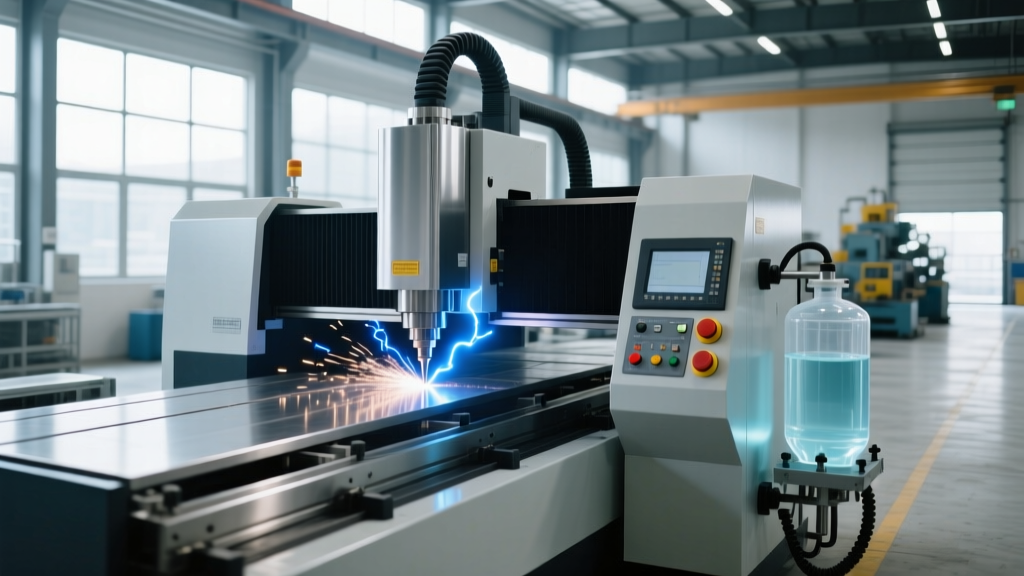
Operating a CNC wire cut EDM machine presents a distinct hazard profile compared to laser, plasma, or waterjet cutting systems. Instead of relying on thermal gas or high-pressure abrasives, wire Electrical Discharge Machining (EDM) utilizes high-frequency electrical sparks and a submerged dielectric fluid to erode conductive materials. This fundamental difference introduces specific compliance challenges spanning high-voltage electrical safety, chemical fluid management, and specialized mechanical guarding.
Facility managers and safety officers must navigate a complex web of regulations, including ISO 28881 (Machine tools — Safety — Electrical discharge machines), IEC 60204-1, and local occupational health mandates. In 2026, with the integration of AI-driven auto-threaders and advanced closed-loop dielectric systems on models like the GF Machining Solutions CUT P 350 and Sodick ALN400G, safety protocols must evolve to address both legacy hazards and modern automated interventions.
⚠️ CRITICAL WARNING: High-Voltage Ignition PulsesWhile the continuous cutting voltage of a wire EDM typically ranges between 40V and 80V DC, the initial ignition pulses required to break the dielectric barrier can spike to 150V–200V DC. Never bypass work tank door interlocks or lower-arm safety switches. A breach in the dielectric fluid level during a cutting cycle can expose operators to unshielded ignition pulses.
Electrical Hazard Mitigation & IEC 60204-1 Compliance
The electrical architecture of a wire EDM machine is governed by strict industrial machinery standards. Under the NFPA 79 Electrical Standard for Industrial Machinery and IEC 60204-1, the machine's power supply must incorporate fail-safe interlocks and precise grounding mechanisms.
Door Interlocks and Tank Sensors
Modern wire EDM machines feature a dual-chamber system: an upper flush arm and a lower submerged work tank. Compliance requires that the lower work tank be equipped with magnetic or RFID safety interlocks. If the tank door is opened while the generator is active, the system must execute a Category 0 or Category 1 stop (per ISO 13850), immediately cutting power to the sparking circuit.
- Testing Protocol: Interlocks must be tested weekly using a calibrated multimeter to verify that the contactor drops out within 50 milliseconds of door actuation.
- Fluid Level Sensors: Capacitive sensors must prevent the generator from firing if the deionized water level drops below 50mm above the workpiece, preventing localized arcing and potential fire hazards.
Single-Point Grounding Requirements
Unlike standard CNC mills, wire EDM machines are highly sensitive to ground loops, which can cause erratic sparking and shock hazards. The machine must be connected to a dedicated, single-point earth ground with a resistance of less than 5 ohms. Sharing a ground bus with heavy inductive loads (like large stamping presses or induction heaters) is a direct violation of most facility electrical codes and will compromise the machine's high-frequency filtering.
Dielectric Fluid Management and Biological Safety
Wire EDM relies on deionized (DI) water rather than traditional oil-based coolants. While this eliminates the immediate fire risks associated with hydrocarbon dielectrics, it introduces biological and chemical compliance requirements outlined by the CDC NIOSH guidelines on Metalworking Fluids.
Resistivity Control and Chemical Hazards
The DI water acts as an insulator. If the water's resistivity drops, it becomes conductive, leading to short circuits, wire breakage, and potential electrical shock. Conversely, if the water is too pure, it can leach ions from the operator's skin, causing severe dermatitis.
| Parameter | Roughing Cuts | Finishing Cuts | Safety / Compliance Action |
|---|---|---|---|
| Resistivity | 10 - 15 µS/cm | 20 - 40 µS/cm | Replace ion-exchange resin if automated system cannot maintain target. |
| Temperature | 20°C ± 1°C | 20°C ± 0.5°C | Verify chiller unit; thermal expansion causes geometric errors. |
| Bacteria Count | < 10^4 CFU/mL | < 10^4 CFU/mL | Apply EDM-specific biocide; standard coolant biocides alter resistivity. |
| pH Level | 7.0 - 8.5 | 7.0 - 8.5 | Acidic water corrodes machine guideways and workholding fixtures. |
Ion-exchange resin cartridges (e.g., Mitsubishi or Sodick OEM resin) typically cost between $150 and $300. Do not attempt to regenerate EDM resin with standard water softener salt. The introduction of sodium chloride into the dielectric system will permanently ruin the fluid's dielectric properties and void the machine's warranty.
Mechanical Guarding: Auto-Threaders and Wire Choppers
The mechanical components of a wire EDM machine operate with high precision and speed, creating severe pinch and laceration hazards. Under OSHA Machine Guarding Guidelines, all automated moving parts must be shielded from operator access during the machining cycle.
The Wire Chopper Hazard
After the wire passes through the workpiece, it is fed into a chopper mechanism that cuts the 0.25mm or 0.30mm brass wire into small segments for disposal.
- Laceration Risk: If the chopper blades become dull, the wire is not cut cleanly. Instead, it wraps around the lower guide or the chopper spindle. Attempting to untangle a bird's nest of hardened brass wire without heavy-duty Kevlar gloves frequently results in deep lacerations.
- Projectiles: A misaligned chopper can eject sharp, 5mm brass shards at high velocity. The chopper collection bin must be securely latched and fitted with a polycarbonate shield.
- Maintenance Lockout: Clearing a jammed chopper requires a full Lockout/Tagout (LOTO) procedure. Simply pausing the CNC program is insufficient, as the auto-threader may attempt a re-thread sequence, activating the feed rollers.
Auto-Threader Pinch Points
Modern 2026 auto-threaders utilize high-pressure water jets and mechanical guides to feed the wire through the upper and lower nozzles. The upper arm assembly moves rapidly across the X-Y plane. Operators must never lean into the work envelope to inspect a threaded hole while the machine is in 'Auto' or 'Feed Hold' mode. The machine's PLC may resume the threading sequence without an audible warning tone, posing a crushing hazard to fingers caught between the upper guide and the workpiece.
Facility-Level Compliance and Ergonomics
Beyond the machine itself, the environment housing the CNC wire cut EDM machine must meet specific industrial standards.
- Lighting: EDM work tanks are deep and often poorly lit by overhead facility lights. Install IP67-rated, 5000K LED machine lights inside the enclosure to reduce eye strain during setup and nozzle inspection.
- Spill Containment: While DI water is non-toxic, the accumulation of heavy metals (copper, zinc, tungsten carbide particles) in the sludge requires environmental compliance. The machine base must sit on a sealed drip pan, and sludge must be disposed of as industrial hazardous waste according to local EPA or equivalent regulations.
- Ergonomic Loading: Heavy tool steel or carbide blanks can weigh upwards of 100 lbs. Compliance dictates the use of overhead jib cranes or hydraulic lift tables to load workpieces into the lower arm assembly, preventing lumbar injuries.
The 2026 Pre-Shift Safety & Compliance Checklist
To maintain continuous compliance and prevent catastrophic machine failure, operators must execute this verified checklist at the start of every shift:
- ☐ Verify Interlocks: Open the lower tank door while the machine is in 'Dry Run' to confirm the spindle and generator halt immediately.
- ☐ Check Resistivity: Confirm the digital readout matches the material requirement (e.g., 15 µS/cm for standard tool steel roughing).
- ☐ Inspect Lower Flush Nozzle: Ensure the ceramic lower guide is free of brass wire fragments that could disrupt the lower flush pressure.
- ☐ Empty Chopper Bin: Verify the wire scrap bin is less than 75% full to prevent wire backup into the lower guide assembly.
- ☐ Test E-Stop: Depress the primary operator panel Emergency Stop button and verify the main contactor audibly disengages.
Adhering to these specialized safety standards ensures not only regulatory compliance but also maximizes the precision and lifespan of your CNC wire cut EDM machine. By treating the dielectric system and electrical interlocks with the same rigor as the CNC toolpaths, facilities can eliminate downtime caused by preventable safety faults.