The 2026 CNC Fabric Cutting Machine Selection Guide
Compare top CNC fabric cutting machine models, tooling types, and vacuum specs to optimize your 2026 textile manufacturing ROI and reduce material waste.
The Core Decision: Oscillating vs. Drag vs. Round Knife Tooling
Selecting the right CNC fabric cutting machine requires matching tooling kinematics to your specific textile portfolio. Whether processing 2-ply silk for haute couture or 60-ply aramid composites for aerospace, the capital expenditure ($80,000 to $250,000+) demands rigorous technical evaluation. According to McKinsey's State of Fashion reports, automated nearshoring is accelerating, making cutting room throughput a primary bottleneck in modern supply chains.
The cutting head configuration dictates 80% of your machine's capability. Below is a technical matrix comparing the three primary tooling types used in industrial textile manufacturing.
| Tooling Type | Stroke/Speed | Max Ply Height (Compressed) | Ideal Materials | Edge Quality |
|---|---|---|---|---|
| High-Freq Oscillating | 20,000 - 36,000 spm | 25mm - 50mm | Woven, knits, spacer mesh, carbon fiber | Exceptional, zero fraying |
| Drag Knife | Continuous (up to 1.5 m/s) | 2mm - 5mm | Single-ply vinyl, leather, airbag fabrics | Good, slight corner rounding |
| CNC Round Knife | Continuous (up to 2.0 m/s) | Up to 75mm | High-ply apparel layups, non-wovens | Poor on tight curves, ply shifting risk |
Tier 1 Equipment: 2026 Market Leaders and Pricing
The industrial CNC fabric cutting market is dominated by a few key players who offer distinct architectural advantages. Pricing varies heavily based on bed width (typically 2.5m to 3.5m) and automation add-ons like automatic roll feeders.
Zünd G3 2500 Series
The Zünd G3 remains the benchmark for precision and modularity. Its dual-gantry option allows simultaneous cutting and picking, which is critical for high-mix apparel environments. The G3's Center Vacuum System dynamically adjusts suction based on the tool's XY position, saving up to 30% on energy costs compared to static full-bed vacuum systems.
- Price Range: $140,000 - $220,000
- Max Acceleration: 3.0 m/s²
- Best For: Technical textiles, automotive interiors, precision aerospace composites.
Eastman Talon Automated Cutting System
Eastman's Talon series is engineered specifically for high-ply, high-speed apparel manufacturing. It utilizes a specialized bristle-block cutting surface and a powerful over-bed compaction system that physically compresses layups before cutting, ensuring the top and bottom plies match within a 1mm tolerance.
- Price Range: $85,000 - $130,000
- Max Cutting Height: 72mm (compressed)
- Best For: Mass-market apparel, denim, heavy canvas, and non-woven medical textiles.
Kuris ProCut Series
A strong contender in the mid-market, the Kuris ProCut offers excellent value for small-to-medium enterprises (SMEs) transitioning from manual die-cutting. It features a lower footprint and integrates seamlessly with standard Gerber-compatible CAD files.
- Price Range: $65,000 - $95,000
- Max Cutting Height: 25mm
- Best For: Upholstery, footwear, and mid-volume contract manufacturers.
Vacuum Hold-Down: The Most Overlooked Specification
A CNC fabric cutting machine is only as accurate as its hold-down system. Textiles are inherently porous; when a vacuum pump pulls air through the material, the fabric is pinned to the cutting bed. However, highly breathable materials like 3D spacer meshes (used in automotive seating and ergonomic mattresses) allow air to pass through too quickly, resulting in insufficient downward force.
For breathable materials, you must specify a regenerative blower rated at a minimum of 15 kW to 18.5 kW, capable of generating high-volume airflow (measured in CFM) rather than just high static pressure. Furthermore, modern machines utilize zoned vacuum tables. Instead of pulling vacuum across the entire 10-meter bed, the system only activates the specific 1-meter zones directly beneath the cutting head. This prevents the 'edge lift' phenomenon where fabric perimeters curl upward during high-speed directional changes.
Conveyor vs. Static Bed Configurations
Your production flow dictates the bed architecture. As noted in Fibre2Fashion industry analyses, integrating continuous material flow reduces operator handling time by up to 40%.
- Static Flatbed: Best for rigid composites, carbon-fiber prepregs, and thick leather hides where optical nesting cameras scan the material for defects before cutting. The material is laid flat, cut, and manually or robotically picked.
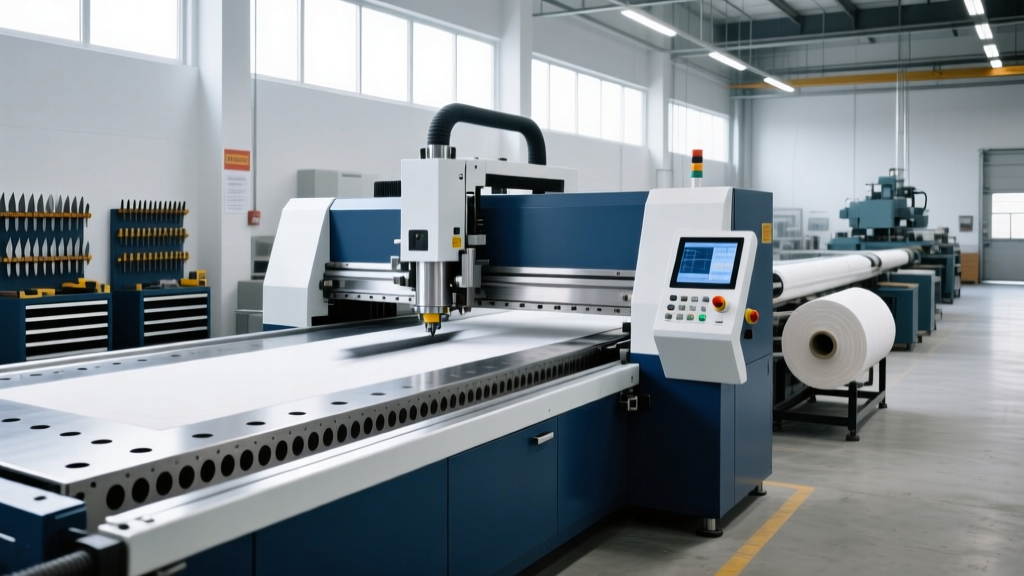
- Conveyorized Bed: Essential for roll-to-roll processing. The cutting surface is a continuous belt that advances the fabric forward after each cutting cycle. This is mandatory for high-volume apparel and requires a synchronized take-off conveyor to prevent cut pieces from overlapping.
Nesting Software and Material Yield Optimization
The hardware executes the cut, but the software dictates profitability. Fabric accounts for 60% to 70% of a finished textile product's cost. A 2% improvement in material yield via advanced nesting algorithms can pay for the machine in under 18 months.
When evaluating software packages (such as Zünd Cut Center, Gerber AccuNest, or Lectra Diamino), demand the following capabilities:
- True-Shape Nesting with Grain Constraints: The algorithm must respect strict warp/weft grainline tolerances (e.g., +/- 2 degrees) while minimizing interlocking waste.
- Dynamic Marker Making: Ability to automatically adjust pattern piece spacing based on the cutting tool's kerf (blade thickness) and oscillation radius.
- Defect Avoidance Mapping: Integration with overhead vision systems to map fabric flaws (slubs, dye spots) and automatically route pattern pieces around them in real-time.
Facility Readiness: Power, Air, and Footprint
Installing a CNC fabric cutter requires specific facility upgrades. Do not sign a purchase order until your floor meets these baseline requirements:
Infrastructure Checklist
- Electrical: 3-phase 400V/50Hz (or 480V/60Hz) with a dedicated 63A breaker. The vacuum pump alone will draw 15-20A under continuous load.
- Compressed Air: 6 to 8 bar (85-115 psi) at 150 liters/min. Air is required for the pneumatic blade clamping, foot pressers, and blow-off nozzles that clear fabric dust from the cutting head.
- Floor Loading: Minimum 1,500 kg/m². A fully assembled 3.5m x 10m machine with vacuum pumps and conveyors can exceed 4,500 kg.
- Climate Control: Maintain 40-60% relative humidity. Low humidity causes static cling in synthetic fibers, which disrupts the automated pick-and-place robotics used in modern cutting cells.
Expert Troubleshooting: Common Cutting Defects
Even with premium Zünd G3 technical specifications and top-tier hardware, operators frequently encounter material-specific defects. Here is how to diagnose and resolve the two most common issues.
Symptom 1: Edge Fraying on Woven Synthetics
Cause: The blade is dragging or generating excessive heat due to friction, melting and fraying the synthetic fibers (like nylon or polyester).
Fix: Switch to a 10-degree acute angle oscillating blade. Increase the oscillation frequency to 30,000+ spm while reducing the XY traversal speed by 15%. Ensure the blade penetration depth is set exactly 0.5mm past the material thickness to avoid cutting into the sacrificial underlay, which creates drag.
Symptom 2: Ply Shifting in High Layups (Bottom Ply Inaccuracy)
Cause: The top layers are held firmly by the vacuum, but the bottom layers shift due to the lateral force of the blade pushing through 50+ plies of cotton or denim.
Fix: Apply a layer of polyethylene plastic film over the top of the layup before cutting. The vacuum will pull the film tight, creating a hermetic seal that exponentially increases the downward clamping force across all plies. Additionally, switch from a straight oscillating blade to a 'notched' or serrated oscillating blade, which slices through the stack with 30% less lateral resistance.