Safety Compliance: Machine Shops Lexington KY 5 Axis CNC Waterjet Laser Cutting
Navigate KYOSH and OSHA safety compliance for 5-axis CNC waterjet and laser cutting in Lexington, KY machine shops. Includes high-pressure and Class 4 protocols.
The Kinematic Complexity of 5-Axis Cutting Safety
Operating 5-axis CNC waterjet and laser systems introduces multidirectional hazards entirely absent in standard 2D flatbed machines. When the cutting head tilts up to 60 degrees to bevel edges or cut 3D contours, the splash vectors, beam reflection angles, and kinematic collision zones expand exponentially. For machine shops in Lexington, KY, navigating Kentucky Occupational Safety and Health (KYOSH) regulations alongside federal OSHA standards requires specialized engineering controls tailored to these complex motion envelopes.
KYOSH Jurisdiction Notice: Kentucky operates a state-plan OSHA program. Lexington machine shops in Fayette County and surrounding areas must comply with Kentucky Revised Statutes (KRS) Chapter 338. While KYOSH adopts federal OSHA standards, state inspectors frequently prioritize machine-guarding and lockout/tagout (LOTO) compliance, with 2026 maximum penalties for serious violations exceeding $16,000 per instance.5-Axis Waterjet: Containing 60,000 PSI Multidirectional Hazards
Standard 2D waterjets contain splash and abrasive rebound within a fixed, predictable tank perimeter. 5-axis waterjet heads, such as the Flow Dynamic Waterjet or the OMAX 5-Axis MAXJET, articulate continuously during operation. This creates two primary safety failures if not properly guarded:
High-Pressure Whip and Hose Routing
The flexible jumper hose connecting the fixed high-pressure plumbing to the moving 5-axis cutting head undergoes severe torsional stress. A failure in a 60,000 PSI (4,136 bar) line generates a lethal whiplash effect. To comply with OSHA machine guarding standards, shops must install dual-redundant whip checks (safety cables) rated for the specific hose diameter. Furthermore, flexible high-pressure jumper hoses must be mandatorily replaced every 500 operating hours or 6 months, whichever occurs first, regardless of visible wear.
Abrasive Rebound and Enclosure Integrity
When a 5-axis head cuts a bevel, the abrasive garnet stream strikes the material at an acute angle, deflecting high-velocity particles upward and outward. Standard polycarbonate splash guards will pit and degrade within weeks under this off-axis bombardment. Facilities must upgrade to 1/2-inch thick cast acrylic or laminated safety glass for the immediate cutting zone enclosure, ensuring all access doors feature magnetic interlock switches wired directly to the motion controller's safe-torque-off (STO) circuit.
5-Axis Laser Cutting: Class 4 Enclosures and Off-Axis Reflection
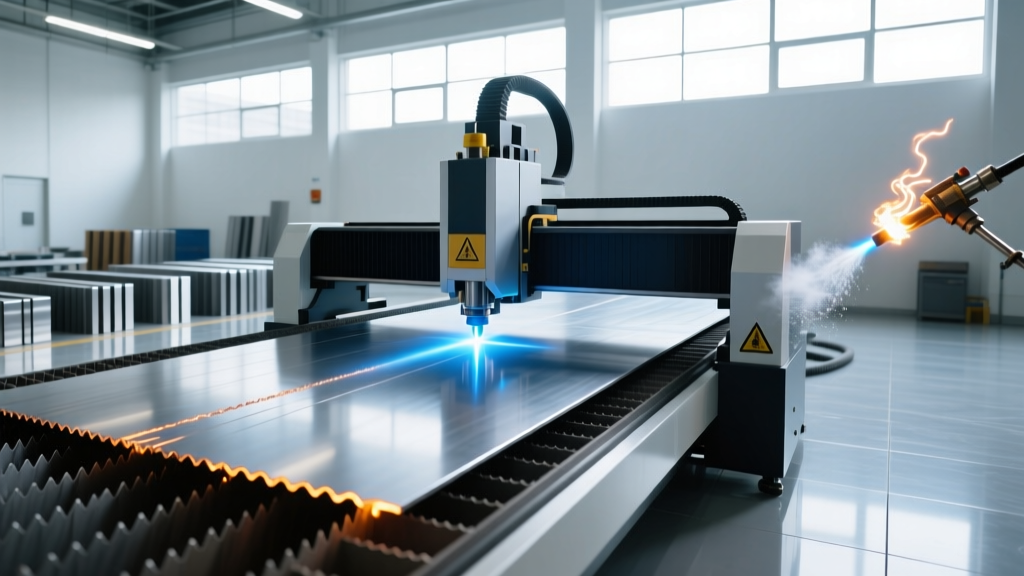
5-axis laser systems (e.g., Mazak Optiplex 3015 5-Axis or Trumpf TruLaser Tube) are classified as Class 4 laser products. The primary compliance challenge with 5-axis kinematics is off-axis beam reflection. When cutting 3D hydroformed tubes or structural beams, the cutting head tilts, meaning specular reflections can strike the enclosure walls at non-perpendicular angles.
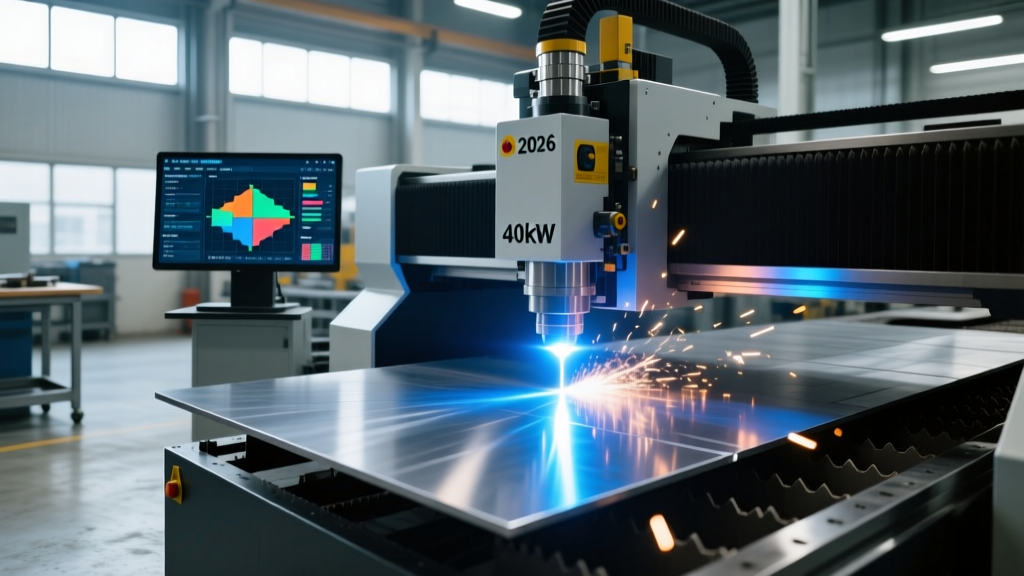
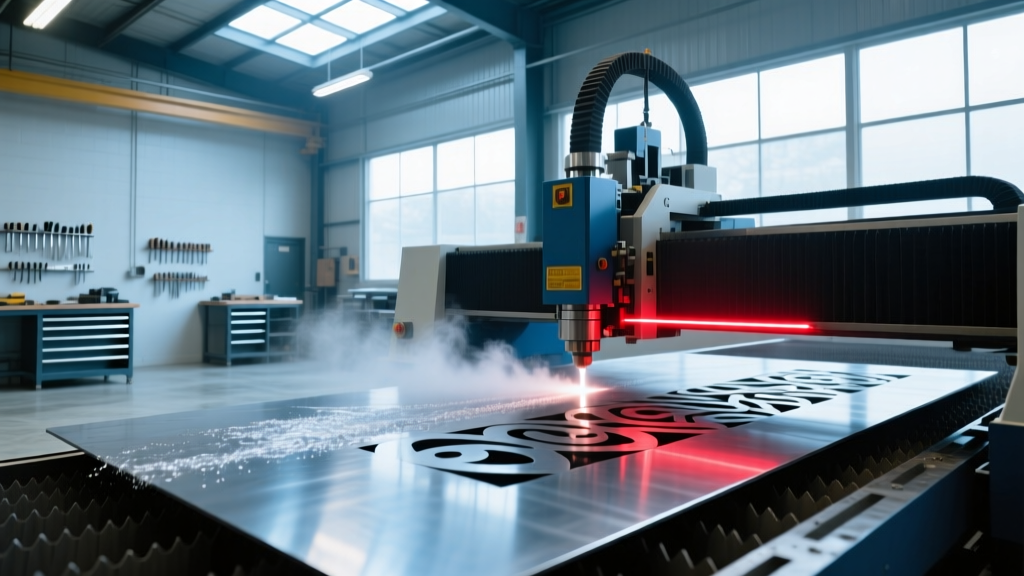
Standard polycarbonate viewing windows are designed for perpendicular strikes. An off-axis strike from a 4kW to 8kW fiber laser (1064 nm wavelength) can bypass the protective coating, instantly melting the window and exposing operators to hazardous scattered radiation. According to the OSHA laser safety guidelines and ANSI Z136.1, enclosures must utilize specialized dielectric-coated laser safety glass rated for the specific wavelength and maximum wattage of the resonator, with an Optical Density (OD) of 7+ for near-infrared fiber lasers.
| Hazard Type | 5-Axis Waterjet Control | 5-Axis Laser Control | Relevant Standard |
|---|---|---|---|
| Kinematic Collision | Capacitive breakaway rings + mechanical Z-axis limits | 3D volumetric software simulation + physical limit switches | ANSI B11.19 |
| Off-Axis Energy Deflection | 1/2-inch cast acrylic splash guards; angled tank grates | OD7+ dielectric-coated glass; non-reflective interior paint | ANSI Z136.1 / OSHA 1910.97 |
| Hose / Conduit Fatigue | Kevlar-braided hoses with dual whip-check restraints | 3D drag chains with internal strain relief dividers | OSHA 1910.212 |
Fume Extraction and KYOSH Air Quality Mandates
Multidirectional laser cutting severely disrupts standard downdraft cross-flow ventilation. When a 5-axis head cuts inside a tube or at a steep upward angle, the thermal plume rises unpredictably, bypassing the machine's primary filtration system. This exposes operators to hexavalent chromium (when cutting stainless steel) and zinc oxide (when cutting galvanized materials).
To maintain compliance with NIOSH and KYOSH permissible exposure limits (PELs), Lexington shops must implement localized extraction. For 5-axis operations, rely on positive-pressure enclosure evacuation rather than open-air extractor arms. Ensure the primary dust collector delivers a minimum of 2,500 CFM for mild steel and 3,500 CFM for galvanized or aluminum profiles, utilizing HEPA secondary filters to capture sub-micron particulate matter before recirculating air into the shop environment.
Preventing 5-Axis Head Collisions and Limit Switch Failures
The Tool Center Point (TCP) on a 5-axis machine is highly sensitive to calibration errors. A micro-millimeter deviation in the rotational axis calibration can result in a catastrophic crash between the cutting head and the workpiece or the machine bed. Such crashes not only cause tens of thousands of dollars in spindle and head damage but can shatter protective enclosures, creating secondary shrapnel hazards.
"Reliance solely on software-based collision avoidance is a critical compliance gap. KYOSH inspectors look for physical, redundant hardware interlocks. If the software loses positional tracking, a physical limit switch must instantly trigger the Safe-Torque-Off (STO) protocol on the servo drives."
Shops must mandate daily TCP verification using automated probing cycles. Furthermore, physical limit switches on the A and C rotational axes must be tested weekly by manually jogging the machine to the soft limits to verify that the hard limits engage before mechanical binding occurs.
The Lexington Machine Shop 5-Axis Compliance Checklist
Facility managers and safety officers should integrate the following specific checks into their monthly KYOSH audit logs:
- Interlock Defeat Check: Verify that no magnetic interlock bypass keys are left in the operator console or taped to the machine frame.
- Whip Restraint Inspection: Inspect waterjet high-pressure safety cables for fraying or stretched crimp fittings; replace if axial play exceeds 1 inch.
- Window Degradation Audit: Inspect laser safety glass for micro-pitting or delamination of the dielectric coating; replace immediately if light transmission exceeds rated thresholds.
- Fume Filter Differential Pressure: Log the static pressure drop across the primary cartridge filters; replace cartridges when pressure drop exceeds 2.5 inches of water gauge.
- LOTO Verification: Ensure energy isolation points for the 5-axis servo drives and high-pressure pumps are clearly labeled and compatible with standardized padlocks.
By treating the unique kinematic profiles of 5-axis machines as distinct hazard categories rather than simple extensions of 2D equipment, machine shops can achieve full regulatory compliance while protecting their most valuable assets: their operators and their high-precision capital equipment.