2026 CNC Plate Cutting Machine Trends: AI Nesting and 40kW Lasers
Explore 2026 CNC plate cutting machine innovations, including 40kW fiber lasers, AI nesting software, and 5-axis bevel cutting for heavy fabrication.
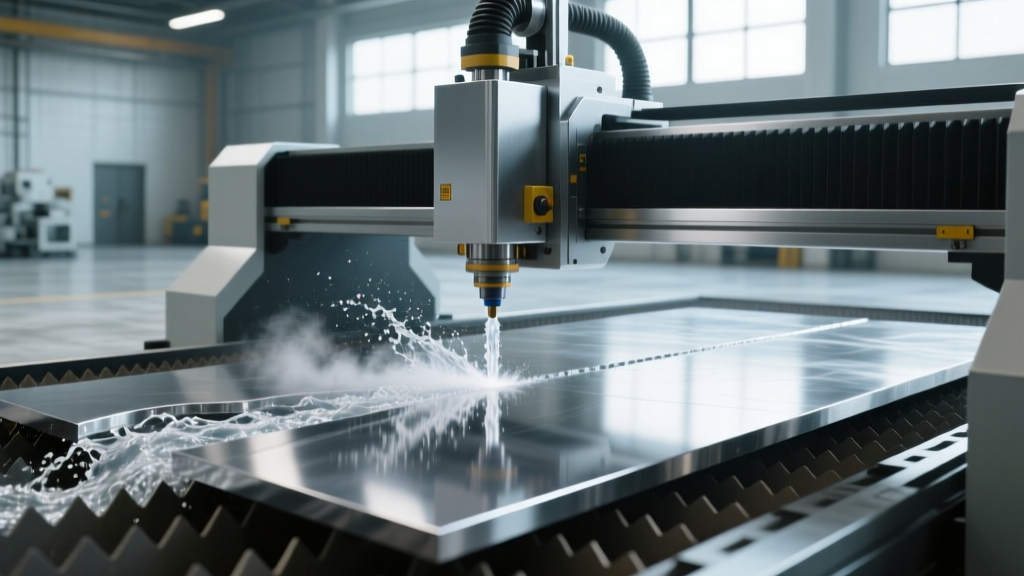
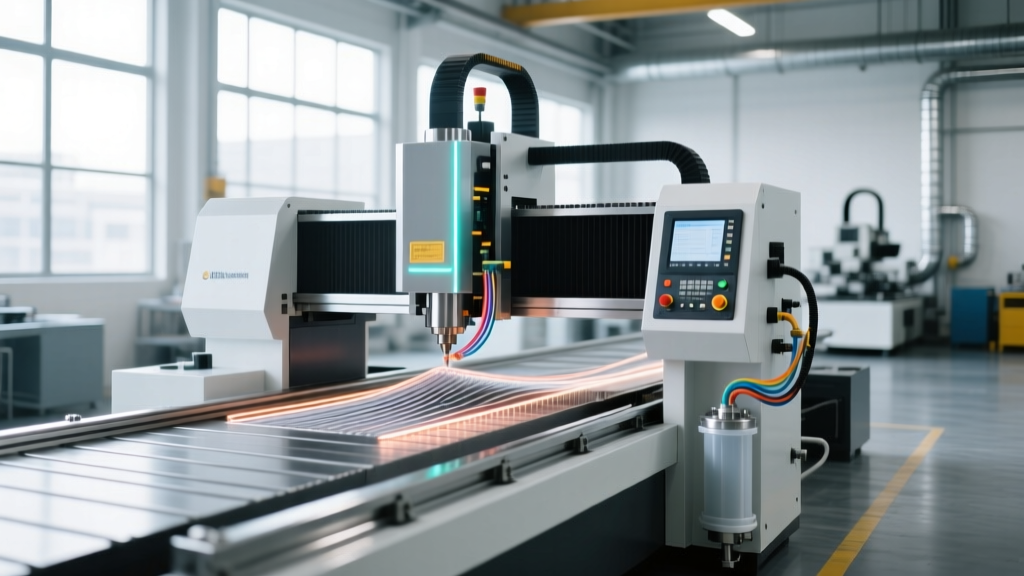
The industrial fabrication sector has crossed a critical threshold in 2026. The modern CNC plate cutting machine is no longer just a thermal profiling tool; it is a fully integrated, data-driven manufacturing node. Driven by the demand for thicker, oxide-free cuts and the elimination of secondary operations, machine builders have fundamentally re-engineered how thermal energy is delivered and managed on the shop floor.
The 40kW to 60kW Fiber Laser Power Surge
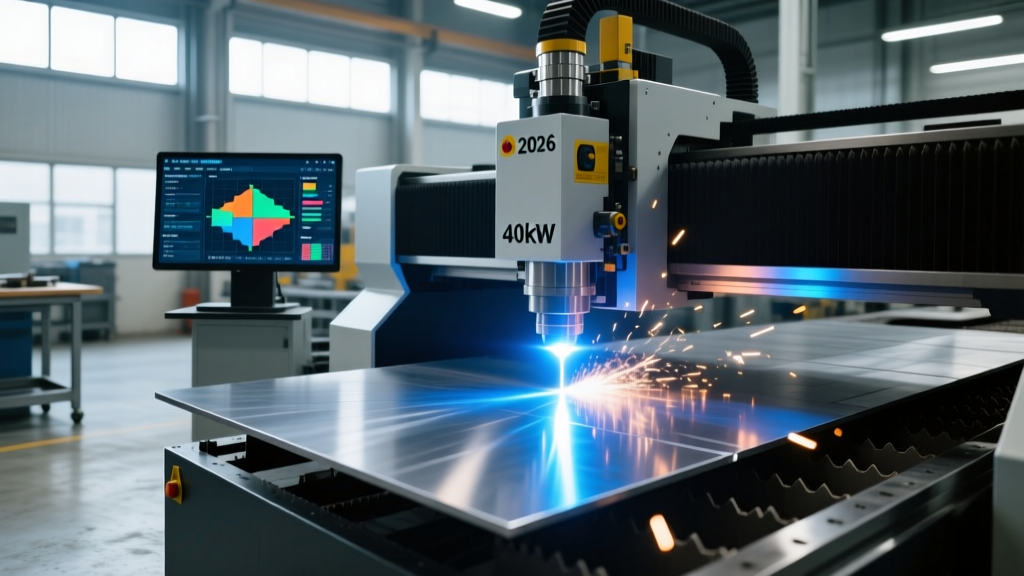
For the past five years, the 12kW to 20kW fiber laser was the standard for heavy plate processing. In 2026, the baseline for high-production CNC plate cutting machines has shifted to 40kW, with early adopters installing 60kW systems. This power scaling is not merely about cutting thicker material; it is about altering the cutting gas dynamics to eliminate secondary grinding.
Data Highlight: High-Power Nitrogen CuttingA 40kW IPG or Raycus source cutting 1-inch (25mm) mild steel using high-pressure nitrogen achieves speeds of 110 to 130 IPM. More importantly, it produces a completely oxide-free edge. This allows fabricators to bypass the edge-grinding station entirely, moving parts directly from the cutting bed to the robotic welding cell, reducing total part cycle time by up to 28%.
Capital Expenditure and ROI Realities
Upgrading to ultra-high-power (UHP) lasers requires significant capital. While a standard 6x12 ft 12kW machine hovers around $185,000, a fully enclosed 40kW system with automated shuttle tables and a 30kW chiller unit ranges from $480,000 to $750,000. However, the ROI is realized through gas consumption shifts and labor reduction. By utilizing nitrogen instead of oxygen for thick plates, shops eliminate the $0.15 to $0.22 per linear foot cost associated with secondary edge preparation.
AI-Driven Dynamic Nesting and Edge-to-Edge Optimization
Hardware advancements are only half of the 2026 innovation cycle. The software driving the CNC plate cutting machine has transitioned from static geometry nesting to predictive, AI-driven dynamic nesting. Platforms like SigmaNEST and advanced ProNest modules now utilize machine learning algorithms trained on millions of historical cut paths.
Legacy CAM software calculates kerf and lead-ins based on static material databases. AI-driven CAM analyzes the specific thermal mass of the nested sheet, predicting localized heat buildup and dynamically adjusting cut speeds and pierce delays in real-time to prevent micro-warping on intricate geometries.
| Feature | Legacy CAM (Pre-2023) | 2026 AI-Driven CAM |
|---|---|---|
| Pierce Optimization | Static time delays based on gauge | Predictive thermal mapping; adjusts per part geometry |
| Scrap Reduction | 8% - 12% material waste | 3% - 5% waste via true-shape and remnant AI matching |
| Kerf Compensation | Global offset applied to entire sheet | Dynamic micro-adjustments based on local cut density |
| Collision Avoidance | Z-axis height sensors (reactive) | 3D topographical scanning of warped plates (proactive) |
5-Axis Bevel Cutting: Eliminating Secondary Operations
For heavy equipment OEMs and structural steel fabricators, preparing plate edges for welding has historically required a secondary pass on a CNC edge-beveler or manual grinding. The integration of 5-axis bevel cutting heads directly onto the CNC plate cutting machine has matured significantly, holding tight tolerances that were impossible just a few years ago.
'By utilizing advanced plasma systems like the Hypertherm X-Definition series with True Bevel technology, or 5-axis fiber laser heads from Mazak, fabricators are consistently holding ±0.020 inches on 45-degree V-grooves and Y-grooves directly off the cutting bed.'
Plasma vs. Laser Beveling in 2026
- Plasma Beveling: Ideal for plates 0.75 inches and thicker. Modern X-Definition plasma systems use specialized consumables and proprietary G-code commands to manage the arc lag, ensuring the root land remains perfectly flat. Capital cost for a 5-axis plasma gantry addition is roughly $65,000 to $90,000.
- Laser Beveling: Dominates the 0.25-inch to 0.75-inch range. 5-axis laser heads tilt up to 45 degrees, but require sophisticated software to adjust the focal point and beam waist dynamically as the head tilts. Systems start around $120,000 for the bevel-head upgrade alone.
Purchasing Framework: Matching Machine to Production Volume
Selecting the right CNC plate cutting machine in 2026 requires moving beyond basic 'thickness capacity' charts. Fabricators must evaluate their material mix, shift patterns, and downstream bottlenecks. Use the following decision matrix to align machine architecture with operational reality.
Strategic Buying Matrix
Scenario A: High-Mix, Thin-to-Medium Plate Job Shop (Up to 0.5 inch)
Recommended Setup: 12kW to 20kW Fiber Laser with a single shuttle table and AI nesting software.
Why: Maximizes cut speed on thinner gauges where 40kW offers diminishing returns. Focus capital on automated material handling towers rather than excess laser power.
Estimated Budget: $250,000 - $350,000.
Scenario B: Heavy Equipment OEM (0.75 inch to 2.0 inch, High Bevel Requirement)
Recommended Setup: 40kW Fiber Laser with 5-axis bevel head, OR Dual-Gantry CNC Plasma (Oxy-Fuel/Plasma combo) with True Bevel.
Why: If edge quality for robotic welding is paramount, the 40kW laser with nitrogen is superior. If parts are massive (e.g., 10x40 ft beds) and tolerances of ±0.040 inches are acceptable, dual-gantry plasma drastically reduces cost-per-part.
Estimated Budget: $550,000 - $850,000 (Laser) / $300,000 - $450,000 (Plasma).
Scenario C: Continuous 3-Shift Mining & Defense Fabrication
Recommended Setup: 30kW+ Laser with automated nozzle changers, linear drive motors (instead of rack-and-pinion), and integrated slag-cleaning conveyors.
Why: Linear drives eliminate backlash and maintenance downtime associated with rack-and-pinion wear during 24/7 operation. Automated nozzle changers reduce manual intervention to under 2 hours per week.
Estimated Budget: $700,000+.
The Shift Toward Closed-Loop Thermal Management
A final, critical trend detailed in recent manufacturing analyses by The FABRICATOR is the implementation of closed-loop thermal monitoring. In 2026, high-end CNC plate cutting machines are equipped with infrared cameras mounted near the cutting head. These sensors monitor the heat-affected zone (HAZ) in real-time. If the plate temperature exceeds the threshold for metallurgical distortion, the CNC controller automatically pauses, shifts to a different zone of the nest to allow cooling, and returns later. This autonomous thermal management virtually eliminates the scrap associated with warped heavy plates, ensuring that the massive capital investment in UHP lasers and AI software translates directly to the bottom line.