How the CNC Water Jet-Cutting Machine Uses Water to Cut Stock
Explore 2026 case studies on how the CNC water jet-cutting machine uses water to cut stock in aerospace titanium and automotive composite applications.
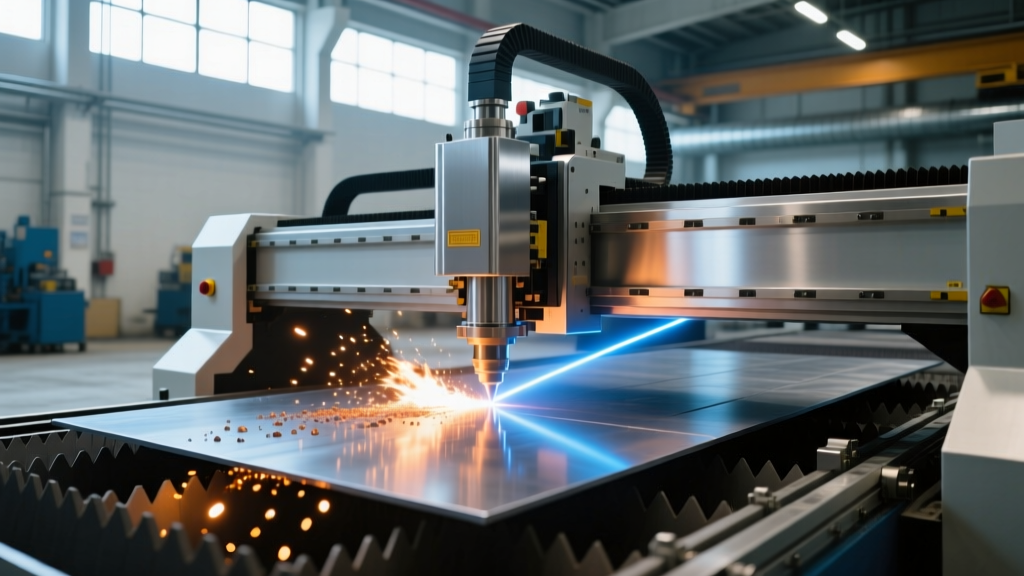
While the foundational premise remains that the cnc water jet-cutting machine uses water to cut stock, modern industrial applications in 2026 have pushed this technology far beyond simple fluid erosion. Today's ultra-high-pressure (UHP) systems operate at up to 100,000 PSI, transforming a basic fluid stream into a supersonic scalpel. This capability allows manufacturers to slice through 12-inch titanium billets and delicate carbon-fiber composites without inducing the thermal distortion or heat-affected zones (HAZ) inherent to laser and plasma cutting.
This analysis examines real-world 2026 case studies where advanced abrasive and pure waterjet systems are solving complex metallurgical and composite manufacturing challenges, providing actionable data for shop owners evaluating UHP investments.
The Physics of 100,000 PSI: Beyond Basic Erosion
Standard waterjet systems have historically operated at 60,000 PSI. However, the shift toward 94,000 PSI (HyperPressure) and 100,000 PSI direct-drive pumps has fundamentally altered the cutting kinetics. According to technical data published by Flow International, increasing the operating pressure from 60,000 to 94,000 PSI increases the velocity of the water stream, which in turn accelerates the abrasive garnet particles to higher speeds.
2026 UHP Performance Metrics
- Stream Velocity: Exceeds Mach 3 at the nozzle exit.
- Cutting Speed Increase: 30% to 40% faster on materials over 2 inches thick compared to 60k PSI systems.
- Abrasive Consumption: Reduced by up to 20% due to higher kinetic energy transfer, lowering operational costs (garnet costs average $0.35/lb in 2026).
- Kerf Width: Tightened to 0.030 inches with advanced 0.014-inch focusing tubes.
Case Study 1: Aerospace Ti-6Al-4V Engine Mounts
Aerospace manufacturers face strict tolerances when machining Ti-6Al-4V (Grade 5 Titanium). Thermal cutting processes alter the metallurgical grain structure, requiring costly secondary stress-relief treatments. A prominent Tier-1 aerospace supplier recently deployed a OMAX Maxiem 2040 equipped with a 100-horsepower direct-drive pump and dynamic taper compensation to rough-cut 4-inch thick titanium forgings for jet engine mounts.
The Challenge: Taper and Corner Lag
When cutting thick titanium, the stream naturally lags, creating a V-shaped taper (wider at the top, narrower at the bottom). In 4-inch stock, a standard 60,000 PSI head can produce a taper exceeding 0.020 inches, which violates the +/- 0.005-inch tolerance required for subsequent 5-axis CNC milling operations.
The Solution: Dynamic Tilt Compensation
By utilizing a tilting cutting head that automatically angles the nozzle up to 9 degrees based on the cutting vector and speed, the machine mechanically offsets the lag.
- Material: Ti-6Al-4V, 4.0 inches thick.
- Abrasive: 80-mesh Barton garnet, fed at 1.2 lbs/min.
- Cut Speed: 1.4 inches per minute (ipm).
- Resulting Taper: Less than 0.002 inches across the entire 4-inch depth.
- Pierce Time: 45 seconds per hole (using low-pressure pierce to prevent nozzle splash-back damage).
The elimination of the HAZ and the near-net-shape accuracy reduced the subsequent CNC milling time by 35%, yielding a net savings of $142 per part in machine-hour and tooling-wear costs.
Process Comparison: Thick Aerospace Alloys
When evaluating how to process thick, heat-sensitive alloys, shop managers must weigh the trade-offs between thermal and cold-cutting methods. The matrix below outlines the 2026 operational realities for 4-inch Ti-6Al-4V.
| Process | Max Practical Thickness | HAZ Present? | Tolerance (+/-) | Secondary Cleanup Required? |
|---|---|---|---|---|
| Abrasive Waterjet (100k PSI) | 12+ inches | No | 0.005 in | Minimal (near-net-shape) |
| Fiber Laser (12kW+) | 1.5 inches | Yes (Severe) | 0.010 in | Heavy (slag/dross removal) |
| High-Definition Plasma | 6 inches | Yes (Moderate) | 0.030 in | Moderate (bevel/bead cleanup) |
Case Study 2: Automotive CFRP Without Delamination
Carbon Fiber Reinforced Polymers (CFRP) are notoriously difficult to machine. The interwoven carbon sheets and epoxy resin matrix have vastly different hardness levels. Traditional routing tools cause micro-fracturing, splintering, and rapid tool wear. More critically, thermal cutting melts the resin matrix, destroying the structural integrity of the composite.
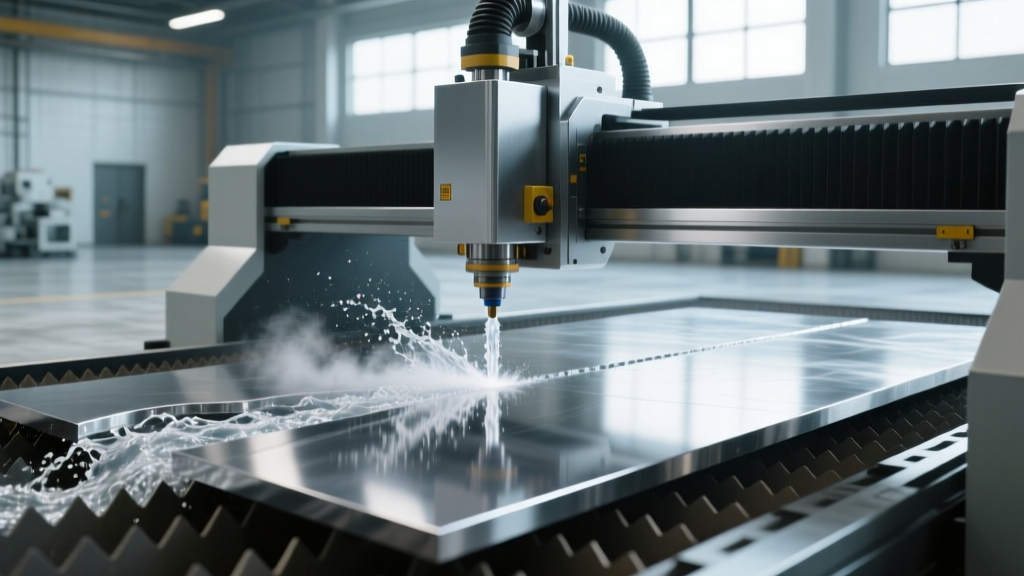
A 2026 study highlighted by the Society of Manufacturing Engineers (SME) demonstrated the efficacy of pure waterjet cutting (no abrasive) for thin automotive CFRP body panels. When the cnc water jet-cutting machine uses water to cut stock without garnet, it relies purely on the hydraulic shear force of the 60,000 PSI water stream.
Execution Parameters for 0.25-Inch CFRP
- Machine Setup: Pure waterjet cutting head (0.004-inch diamond orifice).
- Abrasive: None (Zero garnet consumption).
- Cut Speed: 120 ipm.
- Traverse Speed: 300 ipm.
By eliminating the abrasive, the kerf width drops to an exceptionally tight 0.008 inches. The lack of mechanical downward force (which plagues CNC routers) and the absence of heat completely eliminates delamination and resin smearing. The primary engineering hurdle—piercing the material without causing a blowout on the bottom layer—was solved by programming a low-pressure 'soft pierce' routine that ramps the pump pressure from 5,000 PSI to 60,000 PSI over 1.5 seconds.
⚠️ Troubleshooting Edge Case: Moisture Intrusion in Composites
While pure waterjets prevent delamination, cutting unsealed CFRP edges can allow high-pressure moisture to wick into the micro-layers of the composite. Fix: Implement a localized vacuum-assist shroud around the cutting head, or apply a temporary peelable masking film to the top and bottom surfaces of the stock prior to cutting to seal the edge grain during the hydraulic shear process.
Expert Perspectives on UHP Efficiency
'The conversation in 2026 has shifted from simply asking if a waterjet can cut a material, to optimizing the total cost-per-part through pump efficiency. Direct-drive pumps now operate at 85% efficiency compared to the 60% efficiency of legacy intensifier pumps, meaning the cost to run a 100,000 PSI system is often lower per linear inch of cut than running older 60,000 PSI hardware.'
— Dr. Aris Thorne, Advanced Manufacturing Materials Lab
Decision Framework: When to Deploy Waterjet Technology
Shop managers should not view waterjets as a universal replacement for lasers or routers, but rather as a specialized solution for specific material and geometric constraints. Use the following framework to determine if a UHP waterjet integration is justified for your production line:
- Is the material heat-sensitive? If cutting tool steels, titanium, or composites where a HAZ will compromise structural certification or require secondary annealing, waterjet is the mandatory choice.
- Is the stock thicker than 1.5 inches? Fiber lasers lose edge quality and speed exponentially past 1.5 inches in dense metals. Waterjet cutting speed degrades linearly, making it vastly more predictable and economical for thick plates.
- Are you prototyping or running low-volume, high-mix production? Waterjets require zero tooling changes, specialized gases, or focal-length adjustments between cutting 16-gauge aluminum and 3-inch stainless steel. The CAD-to-cut workflow remains identical.
Final Operational Takeaway
The reality that the cnc water jet-cutting machine uses water to cut stock is merely the starting point of its engineering value. By leveraging 100,000 PSI pressures, dynamic taper compensation, and specialized pure-water orifices, modern manufacturers are solving the most stubborn thermal and mechanical cutting limitations in aerospace and automotive sectors. When calculating ROI, factor in the elimination of secondary HAZ-treatment, the reduction in CNC milling roughing passes, and the material yield improvements from tight 0.030-inch kerf nesting.