Machine Shop Lexington KY 5-Axis CNC Waterjet Laser Cutting Trends
Explore 2026 tech trends in Lexington, KY machine shops utilizing 5-axis CNC waterjet and laser cutting for aerospace and medical manufacturing.
The Shift to Multi-Axis Thermal and Abrasive Machining
When sourcing complex geometries in hard metals, the capabilities of a modern machine shop, Lexington, KY has emerged as a critical hub for advanced 5-axis CNC waterjet and laser cutting. Historically overshadowed by coastal manufacturing centers, Central Kentucky's industrial corridor has leveraged lower operational overhead to invest heavily in multi-axis cutting technology. As of 2026, the integration of 5-axis kinematics into both abrasive waterjet and fiber laser platforms has fundamentally altered the quoting landscape for aerospace turbine components and medical implant prototypes.
According to the NIST Manufacturing Extension Partnership, regional manufacturing hubs that adopt advanced 5-axis subtractive and non-traditional machining see a 22% reduction in lead times compared to traditional 3-axis job shops. For Lexington-based facilities, this technology bridges the gap between rough cutting and final CNC milling, often eliminating secondary deburring and edge-beveling operations entirely.
2026 Regional Data Highlight: Central Kentucky Manufacturing
- Industrial Real Estate Cost: $6.50 - $8.25 / sq. ft. NNN (vs. $16+ in traditional coastal hubs), freeing CapEx for 5-axis machinery.
- Dominant Sectors: Aerospace (turbine brackets), Medical (titanium orthopedic implants), and Heavy Machinery hydraulics.
- Average 5-Axis Machine Hourly Rate: $165 - $220 per hour (fully burdened).
Core Technologies: 5-Axis Waterjet vs. 5-Axis Laser
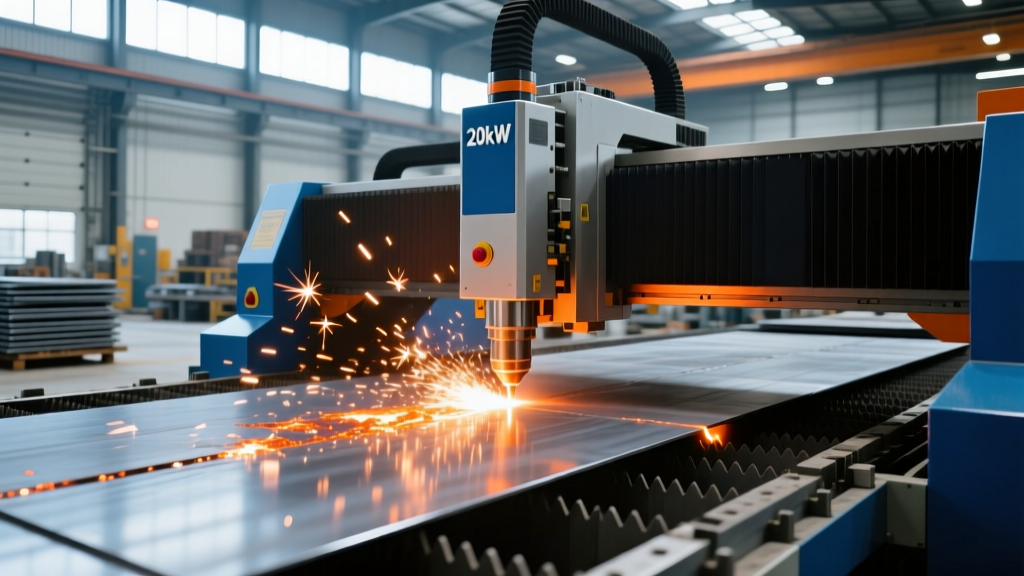
Understanding the operational boundaries of 5-axis waterjet and 5-axis laser systems is critical for design engineers and procurement managers. While both utilize 5-axis simultaneous movement, their material interaction physics dictate entirely different use cases.
| Parameter | 5-Axis Abrasive Waterjet (e.g., OMAX 60120) | 5-Axis Fiber Laser (e.g., TRUMPF Cell 3000) |
|---|---|---|
| Max Effective Thickness | 8.0 inches (Titanium/Inconel) | 1.0 inch (Mild Steel), 0.6 inch (Stainless) |
| Positional Tolerance | ±0.003" to ±0.001" (with taper compensation) | ±0.0005" on 3D contours |
| Heat Affected Zone (HAZ) | None (Cold cutting process) | Micro-HAZ (0.005" - 0.015" depending on assist gas) |
| Edge Finish Quality | Matte, uniform striations (Ra 125-250 μin) | BrightLine finish, near-mirror on thin gauge |
| Primary Consumable Cost | 80-mesh Garnet (~$0.48/lb in 2026) | Assist gases (N2, O2, Ar) and nozzle tips |
Deep Dive: 5-Axis Waterjet Taper Compensation
The primary limitation of traditional 3-axis abrasive waterjet cutting is kerf taper. As the high-velocity stream of water and garnet abrasive penetrates thick material, the stream naturally lags and widens, resulting in a part that is wider at the top than the bottom. On a 4-inch block of Inconel 718, a standard 3-axis cut might yield a 0.030" taper, rendering the part useless for tight-tolerance aerospace fits without secondary CNC milling.
Modern Lexington machine shops utilize 5-axis tilting heads, such as the Hypertherm OMAX Tilt-A-Jet. This technology physically tilts the cutting nozzle up to 9 degrees in real-time, guided by CAM software algorithms that calculate the exact kerf geometry based on material density, thickness, and cutting speed. By angling the stream, the taper is pushed into the scrap skeleton, leaving the finished part with a perfectly square 90-degree edge. This innovation allows job shops to hold ±0.001" tolerances on parts up to 6 inches thick, effectively competing with 5-axis wire EDM but at a fraction of the cycle time.
Abrasive Consumption and Pump Economics
Running a 5-axis waterjet in 2026 requires strict management of abrasive consumption. A 50-horsepower, 87,000 PSI direct-drive pump consuming 1.2 pounds of garnet per minute will burn through approximately $35 in abrasive costs per hour. Shops are increasingly adopting closed-loop garnet recycling systems, which can reclaim up to 60% of the abrasive media, reducing the net consumable cost to roughly $14 per hour and significantly lowering landfill disposal fees.
Deep Dive: 5-Axis Laser for 3D Contours and Formed Parts
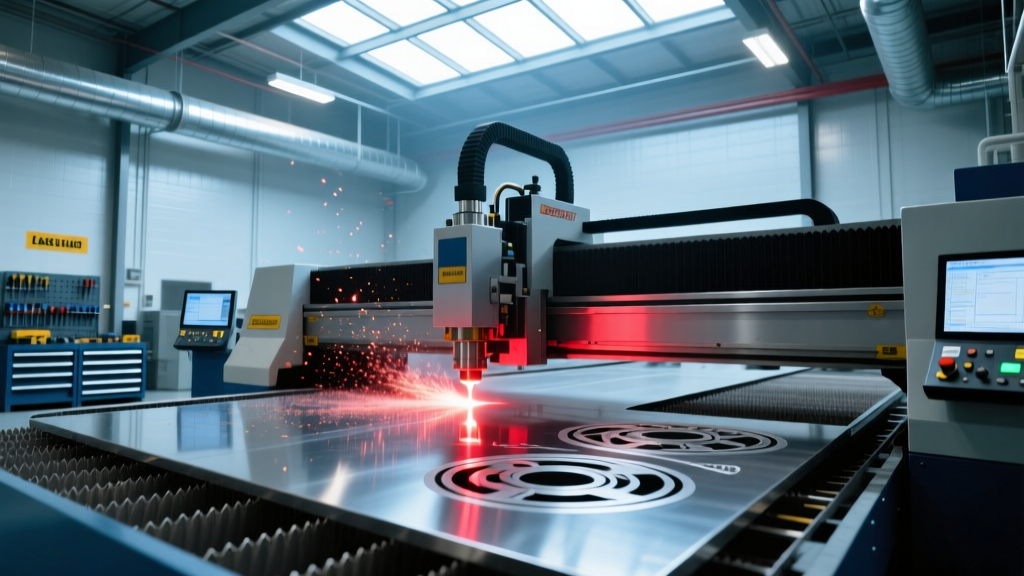
While waterjet dominates thick, flat, or slightly contoured stock, 5-axis laser cutting is the undisputed leader for processing pre-formed 3D geometries. In the medical device sector, manufacturers frequently hydroform or stamp titanium and cobalt-chromium blanks that require complex cutouts, holes, and trim lines post-forming.
Systems like the TRUMPF TruLaser Cell 3000 utilize a 6kW TruDisk solid-state laser with 5-axis simultaneous kinematics. The machine's cutting head maintains a precise standoff distance and perpendicularity to the curved surface of the part, regardless of the contour's complexity. Furthermore, advanced features like BrightLine fiber technology manipulate the beam's spatial profile and assist gas dynamics to eject molten slag smoothly from thick 3D contours, producing edges that require zero post-processing before passivation or anodizing.
⚠️ Warning: Assist Gas Purity in 5-Axis Laser Cutting
When cutting medical-grade 316L stainless steel or Titanium Grade 5 on a 5-axis laser, the purity of the nitrogen assist gas is paramount. Using standard 99.5% purity nitrogen will result in micro-oxidation (a faint yellow/blue tint) on the cut edge, which can fail stringent medical passivation standards. Lexington shops specializing in medical implants mandate 99.999% (Grade 5.0) liquid nitrogen bulk delivery to ensure perfectly oxide-free, bright cut edges.
Decision Framework: Quoting 5-Axis Waterjet vs. Laser
For engineering teams and procurement managers evaluating a machine shop in Lexington, KY for 5-axis CNC waterjet and laser cutting, selecting the correct process is vital for cost control. Use this operational framework to determine the optimal cutting method:
- Evaluate Material Thickness and HAZ Sensitivity:
- If the material is > 1.5 inches thick, or if the material is heat-sensitive (e.g., tool steels that will lose temper, or aerospace alloys prone to micro-cracking in the HAZ), mandate 5-axis waterjet.
- If the material is < 0.75 inches thick and HAZ is acceptable or easily managed via post-cut annealing, proceed to step 2.
- Assess Part Geometry and Fixturing:
- If the part is a flat plate requiring complex 2.5D profiles, bevels for weld prep, or countersinks, 5-axis waterjet is highly efficient.
- If the part is a 3D drawn, stamped, or hydroformed shell requiring trim lines, hole piercing on curved surfaces, or tube intersections, 5-axis laser is the only viable non-contact option.
- Calculate Run-Time vs. Setup-Time Ratios:
- Waterjet setup is minimal (no custom fixturing required; parts are simply weighted down on the slat bed), but cutting speed is slow (typically 10 to 40 inches per minute on thick metals).
- Laser setup requires complex 3D fixturing and offline programming, but cutting speeds can exceed 800 inches per minute on thin-gauge 3D contours.
The Supply Chain Advantage of Regional Hubs
The decision to source from a Central Kentucky machine shop rather than a Tier-1 supplier in California or the Northeast is increasingly driven by supply chain resilience. The logistical footprint of a Lexington-based shop allows for rapid prototyping and mid-volume production runs with significantly reduced freight times to the Midwest and Southeast automotive and aerospace corridors.
By combining 5-axis CNC waterjet for heavy, thick-section roughing and 5-axis laser for precision 3D finishing, these regional facilities offer a turnkey solution that eliminates the need for multi-vendor coordination. As manufacturing tolerances tighten and material science advances toward harder, more exotic alloys in 2026, the machine shops that have invested in multi-axis thermal and abrasive technologies are setting the new standard for regional industrial dominance.