CNC Fiber Laser Cutting Machine ROI: Heavy Fabrication Case Studies
Analyze real-world ROI and edge cases of upgrading to a 20kW CNC fiber laser cutting machine in heavy fabrication, including cut speeds and gas costs.
The Shift to 20kW+ Resonators in Heavy Fabrication
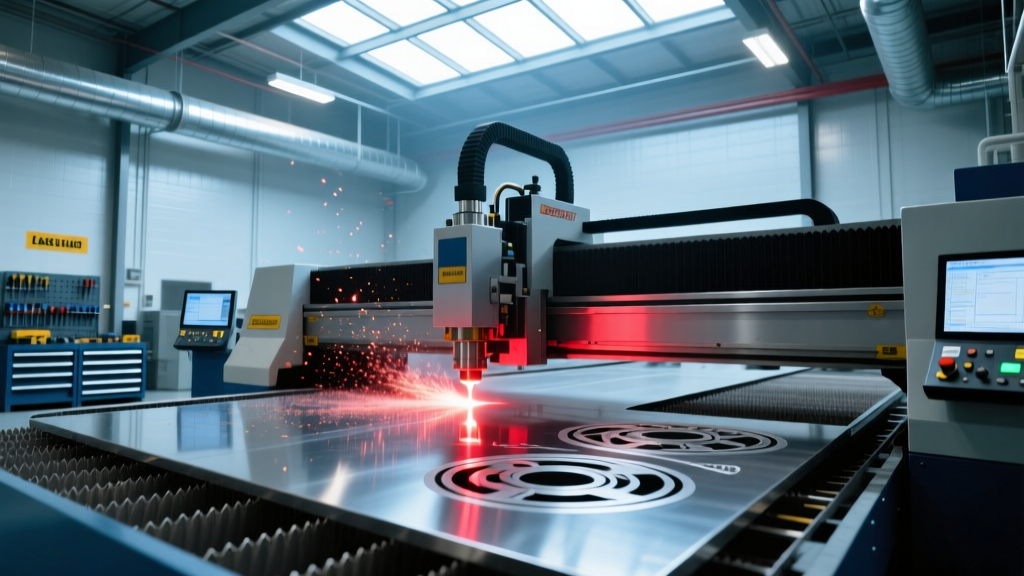
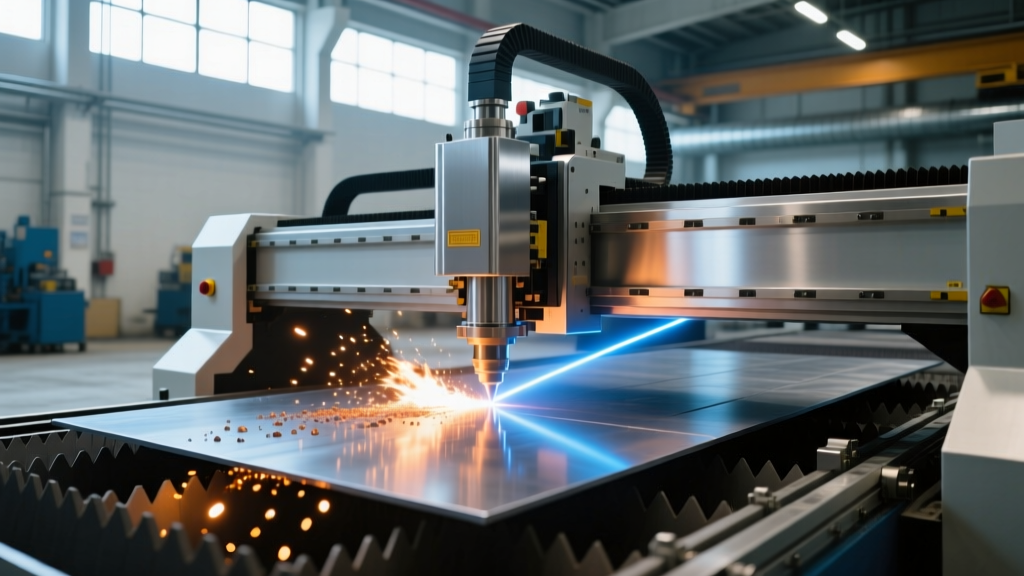
Historically, fabricators cutting plate steel thicker than 1 inch relied on CNC plasma or oxy-fuel systems due to the power limitations of early fiber lasers. By 2026, the widespread availability of 15kW to 30kW resonators—such as the IPG Photonics YLS series and Trumpf TruDisk solid-state lasers—has fundamentally disrupted this hierarchy. A high-power cnc fiber laser cutting machine now processes 1.25-inch mild steel and 0.75-inch stainless steel with edge qualities that rival or exceed fine plasma, while eliminating the secondary grinding operations typically required for weld prep.
Key Specs of Modern 20kW Fiber Systems
- Beam Parameter Product (BPP): Typically 3.5 to 4.5 mm*mrad at 20kW, allowing for a tight focal spot even at high power levels.
- Assist Gas Pressures: Capable of utilizing high-pressure nitrogen (up to 25 bar) for clean, oxide-free edges on thick stainless and aluminum.
- Acceleration: Modern gantry systems maintain 2G to 3G acceleration, though thick-plate cutting relies more on steady-state velocity than rapid traversal.
According to market analysis tracked by The Fabricator, the adoption rate of 12kW+ lasers in job shops processing plate over 0.5 inches has tripled since 2022, driven by the shrinking price gap between high-power and mid-power resonators.
Case Study 1: Earthmoving Equipment Manufacturer
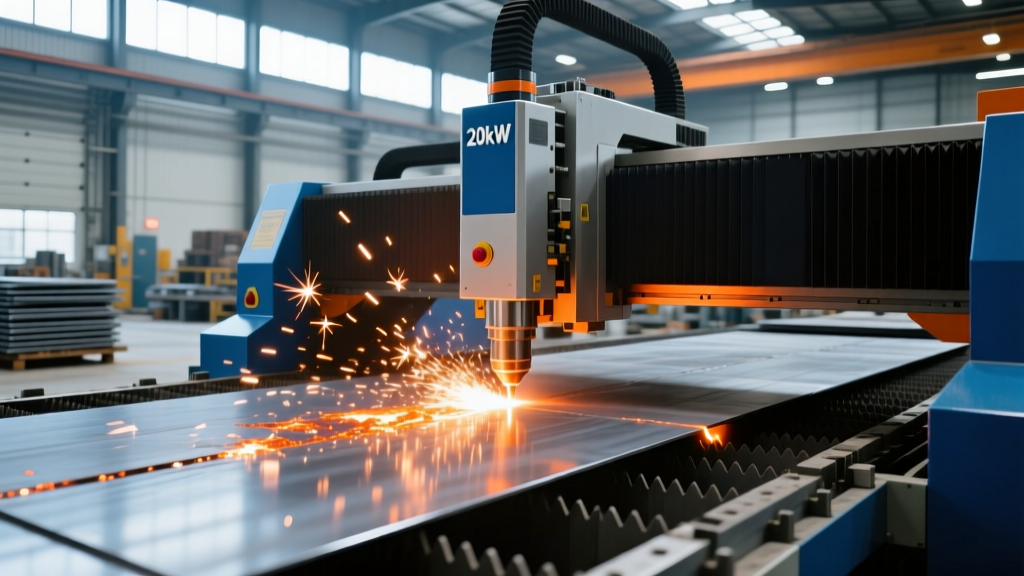
A Midwest-based manufacturer of excavator buckets and dozer blades transitioned from a 400-amp CNC plasma system to a 20kW CNC fiber laser cutting machine (specifically, a Bystronic ByStar Fiber equipped with a 20kW IPG source). Their primary material is 0.75-inch to 1.25-inch AR400 (abrasion-resistant) steel and A514 high-yield structural steel.
Plasma vs. 20kW Fiber Laser: Operational Comparison
| Metric | 400A Plasma (O2/H2) | 20kW Fiber Laser (N2/O2) | Net Impact |
|---|---|---|---|
| Cut Speed (0.75" A514) | 28 IPM | 65 IPM (with O2 assist) | +132% throughput |
| Kerf Width | 0.150 inches | 0.025 inches | 600% more precise nesting |
| Edge Squareness | 3° to 5° bevel | < 0.5° bevel | Eliminates secondary milling |
| Consumable Cost / Hour | $18.50 (electrodes/nozzles) | $4.20 (nozzles/windows) | 77% reduction in consumables |
| Heat Affected Zone (HAZ) | Wide, causes warping | Narrow, minimal distortion | Reduces press-brake tonnage needed |
Edge Case: Managing Dross and Bevel on 1.25-inch AR400
Cutting 1.25-inch AR400 with a 20kW laser presents a specific thermal challenge. The high carbon and chromium content in AR400 makes it prone to severe low-frequency dross (slag) when cut with nitrogen. The engineering team solved this by switching to pure oxygen assist gas, but this introduced an exothermic reaction that caused edge burning and a noticeable taper.
The Fix: They implemented a dynamic focal point strategy. By dropping the focal point to -35mm (deep inside the material) and reducing the oxygen pressure to just 0.8 bar, they stabilized the exothermic reaction. The cut speed dropped from 45 IPM to 22 IPM, but the edge emerged with a smooth, dross-free finish requiring zero post-processing, saving 4 minutes of grinding per part.
Case Study 2: Aerospace Subcontractor Processing Inconel
A Tier-2 aerospace supplier utilized a Trumpf TruLaser 5000 series with a 20kW TruDisk source to cut engine mounting brackets from 0.375-inch Inconel 718 and 0.25-inch Ti-6Al-4V (Titanium). Inconel is notoriously difficult to machine mechanically due to rapid work hardening, making laser cutting the preferred method. However, high-power fiber lasers introduce the risk of micro-cracking in the HAZ if thermal input is not strictly controlled.
Expert Insight on Assist Gases: "When cutting titanium alloys above 0.2 inches with a high-power fiber laser, nitrogen is strictly prohibited. The exothermic reaction between molten titanium and nitrogen creates a brittle nitride layer that will fail aerospace fatigue testing. We mandate ultra-high-purity (99.999%) argon assist gas, despite the higher cost."
— Lead Manufacturing Engineer, Tier-2 Aerospace Fabricator
Parameter Tweaks for 0.25-inch Ti-6Al-4V
- Gas Selection: Argon at 14 bar to ensure complete ejection of the highly viscous molten titanium.
- Nozzle Type: Single-layer ceramic nozzle with a 2.5mm orifice to maintain a laminar gas flow and prevent turbulence that could draw in ambient air.
- Pulsing Mode: Instead of continuous wave (CW), the machine utilizes a modulated pulse frequency (500 Hz, 60% duty cycle). This allows the material to cool for microseconds between pulses, keeping the HAZ below the critical alpha-case formation threshold.
For deeper safety and operational guidelines on processing reactive metals, the Laser Institute of America provides stringent protocols regarding ventilation and argon gas displacement hazards in enclosed laser cells.
Hidden Costs and Failure Modes in High-Power Lasers
While a 20kW CNC fiber laser cutting machine drastically reduces cost-per-part, the capital expenditure (typically $850,000 to $1.2 million for a fully automated shuttle-table system in 2026) comes with specific maintenance vulnerabilities that mid-power systems do not face.
⚠️ Warning: Protective Window Degradation
At 20kW, back-reflections from piercing highly reflective materials (like 1-inch aluminum or copper) can instantly shatter a standard protective window. Modern systems use specialized AR-coated synthetic quartz windows rated for 30kW. However, these cost between $180 and $250 each. If the automated nozzle changer fails to clean the nozzle properly, spatter will adhere to the window, causing localized heating and catastrophic lens failure within minutes. Operators must enforce strict capacitive height sensor calibration and nozzle cleaning cycles every 4 hours when cutting thick plate.
Chiller Capacity and Thermal Lensing
A 20kW resonator generates immense waste heat. If the dual-circuit water chiller fails to maintain the cutting head optics at exactly 20°C (± 0.5°C), thermal lensing occurs. The collimating lens heats up, changes its refractive index, and shifts the focal point dynamically during the cut. This results in a cut that starts perfectly square but develops a massive taper halfway through the sheet. To prevent this, facilities must install high-capacity chillers (minimum 30kW cooling capacity) with redundant pumps and inline deionized water filters to prevent mineral buildup in the micro-channels of the cutting head.
Calculating True Cost-Per-Part in 2026
To accurately justify the ROI of a high-power CNC fiber laser cutting machine, fabricators must move beyond simple machine-hour rates and calculate the Fully Burdened Cut Cost (FBCC). This includes assist gas, electrical consumption, optics depreciation, and floor space.
FBCC Formula & Example
FBCC = (Machine Depreciation + Labor + Gas + Electricity + Optics) / Total Parts Per Hour
- Machine Depreciation & Labor: $145/hour (assuming a $1M machine amortized over 7 years, plus 1 operator at $35/hr fully burdened).
- Gas Cost: Bulk liquid nitrogen at $0.45 per cubic foot. Cutting 0.5-inch stainless at 120 IPM consumes roughly 40 CFM, equating to $18/hour in gas.
- Electricity: A 20kW system (including chiller and dust collector) draws approximately 65 kW under load. At $0.12/kWh, this is $7.80/hour.
- Optics/Consumables: $6/hour (nozzles, windows, ceramic rings).
Total Hourly Operating Cost: $176.80.
If the machine produces 120 nested parts per hour (a realistic figure for a mixed-thickness nest on a 6x12 foot bed utilizing high-speed piercing), the cost-per-part is $1.47. Compare this to a 6kW machine that might only produce 55 parts per hour of the same nest due to slower thick-plate cut speeds, resulting in a cost-per-part of $2.95. The 20kW system cuts the per-part cost in half, paying for the $600,000 price premium in approximately 14 months of two-shift operation.
For manufacturers processing plate thicker than 0.5 inches, the decision in 2026 is no longer whether to adopt high-power fiber lasers, but how quickly they can optimize their gas delivery systems and nesting software to capture the ROI. For further technical specifications on beam delivery and material interactions, refer to the manufacturing resources provided by the Society of Manufacturing Engineers (SME).